Where the River Is Said to Emerge
Adi Badri lies in Yamunanagar district of Haryana, where the plains meet the Shivalik foothills, and it holds a particular place in the region's devotional geography.
Tradition here holds that this is the point from which the Saraswati emerged, flowing out of the hills and south across what is now Haryana, past Pehowa and Kurukshetra, toward the desert.
What stands at the site:
- The Adi Badri Narayan temple, dedicated to Vishnu, which gives the place its name
- A Kedarnath temple nearby, dedicated to Shiva
- The Mantra Devi temple on the hill above
- The Saraswati Udgam Sthal, the point marked as the river's origin, with a small water source and a tank
- Archaeological remains excavated in the area, indicating early habitation
The combination of a Vishnu shrine, a Shiva shrine and a Devi shrine at the origin point of a river is not unusual in Hindu practice. Origin sites tend to accumulate shrines, since a source is treated as a tirtha in its own right.
What is unusual here is the river. The Saraswati is the one major river of the tradition that cannot simply be visited, and this site exists because devotees continued to mark her course long after the water stopped being visible along most of it.
The Saraswati in Tradition
The Saraswati occupies a position in Hindu tradition that no other river shares.
- In the Rig Veda she is praised in extraordinary terms, described as a great river and invoked repeatedly, at times above the Ganga and the Yamuna
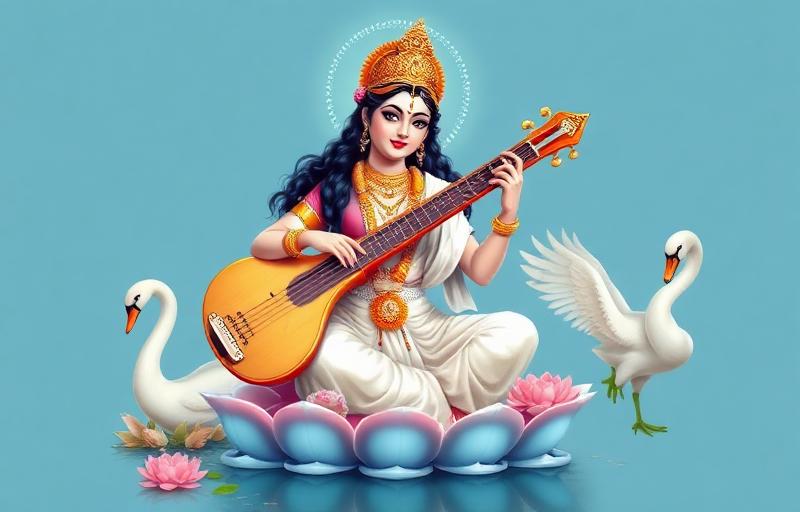
- She is a goddess as well as a river, and over time the goddess of learning, speech and music who is worshipped on Vasant Panchami became inseparable from the river
- In later texts she is described as flowing underground, and as joining the Ganga and the Yamuna invisibly at Prayagraj, which is what makes that confluence a triveni, a meeting of three
- The Mahabharata describes her as disappearing into the sands at a place called Vinashana, and pilgrimage along her course appears in the epic
That combination is why she never left the tradition. A river that stops flowing usually stops being worshipped. The Saraswati instead acquired an explanation for her disappearance and became the invisible third at India's most important sangam.
Modern work has added another layer to this. Studies of palaeochannels, satellite imagery and the archaeology of the Ghaggar Hakra system have generated considerable discussion about a large river system that once flowed through this region, and the relationship between that system and the Saraswati of the texts continues to be debated by scholars.
At Adi Badri, none of this is the point for devotees. The site is where the tradition says she began, and it is worshipped as such.
The Temples at the Site
The shrines at Adi Badri are modest in scale, and the site is visited for what it marks rather than for architecture.
- Adi Badri Narayan temple - dedicated to Vishnu, and the shrine from which the site takes its name. Devotees connect the name to the Badri tradition of Vishnu worship.
- Kedarnath temple - a Shiva shrine close by, completing the pairing found at most old tirthas
- Mantra Devi temple - on the hill above, reached by a climb, dedicated to the Devi
- The Saraswati Udgam Sthal - the marked origin point, with a small source and tank where devotees offer
Worship follows ordinary practice. Water, flowers, tulsi at the Vishnu shrine, bel patra at the Shiva shrine, chunri and sindoor at the Devi shrine, and offering at the udgam.
Development work has been undertaken at the site in recent years, including construction associated with the Saraswati revival effort in Haryana, involving a reservoir project intended to sustain flow along the traditional course. Work of this kind changes a site's character, and visitors will find a more built up complex than photographs from earlier decades show.
What has not changed is the reason people come. The place is visited as a udgam sthal, a source, and sources have a particular standing in Hindu practice. Gomukh, Amarkantak, the Godavari at Trimbakeshwar and the Kaveri at Talakaveri are all visited on the same logic. Adi Badri is the source of a river most devotees will never see, which is precisely why it is marked so carefully.
Following the Course to Kurukshetra
Adi Badri is the beginning of a route that Haryana's devotional geography follows south.
- Adi Badri, the origin, in the Shivalik foothills
- Kapal Mochan, in the same district, a tirtha with tanks where pilgrims come for the Kartik Purnima snan
- Pehowa, traditionally Prithudaka, on the Saraswati, one of the principal sites in India for shraddh and pind daan for ancestors, particularly for those who died in accidents or unnatural circumstances
- Kurukshetra, with the Brahma Sarovar and Sannihit Sarovar, and the great gathering at solar eclipses
- Jyotisar, where the Bhagavad Gita is traditionally held to have been spoken
- Bhadrakali temple, the Shakti Peeth of Kurukshetra
This is a coherent pilgrimage route, and it is old. The Mahabharata itself describes tirthas along the Saraswati, and the sites on this stretch have been visited continuously for a very long time.
For devotees, the sequence has a logic. The origin at Adi Badri, the ancestral rites at Pehowa, the great tanks at Kurukshetra and the Gita site at Jyotisar can be covered in two or three days, and together they take in the river, the ancestors, the war and the teaching that came out of it.
Haryana is not a state most pilgrims think of as a destination. This route is the reason it should be.
The River and the Goddess
One question comes up constantly at sites like this. Is Saraswati the river or the goddess of learning?
The tradition's answer is both, and the relationship developed over time.
- In the earliest layer, she is a river praised for her power, her waters and her nourishment of the people along her banks
- Alongside this she is associated with vak, speech, and with the sound of the hymns themselves
- As the river's visible flow declined, the goddess of speech, learning, music and the arts became the dominant identity, and that is the Saraswati most Hindus worship today
- She is worshipped on Vasant Panchami, when students, musicians and artists offer their instruments and books before her
- The river identity persisted in sacred geography, at Prayagraj as the invisible third stream and at sites like Adi Badri as the origin
Both identities are alive. A student in Kerala offering books on Vasant Panchami and a pilgrim in Haryana offering at the udgam sthal are worshipping the same Saraswati, approaching her from different ends of a very long tradition.
What connects them is the idea the tradition never lets go of, which is that what nourishes the land and what nourishes the mind are the same thing. A civilisation that made its goddess of learning a river was making a specific point, and it is worth noticing that the point survived the river.
Visiting Adi Badri
Adi Badri is easily reached and is best done as part of the wider Haryana circuit.
- Location - Yamunanagar district, Haryana, at the Shivalik foothills near the Himachal border
- Access - by road from Yamunanagar, Ambala or Chandigarh, all within a couple of hours
- Best time - October to March. Summer is very hot in this belt.
- Time needed - a couple of hours at the site, longer if you climb to the Mantra Devi temple
- What to carry - offerings for the three shrines, water, and sun protection
- Facilities - basic, with more available at Yamunanagar
Suggested route through Haryana:
- Adi Badri, the Saraswati origin
- Kapal Mochan, in the same district
- Pehowa, for the ancestral rites
- Kurukshetra, for Brahma Sarovar, Sannihit Sarovar, Jyotisar and the Bhadrakali temple
- Sthaneshwar Mahadev, in Kurukshetra
Two or three days covers this comfortably from a base at Kurukshetra or Ambala.
One closing thought for visitors. This is not a spectacular site. There is no great architecture, no famous darshan and no large crowd outside festival days. What there is, is a marked point where a tradition insists a river began, maintained for centuries by people who could not see the river. That persistence is the thing worth going to look at.
Quick Answers
What is Adi Badri in Haryana?+
Adi Badri is a site in Yamunanagar district at the Shivalik foothills, held in tradition to be the point where the Saraswati river emerged. It has the Adi Badri Narayan temple, a Kedarnath temple, the Mantra Devi temple on the hill and the marked Saraswati origin point.
Why is the Saraswati called an invisible river?+
The Rig Veda praises her as a great river, and later texts describe her as flowing underground and joining the Ganga and Yamuna invisibly at Prayagraj, which is why that confluence is called a triveni. The Mahabharata describes her disappearing into the sands.
Is the Saraswati a river or the goddess of learning?+
Both. In the earliest layer she is a river praised for her waters, and she is also associated with vak, speech. As the river's visible flow declined, the identity of the goddess of learning, music and the arts became dominant, while the river identity persisted in sacred geography.
What can be visited near Adi Badri?+
Kapal Mochan in the same district, Pehowa for ancestral rites on the Saraswati, and Kurukshetra with the Brahma Sarovar, Sannihit Sarovar, Jyotisar and the Bhadrakali temple. Two or three days covers the circuit comfortably.
How do you reach Adi Badri?+
By road from Yamunanagar, Ambala or Chandigarh, all within a couple of hours. October to March is the comfortable season, since summers in this belt are very hot.
Has there been work to revive the Saraswati?+
Yes. Development work has been undertaken at and around the site in recent years as part of the Saraswati revival effort in Haryana, including a reservoir project intended to sustain flow along the traditional course, so the complex is more built up than in earlier decades.
About the author
Pandit Ravindra Sharma · Vedic Rituals & Bhakti, 22+ years
Pandit Ravindra is the Vandnaa editorial team's resident specialist on aarti, chalisa, and daily devotion. He has performed home and temple pujas across Varanasi and Delhi for over two decades and contributes the bhakti-focused articles on this site.
Meet the Vandnaa editorial team →