The Saraswati River in Vedic Tradition
Long before she became known chiefly as the goddess of speech, music and learning, Saraswati was celebrated in the Rigveda as a mighty, flowing river, praised as the greatest and most life-giving of all the waters of that age. The Vedic hymns describe her as vast and powerful, nourishing the lands and people who lived along her banks in the northwestern regions of the Indian subcontinent.
Over the centuries, tradition holds that this great river gradually diminished and eventually vanished from the surface, drying up or sinking underground, yet devotees never let go of her sacred memory, carrying her forward as a goddess even as her physical waters receded from view.
Hymns and Scriptural Origin
The Rigveda's Nadistuti Sukta, a hymn dedicated to praising the rivers, places Saraswati among the greatest, describing her waters as pure and abundant. Other Vedic verses speak of her as 'best of mothers, best of rivers, best of goddesses', a triple praise found nowhere else for any other river in the scriptures.
As centuries passed and the physical river is believed to have dried, the name Saraswati came to be closely associated with the goddess of wisdom, speech and the arts, a transformation devotees see not as a loss but as the river goddess taking on a new, more inward form of blessing for humanity.
The Invisible Stream at the Sacred Sangam
Perhaps the most enduring belief connected to the Saraswati is her presence at the Triveni Sangam in Prayagraj, where the Ganga and Yamuna are believed to be joined by Saraswati flowing invisibly beneath the earth. Devotees call this the Gupt Saraswati, or hidden Saraswati, and her unseen presence is precisely what elevates this confluence into one of the holiest pilgrimage sites in all of Hinduism.
Some devotees also point to sites such as Kurukshetra and areas near Adi Badri as places where traces of the ancient river's course are still remembered in local tradition, though such connections are held as matters of faith and tradition rather than settled fact.
How Devotees Honour Saraswati

- At the Triveni Sangam, pilgrims taking a holy dip believe they are bathing in the combined grace of all three rivers, Ganga, Yamuna and the unseen Saraswati
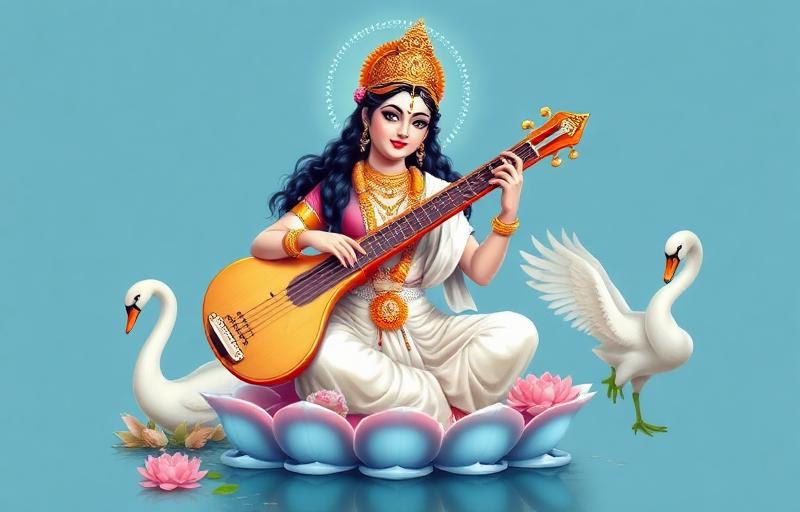
- As goddess of speech and learning, Saraswati is separately worshipped with great devotion during Vasant Panchami, when students and artists seek her blessings
- Many devotees begin the study of scriptures or new learning with a simple prayer invoking Saraswati's grace
- Her invisible river form is often remembered in the daily sankalpa, or ritual intention, recited before worship, where devotees name the sacred rivers including Saraswati
Why the Mystery Deepens Devotion
For many devotees, the fact that Saraswati cannot be seen with the eyes makes her presence feel even more intimate and sacred, a reminder that faith is not always about what can be measured or proven. Just as wisdom and inspiration often work quietly within a person without visible sign, Saraswati is believed to flow unseen yet ever present, nourishing the spiritual life of those who seek her.
This quality has made her one of the most poetically loved figures in Hindu devotion, a goddess who teaches that the deepest currents of blessing are often the ones we cannot directly observe.
Mantra to Chant and a Devotee's Takeaway
Devotees commonly chant 'Om Saraswatyai Namah', meaning 'salutations to Mother Saraswati', before beginning study, music or any creative pursuit, and also recall her name while bathing at the Triveni Sangam.
The story of Saraswati, a mighty river of old who now flows unseen yet is still deeply revered, reminds devotees that faith does not depend on visible proof. Whether one stands at the sacred Sangam or simply prays quietly for wisdom, worship of Saraswati is an act of faith and love, not a transaction.
Frequently Asked Questions
Why is the Saraswati river called invisible or hidden?+
Tradition holds that the once-mighty Saraswati river dried up or sank underground over the centuries, and devotees believe she still flows invisibly, joining the Ganga and Yamuna at the Triveni Sangam in Prayagraj as the Gupt Saraswati.
What does the Rigveda say about Saraswati?+
The Rigveda's Nadistuti Sukta praises Saraswati as the greatest of rivers, calling her the best of mothers, best of rivers and best of goddesses, reflecting the reverence she held in Vedic times.
How is Saraswati worshipped today?+
Devotees honour Saraswati both as an unseen presence at the Triveni Sangam and as the goddess of learning, especially during Vasant Panchami, when students and artists seek her blessings for wisdom and creativity.
About the author
Anjali Mehta · Editor, M.A. Religious Studies
Anjali is the managing editor for Vandnaa and oversees the festival and vrat coverage. She holds an M.A. in Religious Studies and reviews every published article for accuracy, accessibility, and tradition-fidelity.
Meet the Vandnaa editorial team →