A Camp Guarded by Hanuman, and a Demon Who Didn't Need the Gate
This story does not appear in Valmiki's Ramayana. It comes from later regional and folk traditions, most prominently the Adbhut Ramayana and various Bengali, and Southeast Asian retellings, where it is one of the most beloved episodes despite sitting outside the core Sanskrit text. Worth saying plainly before the story itself, so a reader knows exactly what kind of source they are dealing with.
In the version most commonly told, Ahiravana is a rakshasa king ruling Patala, the netherworld, sometimes named as Ravana's brother or ally, who wants to perform a sacrifice to the goddess and needs exactly the right offering: Rama and Lakshmana themselves.
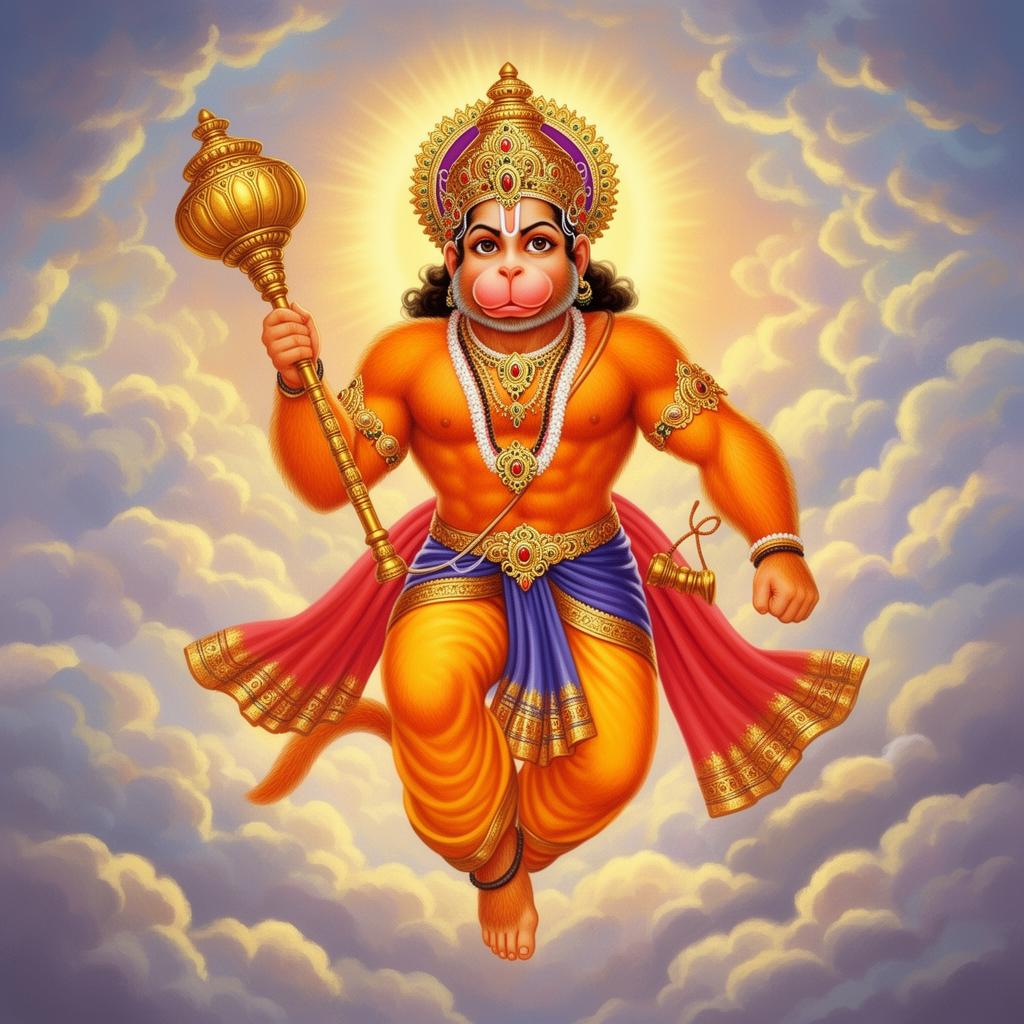
Hanuman is posted to guard the sleeping brothers during the war, standing watch with his usual vigilance against any threat approaching from outside the camp. Ahiravana does not approach from outside. Using sorcery, he tunnels in from below, through the earth itself, bypassing every guard positioned to watch the perimeter, and carries both Rama and Lakshmana down into Patala while they sleep.
When Hanuman discovers them gone, the trail leads underground, and he follows it, descending into a realm no vanara army could reach in time to help him.
Five Lamps, One Breath
In Patala, Hanuman learns the specific mechanism protecting Ahiravana's life, usually from Makardhwaja, a guardian of the netherworld's gates who in some tellings is described as Hanuman's own son, born from a drop of his sweat swallowed by a fish, a detail that is itself a separate strand of the same folk tradition.
Ahiravana's life is tied to five lamps, or in some versions five wicks of a single great lamp, burning in five different directions. All five must be extinguished at the exact same moment for him to die. Put out one, or four, and he remains untouched, alerted, and now aware someone is trying to kill him. There is no way for a figure with two hands and one set of lungs to blow out five flames in five directions simultaneously.
So Hanuman does not attempt it as himself. He expands into Panchamukhi Hanuman, a five-faced form, most commonly described with his own vanara face looking forward and four others facing the cardinal directions: Narasimha's lion face, Garuda's eagle face, Hayagriva's horse face, and Varaha's boar face, each one itself the form of a Vishnu avatar. With five faces now oriented toward all five lamps at once, he extinguishes every flame in a single breath, and Ahiravana dies instantly.
Hanuman then wakes Rama and Lakshmana, and carries them back up out of Patala, the sacrifice prevented in the same motion that ends the demon who planned it.
Why This Form Is Still Worshipped Today
Panchamukhi Hanuman is one of the most widely installed Hanuman forms in South Indian temples specifically, and it draws directly from this rescue story rather than from anything in the core Sanskrit epic.
Each of the five faces carries its own attributed power in worship: the vanara face for general strength and courage, Narasimha's face for fearlessness and protection from black magic, Garuda's face for freedom from poison and disease, Hayagriva's face for knowledge, and Varaha's face for prosperity and the removal of obstacles. Devotees approach the murti with specific concerns matched to the direction and face they pray before.
The theological point worth noticing is that this is not a random assembly of five heads. Each face belongs to a Vishnu avatar, which makes the form itself a statement: Hanuman, already understood as the perfect devotee of Rama, is shown here as a vessel capable of channeling the protective power of Vishnu's other avatars simultaneously, at the exact moment that power was needed to save Rama's own life. It is one of the clearest visual arguments in later Hindu iconography for Hanuman's unique status among devotees, someone whose devotion earns him not just strength but access.
Reader Questions Answered
Is the Ahiravana story part of Valmiki's original Ramayana?+
No, it comes from later texts and regional oral traditions, chiefly the Adbhut Ramayana, and is especially popular in Bengal, Odisha and parts of Southeast Asia. It is not part of the core Sanskrit epic most commonly studied, though it is widely known and devotionally significant.
Is Ahiravana the same as Mahiravana?+
Different tellings use the names differently. Some treat Ahiravana and Mahiravana as two separate demon brothers ruling Patala together, with one carrying out the abduction and the other planning the sacrifice; others use the two names interchangeably for a single figure.
Are there real Panchamukhi Hanuman temples?+
Yes, they are common across South India, with well-known examples including shrines at Kumbakonam and several temples in Andhra Pradesh, Karnataka and Tamil Nadu where the five-faced form is the primary murti.
Why five specific avatar faces and not others?+
The tradition generally explains the choice through each avatar's particular power being useful against a different category of threat, black magic, poison, ignorance, misfortune, alongside raw strength, making the combined form protective across every domain a devotee might need.
About the author
Anjali Mehta · Editor, M.A. Religious Studies
Anjali is the managing editor for Vandnaa and oversees the festival and vrat coverage. She holds an M.A. in Religious Studies and reviews every published article for accuracy, accessibility, and tradition-fidelity.
Meet the Vandnaa editorial team →