A Boon Aimed at Its Own Giver
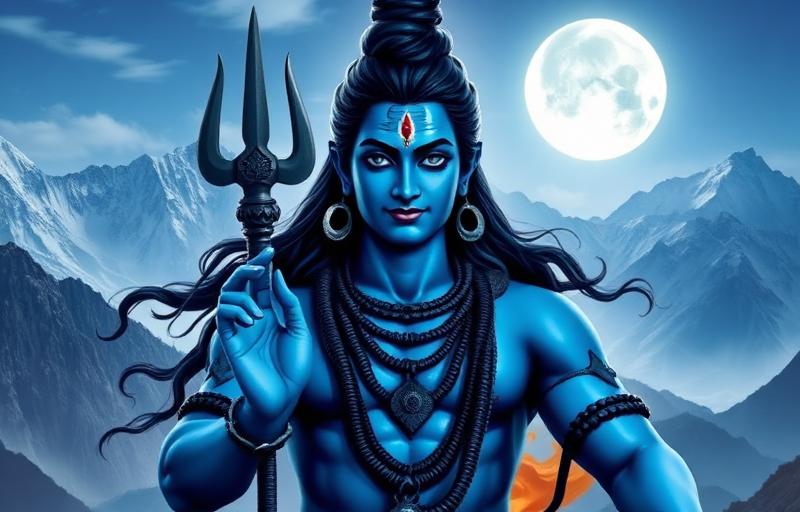
Bhasmasura, in some texts also called Vrikasura, performed intense tapasya to Shiva seeking a boon of extraordinary and dangerous specificity: the power to reduce anyone to ashes simply by placing his hand on their head. Shiva, moved by the depth of the devotee's austerity, granted the boon without immediately anticipating how it might be turned.
Bhasmasura's very first act with his new power was to attempt to use it on Shiva himself, chasing the god across the three worlds with the intention of testing the boon on the one being who had granted it, whether from arrogance, a desire to prove the boon absolute, or genuine malice depending on the telling. Shiva fled, unable to simply revoke a boon he had freely given, leaving the devas to find another solution before the demon caught up with him.
A Dance That Turned the Boon Around
Vishnu, appealed to by the panicked devas, took the form of Mohini, an enchantress of such overwhelming beauty that Bhasmasura, spotting her, abandoned his pursuit of Shiva immediately and became consumed instead with winning her hand. Mohini agreed to marry him on one condition: that he first join her in a dance, matching her every movement exactly.
As the dance grew more elaborate, Mohini eventually placed her own hand on her head as one of the dance's gestures, and Bhasmasura, entirely absorbed in mimicking her every move without a moment's independent thought, placed his hand on his own head in imitation, instantly reducing himself to ashes with the very boon he had intended to use on Shiva. The devas, watching, were free of the threat without Shiva ever having to break his word.
The First Appearance of Mohini's Power
This episode is significant within Vaishnava tradition as one of the notable early appearances of Vishnu's Mohini form outside the Samudra Manthan context, demonstrating a different application of the same disguise: not distributing a divine substance under contested circumstances, but using irresistible beauty and a dance of mirrored movement as a precise instrument to neutralize a threat without direct confrontation.
The story circulates widely as a teaching example of how a boon, however powerful, can only ever do exactly what it was defined to do, and a being obsessed enough with imitation or desire can be led to undo themselves entirely through their own unexamined actions rather than through any external force acting against them.
What People Ask Most
Why didn't Shiva just refuse to give such a dangerous boon in the first place?+
Shiva's tradition of rewarding sincere, intense tapasya without withholding boons based on anticipated misuse is a recurring theme across many Puranic stories, and this episode is often read as an example of why that generosity sometimes requires a second intervention to correct.
Is this the same Mohini form used during the Samudra Manthan?+
It is the same divine disguise, Vishnu taking female form as Mohini, but deployed on a separate occasion for a different purpose, here to neutralize Bhasmasura rather than to manage the distribution of amrita among devas and asuras.
Did Bhasmasura realize what he had done before he burned?+
Most tellings suggest the realization, if it came at all, came only in the instant of the act itself, since he was fully absorbed in mimicking Mohini's dance without pausing to think about what the gesture would actually do to him.
About the author
Anjali Mehta · Editor, M.A. Religious Studies
Anjali is the managing editor for Vandnaa and oversees the festival and vrat coverage. She holds an M.A. in Religious Studies and reviews every published article for accuracy, accessibility, and tradition-fidelity.
Meet the Vandnaa editorial team →