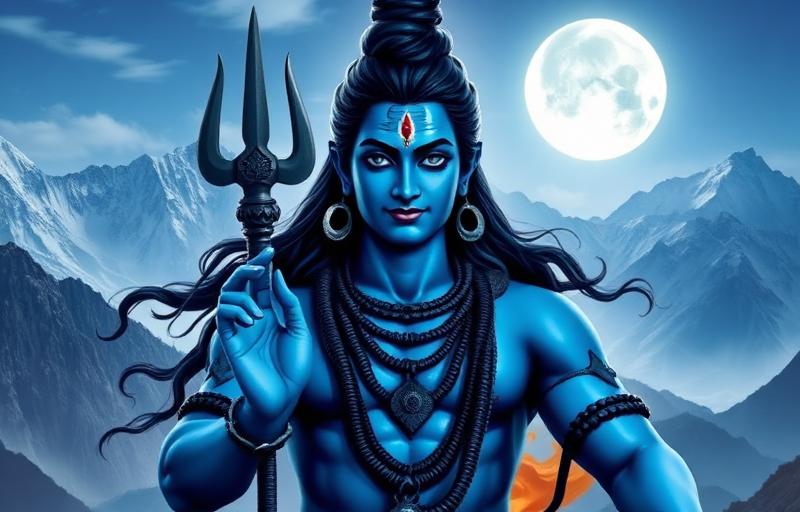
Three Sons, Three Cities
Tarakasura's three sons, Tarakaksha, Kamalaksha and Vidyunmali, performed extended tapasya to Brahma and received a boon that granted them three separate flying cities, one of gold, one of silver, and one of iron, built for them by the demon architect Maya. The cities could roam independently through the sky and, crucially, the boon specified that they could only be destroyed if all three aligned perfectly in a single line and were struck by one weapon capable of piercing all three at once, a condition the brothers assumed made them essentially permanently safe, since they could simply keep the cities apart.
Secure in this protection, the three demon brothers, collectively known through their cities as the Tripura, grew increasingly destructive, terrorizing the three worlds and disrupting the devas' order until the gods, unable to breach a defense built on a near-impossible coincidence, turned to Shiva as the only power capable of the task.
A Chariot Made of the Universe Itself
What makes this episode distinct from a straightforward battle story is the sheer scale of what Shiva's single shot required. The Puranas describe a chariot built from the components of the universe itself for the occasion: the earth as the chariot's base, the sun and moon as its two wheels, Brahma as the charioteer, Meru as the bow, and Vishnu as the arrow, with the Vedas as the horses. Every other deva contributed some part of their own power to the effort, making the shot as much a cosmic collaboration as an act of Shiva's individual strength.
Shiva waited a thousand years, the interval at which the three cities were fated to align exactly once, and when that single alignment finally occurred, released one arrow that pierced all three cities simultaneously, destroying Tripura in a single stroke and earning Shiva one of his most celebrated titles, Tripurantaka, the destroyer of the three cities, and Tripurari, enemy of Tripura, both still widely used in his hymns and temple names today.
A Title Still Spoken in Temples Today
Tripurantaka Shiva has his own dedicated iconography and temple tradition, most famously at the Tripurantakeshwara temple in Andhra Pradesh, and the episode is recited as part of several Shiva stotras that list his titles and victories. The phrase "Tripurari" remains in common devotional use, appearing in bhajans and in the naming of temples and even given names, largely detached from most devotees' awareness of the specific three-city, thousand-year, cosmic-chariot story behind it.
The episode is also notable for a detail worth remembering alongside the militaristic imagery: Maya, the architect who built the three cities, survives the destruction and later reappears elsewhere in the Puranic corpus, including as the architect associated with the illusion-filled hall built for the Pandavas, a separate story in its own right that shares this same figure as a recurring, morally ambiguous builder-for-hire to whichever power employs him.
Quick Answers
Why did it take a thousand years to strike the three cities?+
The boon protecting the cities specified they could only be destroyed at the one moment they aligned perfectly in a single line, and the three flying cities were fated to align that precisely only once every thousand years, so Shiva had to wait for the exact window.
What does the title "Tripurantaka" mean?+
It means the ender or destroyer of Tripura, the three cities, and it is one of Shiva's widely used epithets, appearing in temple names, stotras and hymns even among devotees unfamiliar with the full story behind it.
Is Maya the architect the same figure connected to the Pandavas' hall?+
Yes, this is the same Maya Danava, an asura architect who survives the Tripura episode and later builds the illusion-filled assembly hall for the Pandavas at Indraprastha, a separate story that treats him as a skilled builder available to different powers over time.
About the author
Anjali Mehta · Editor, M.A. Religious Studies
Anjali is the managing editor for Vandnaa and oversees the festival and vrat coverage. She holds an M.A. in Religious Studies and reviews every published article for accuracy, accessibility, and tradition-fidelity.
Meet the Vandnaa editorial team →