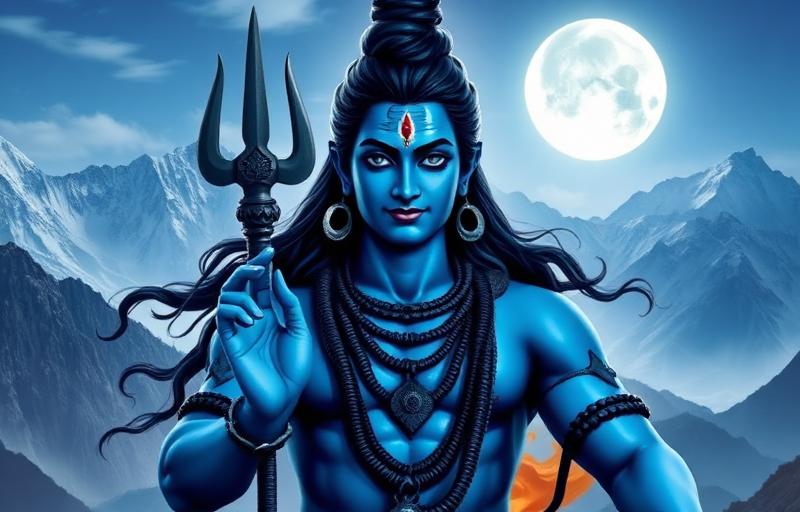
A Demon No Weapon Could Touch
Jalandhara, in the Shiva Purana and Padma Purana tellings, was born of an immense burst of energy from Shiva's own third eye, cast into the ocean where the sea god raised him as a son of extraordinary power. Growing into a demon king who conquered the three worlds, Jalandhara married Vrinda, a woman of such complete and unwavering devotion to her husband that her chastity itself became a kind of shield around him, one the gods discovered only after repeated attempts to defeat him in battle failed for no reason they could explain by strength or weapons alone.
As Jalandhara's conquests pushed further, eventually threatening even Shiva directly, the devas realized the pattern: as long as Vrinda's devotion to her husband remained unbroken, Jalandhara could not be killed by any conventional means, because her virtue itself had become the actual source of his invulnerability. This left the gods facing a war they could not win on the battlefield alone.
The Disguise That Ended the War
With the war at a stalemate and Jalandhara's threat growing, Vishnu took on Jalandhara's own form and appearance and approached Vrinda in her husband's likeness. Believing this was truly her husband returned from battle, Vrinda's devotion, still directed faithfully at the man she believed stood before her, was in that moment misdirected onto an impostor, and her chastity's protective hold on the real Jalandhara broke at exactly the instant Shiva needed it to. Shiva was then able to kill Jalandhara in battle.
When Vrinda discovered the deception, her grief and fury were immense, and she is said to have cursed Vishnu directly for the trick, a curse that in some traditions is connected to Vishnu's later stone form as the Shaligram and to the specific conditions of his worship. Vrinda then entered the fire herself. From her body, or from her ashes depending on the telling, grew the tulsi plant, which Vishnu himself is said to have blessed and declared inseparable from his own worship from that point forward, which is why tulsi remains central to Vaishnava puja to this day and why a Shaligram is traditionally never worshipped without a tulsi leaf present.
Why Tulsi Sits Beside the Shaligram
Outside the war itself, this story is the reason for a specific and widely observed household practice: tulsi and Shaligram worship together, and the Tulsi Vivah ceremony performed in the month of Kartik, which ritually marries the tulsi plant to Vishnu, symbolically restoring the relationship the Jalandhara episode had broken. Households across India that keep a tulsi plant in their courtyard are, whether consciously or not, participating in a devotional tradition whose origin lies in this specific and morally uncomfortable story.
The episode is rarely told in full in casual retellings precisely because it does not resolve neatly: Vishnu's deception is necessary to defeat a genuine threat, but it is also a real violation of Vrinda's devotion, and the tradition does not pretend otherwise, giving her both a curse against Vishnu and a permanent, honoured place in his worship as her due.
Common Questions From Devotees
Why couldn't the devas simply defeat Jalandhara in battle?+
Jalandhara's invulnerability was tied to his wife Vrinda's unbroken chastity and devotion rather than to his own strength alone, so no amount of conventional force could kill him while that condition held.
What is the connection between this story and the Shaligram stone?+
In several tellings, Vrinda's curse on Vishnu for deceiving her is linked to his later manifestation in the Shaligram stone form, and to the tradition that a Shaligram should always be worshipped alongside tulsi as a form of continuing reconciliation.
Is Tulsi Vivah connected to this story?+
Yes. The Tulsi Vivah ceremony, performed in Kartik month, ritually marries the tulsi plant to Vishnu, and is widely understood as symbolically restoring the bond this episode broke.
Was Jalandhara considered evil, or simply powerful?+
The tradition presents him primarily as a conqueror whose growing power threatened the cosmic order, rather than as gratuitously cruel, which is part of why the story spends real attention on Vrinda's tragedy rather than treating his death as simple triumph.
About the author
Pandit Ravindra Sharma · Vedic Rituals & Bhakti, 22+ years
Pandit Ravindra is the Vandnaa editorial team's resident specialist on aarti, chalisa, and daily devotion. He has performed home and temple pujas across Varanasi and Delhi for over two decades and contributes the bhakti-focused articles on this site.
Meet the Vandnaa editorial team →