A Flower, a Forest, and a Tail in the Path
During the Pandavas' exile in the forest, told in the Mahabharata's Vana Parva, a strong wind one day blew a single, extraordinarily fragrant flower into the couple's hermitage, a saugandhika, and Draupadi, taken with its scent, asked Bhima to bring her more of the same kind so she could carry them to their next dwelling.
Bhima set out alone toward the source of the wind, up the slopes of Mount Gandhamadana, through terrain that grew steeper and stranger the higher he climbed, roaring as he went partly to announce his own strength to any creature that might block him and partly, the text suggests, because he enjoyed the sound of it.
The path narrowed into a forest of plantain trees, a kadali vana, and there, stretched fully across the only way through, lay an old monkey, grey with age, apparently too feeble to move, its long tail resting across the trail like a fallen branch.
Bhima, in no mood to walk around an animal, told the monkey to get out of his way.
The monkey, without stirring, answered that he was old and his limbs would not obey him anymore, and suggested, almost lazily, that Bhima simply step over the tail instead, since jumping over an ascetic's tail was apparently the only obstacle troubling him.
Bhima, who considered himself bound by a warrior's code not to step over any part of a rishi's body, told the monkey to move the tail himself then, and when the monkey again pleaded old age and told Bhima to just shift it aside with his own hand if it was such a small thing, Bhima reached down without breaking stride, expecting the light flick of an old animal's tail.
It did not move.
Bhima gripped it properly and pulled with one arm, the way he would clear a fallen log, and the tail stayed exactly where it was, as though it were rooted into the mountain itself.
He planted his feet, took the tail in both hands, and used the same strength that had let him break Bakasura's back and uproot trees as clubs, and still nothing happened, not so much as a tremor.
Sweat came, and with it the first real doubt Bhima had felt in that forest: an old, apparently crippled monkey was outweighing everything he had.
He stopped pulling, stood back, and for the first time since entering the kadali vana, looked at the monkey properly instead of past him, and asked, this time without any command in his voice, who he actually was.
Where the Story Comes From, and What Hanuman Reveals
The episode belongs to the Mahabharata's Vana Parva, inside the longer sequence usually called the Saugandhika-harana, the fetching of the saugandhika flowers, and it is one of the few places in the Sanskrit epic where the Ramayana's Hanuman steps directly onto the Mahabharata's stage.
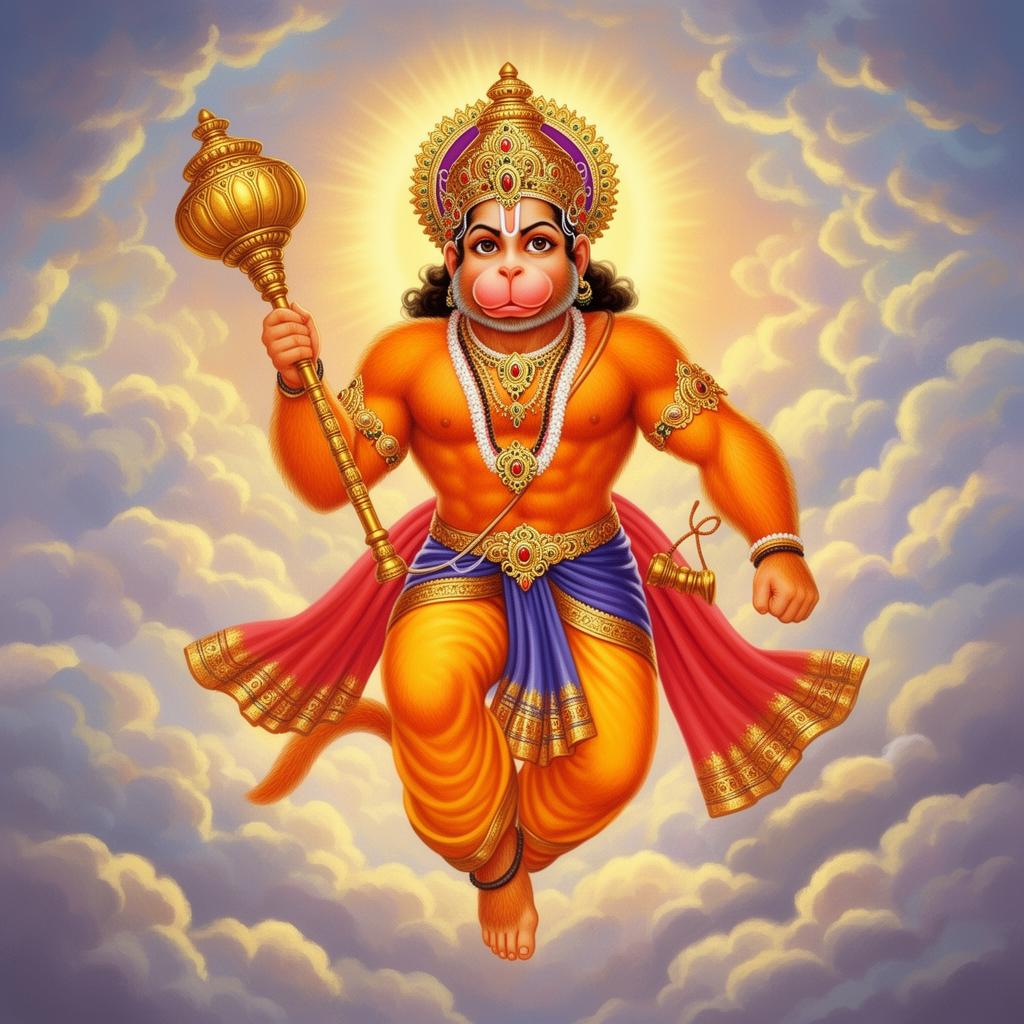
Once Bhima asked properly, the monkey identified himself as Hanuman, son of Vayu, the wind god, and pointed out that Bhima, also fathered by Vayu on Kunti, was therefore his own younger brother, which is the detail that gives both of them the shared title Vayuputra used across both epics.
Hanuman explained that his tail had grown heavy with age and that lifting it took an effort even he no longer made without meaning to, a deliberately modest explanation that leaves out what every listener already suspects: that the weight was never about age at all, and that an old monkey lying across a mountain path in the middle of the Pandavas' exile was never going to be an accident.
Bhima asked to see the form Hanuman had worn crossing the ocean to Lanka, and Hanuman obliged briefly, growing to a height that blotted out the forest canopy before Bhima, overwhelmed, asked him to return to his ordinary size, since the scale of it was more than Bhima's eyes could hold.
Before sending him on toward the lake where the saugandhika flowers actually grew, guarded by Kubera's yakshas, Hanuman gave Bhima a teaching on the four yugas, on how strength and dharma both diminish as the ages turn, and on why a being suited to the openness of Treta Yuga has to hold himself back in a narrower age rather than loose his full form on it.
He also made Bhima a promise that would only pay off years later: that when the Pandavas went to war, he would station himself on Arjuna's chariot banner, the Kapidhwaja, and that his presence there would unsettle the enemy and steady the Pandava army before a single arrow was loosed.
Regional and vernacular retellings vary in how much of this exchange they keep. Some dwell at length on the yuga teaching, some barely mention it and linger instead on the humbling of Bhima's pride, and some soften Hanuman's opening reply about age into something gentler than the dry, almost teasing tone the Sanskrit original gives him, but the shape of the encounter, the impossible tail, the reveal, the promise of the Kapidhwaja, stays constant across nearly every version told.
Why This Meeting Still Matters
Arjuna's chariot flag through the entire Kurukshetra war carried Hanuman's image, and the Mahabharata brings it up repeatedly, not as decoration but as an active presence, unsettling enemy soldiers and, in several passages, described as roaring at moments the Pandava side needed heart.
That single detail is this episode's most durable legacy: the Kapidhwaja is one of the most recognisable emblems to come out of either epic, and every time it is mentioned later in the Mahabharata, it is this forest meeting on Gandhamadana that put it there.
The episode is also one of the clearest threads tying the Ramayana and the Mahabharata together as a connected itihasa rather than two separate stories, since it lets a character from one epic act directly inside the events of the other, aging across the gap between the two yugas but still present, still keeping a promise made generations earlier to help the line of Rama's devotees when they would need it most.
In pravachan and storytelling traditions, the scene is used regularly as a stock example of garva-bhanga, the breaking of pride, alongside episodes like Arjuna's humbling before Shiva disguised as a hunter, and it is told to children specifically because the lesson does not need explaining: Bhima never hears a lecture about humility, he simply fails to lift a tail, and that failure does the entire job by itself.
Gandhamadana and the kadali vana are associated in tradition with the high Himalayan stretches near Badrinath and Kedarnath, and pilgrims on that route still sometimes retell the story at points along the way, less as a claim about the exact geography than as a reminder of what the mountains are supposed to be full of: things far older and far stronger than they look.
Common Questions From Devotees
Why couldn't Bhima lift Hanuman's tail?+
The story does not treat it as a matter of physical size or ordinary strength. Hanuman's tail carried a weight that only his own will controlled, and no amount of muscular effort from Bhima, however great, could move something that was never resting on muscle in the first place.
Are Bhima and Hanuman really considered brothers?+
Yes, within the tradition. Both are described as sons of Vayu, the wind god, Hanuman born to Anjana and Bhima born to Kunti through the same divine father, which is why both carry the shared title Vayuputra and why the Mahabharata treats their meeting as a family reunion rather than a chance encounter.
What is the Kapidhwaja and why does it matter?+
The Kapidhwaja is the emblem of Hanuman that Arjuna's chariot carried throughout the Kurukshetra war, promised by Hanuman during this Gandhamadana meeting. The Mahabharata describes it as an active presence during the fighting, not mere decoration, unsettling enemy troops at key moments.
Where does this story appear in the Mahabharata?+
It is part of the Vana Parva, the book of the forest, inside the longer episode usually called the Saugandhika-harana, which begins when a fragrant flower blows into Draupadi and the Pandavas' forest hermitage and she asks Bhima to bring her more of them from their source.
About the author
Anjali Mehta · Editor, M.A. Religious Studies
Anjali is the managing editor for Vandnaa and oversees the festival and vrat coverage. She holds an M.A. in Religious Studies and reviews every published article for accuracy, accessibility, and tradition-fidelity.
Meet the Vandnaa editorial team →