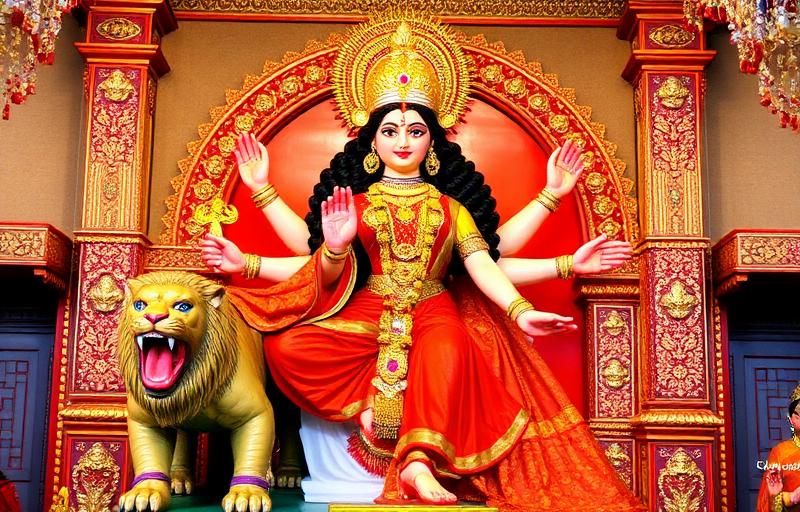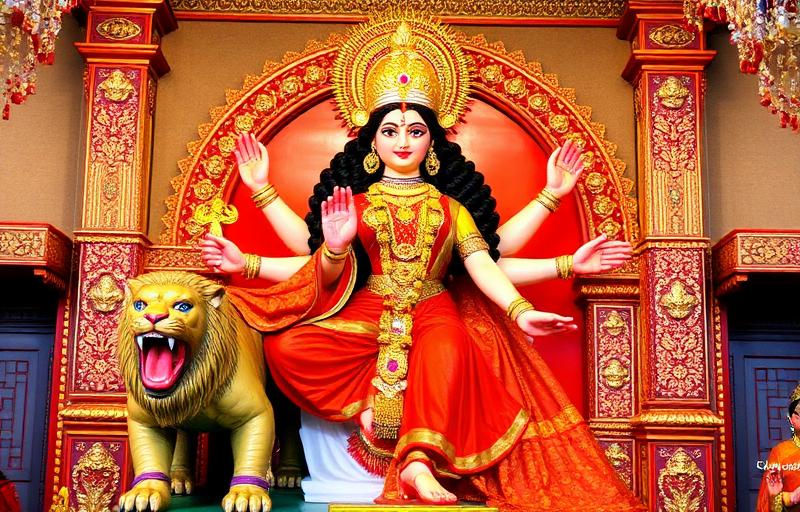
Who Is Chinnamasta Devi?
Chinnamasta Devi is the sixth of the ten Mahavidyas - the ten great wisdom-goddesses who are forms of the one Divine Mother (Adi Shakti), each revealing a different truth about the ultimate reality. Her name means 'she whose head is severed', and her form is one of the most striking and symbolically profound in the entire tradition.
Because her imagery is intense, it is meant to be understood symbolically, not literally. Chinnamasta represents the fearless power of self-sacrifice, the transcendence of the ego, and the ceaseless flow of life-energy that sustains all creation. She is worshipped mainly within the Shakta and Tantric traditions by advanced seekers under proper guidance. For most devotees, she is best approached with reverence and contemplation of her deep meaning, rather than the outer detail of her form. She embodies the truth that the small self must be offered up for the higher Self to shine.
The Deep Symbolism
Sages interpret Chinnamasta's form as a teaching in living wisdom:
- Transcendence of the ego: The offering of one's own head symbolises the surrender of the ego and the limited mind - the greatest sacrifice on the spiritual path, letting the small self dissolve into the divine.
- The flow of life-energy: Her form depicts life-force being freely given and shared, representing the truth that all life is sustained by ceaseless giving, and that creation, sustenance and dissolution are one continuous flow.
- Fearlessness and self-control: She stands upon the forces of desire, showing mastery over the restless senses and passions.
- Non-duality: The image conveys that giver, receiver and gift are ultimately one - a profound expression of Advaita, the oneness behind all appearances.
Understood rightly, Chinnamasta is not fearsome but a fierce grace, teaching that true freedom comes when the ego is offered up in devotion and self-knowledge.
Significance, Mantra & Worship
Chinnamasta is revered for courage, spiritual transformation, victory over the ego, and awakening of inner energy. In the Tantric tradition she is also associated with breaking through obstacles and fears.
A simple seed salutation is 'Om Shrim Hreem Kleem Chinnamastayai Namah.'
A word of guidance: Because Chinnamasta is a powerful, esoteric Mahavidya, her detailed worship and mantra sadhana are traditionally undertaken only under the guidance of a qualified guru. For most devotees, the fitting way to honour her is:
- Bowing to her as a form of the one Divine Mother, alongside the other Mahavidyas.
- Contemplating her teaching - offering the ego, living generously, and cultivating fearlessness.
- Praying with reverence for courage and inner transformation.
Approached with humility, respect and the right understanding, Chinnamasta's message is deeply uplifting. These are matters of sacred tradition, held with faith.
Quick Answers
Who is Chinnamasta Devi?+
Chinnamasta Devi is the sixth of the ten Mahavidyas, forms of the one Divine Mother. Her striking form is understood symbolically, representing the fearless power of self-sacrifice, transcendence of the ego, and the ceaseless flow of life-energy that sustains all creation.
What does Chinnamasta's form symbolise?+
Understood symbolically, her form represents the surrender of the ego and limited mind, the truth that all life is sustained by ceaseless giving, mastery over desire, and the non-dual insight that giver, receiver and gift are ultimately one. It teaches that true freedom comes when the ego is offered up.
How should Chinnamasta Devi be worshipped?+
Because she is a powerful, esoteric Mahavidya, detailed mantra sadhana is traditionally done only under a qualified guru's guidance. For most devotees, the fitting way is to bow to her as a form of the Divine Mother, contemplate her teaching of offering the ego and living generously, and pray with reverence for courage and inner transformation.
About the author
Acharya Vinaya Kapoor · M.A. Sanskrit, Mantra & Stotra Studies
Acharya Vinaya holds an M.A. in Sanskrit from Banaras Hindu University and writes the mantra and stotra commentary on Vandnaa. Her focus is on accurate pronunciation, traditional context, and helping modern readers connect with classical texts.
Meet the Vandnaa editorial team →