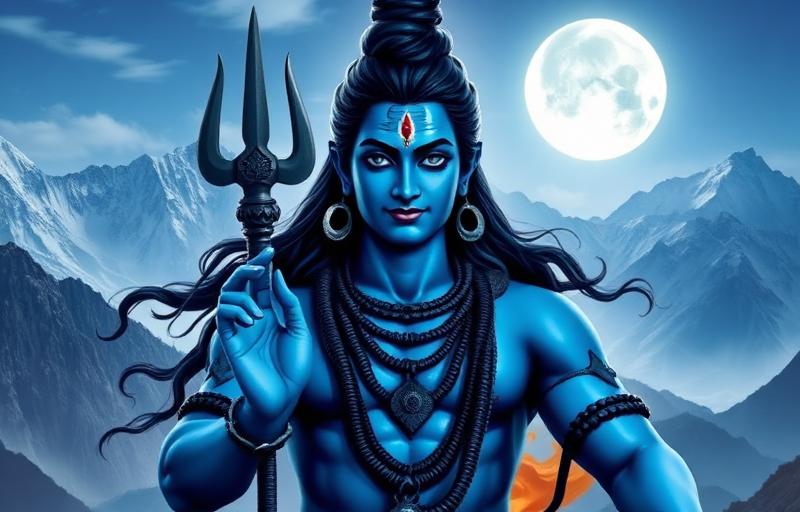
What Is the Damaru?
The damaru is the small, hourglass-shaped drum that Lord Shiva holds in one of his hands, often in his upper right hand during the cosmic dance (Tandava). Two knotted cords with beads strike the two drumheads when the drum is twirled, producing its distinctive rhythmic sound.
Its shape - two triangles meeting at a single point - is itself rich with meaning. In the tradition of Nada Brahma, the universe arises from sound, and the damaru is the instrument from which that primal sound is born. It is small in size yet vast in symbolism, representing the very beat of creation.
The Maheshwara Sutras: Sound Becomes Language
Tradition holds that at the close of Shiva's Tandava, he played his damaru fourteen times. From these fourteen sounds arose the Maheshwara Sutras (also called the Shiva Sutras) - fourteen aphorisms that organise the sounds of the Sanskrit language.
The great grammarian Panini is said to have received these fourteen sutras and built upon them his Ashtadhyayi, the foundation of Sanskrit grammar. In this way, the beat of Shiva's damaru is honoured as the source of:
- The ordered sounds of speech
- The structure of Sanskrit grammar
- All language, learning and the sciences that flow from it
This is why Shiva is revered not only as the destroyer but also as the origin of knowledge and the arts. The dance and the drum together teach that creation itself moves to a divine rhythm.
The Deeper Spiritual Meaning
The damaru's shape and sound carry layered meaning:
- Creation and dissolution: The two triangles widen out from a single point and meet again. As the drum sounds, the universe expands; as the sound fades, it dissolves - the eternal rhythm of creation and pralaya.
- The union of Shiva and Shakti: The two halves of the damaru are seen as the meeting of the masculine and feminine principles, from whose union the world is born.
- Nada Brahma: The sound of the damaru is linked to the primal vibration Om (Pranava), from which all existence is said to spring.
- Time and rhythm: Its beat marks the steady pulse of cosmic time, reminding us that all things move and change in measure.
To hear the damaru, in tradition, is to be reminded that behind all forms there is a single divine sound holding the universe together.
Significance in Worship

- A symbol of Mahadev: Along with the trishul, the damaru is one of the most recognisable emblems of Shiva. Seeing it in an image instantly recalls the Lord of the dance and of sound.
- In aarti and bhajan: Small damarus and bells are sounded during Shiva worship; their rhythm is believed to purify the atmosphere and focus the mind.
- During Shiv Tandav Stotram: Devotees often recall the damaru's dhimid-dhimid beat described in the stotra, feeling the rhythm of Shiva's dance.
- In meditation: Reflecting on the damaru as Nada Brahma, some sadhaks meditate on inner sound and the pranava Om.
Kept in the home shrine, a small damaru is a reminder that the divine is present in sound and rhythm, and that the same beat which creates the cosmos beats within us.
Quick Answers
Why does Lord Shiva hold a damaru?+
The damaru represents the primal sound from which the universe is created. As the Lord of the cosmic dance, Shiva holds the damaru to mark the rhythm of creation, and its sound is honoured as the source of language and Nada Brahma.
What are the Maheshwara Sutras?+
The Maheshwara Sutras, also called Shiva Sutras, are fourteen aphorisms said to have arisen from fourteen beats of Shiva's damaru at the end of his Tandava. They organise the sounds of Sanskrit and form the foundation of Panini's grammar.
What does the hourglass shape of the damaru mean?+
The two triangles meeting at a single point represent the union of Shiva and Shakti, and the cycle of creation and dissolution. As the universe expands and contracts, so the two halves of the damaru widen and meet.
Is the damaru connected to Om?+
Yes, in the tradition of Nada Brahma the sound of the damaru is linked to the primal vibration Om (Pranava), from which all existence is said to spring. Meditating on the damaru is therefore a way of contemplating that source-sound.
About the author
Anjali Mehta · Editor, M.A. Religious Studies
Anjali is the managing editor for Vandnaa and oversees the festival and vrat coverage. She holds an M.A. in Religious Studies and reviews every published article for accuracy, accessibility, and tradition-fidelity.
Meet the Vandnaa editorial team →