Chanod on the Narmada
Dayaram, properly Dayaram Prabhuram Bhatt, 1777 to 1852, and the conventional last figure of the medieval Gujarati poetic tradition.
Where he came from
Chanod, on the Narmada in what is now Vadodara district, into a Nagar brahmana family, and later associated most strongly with Dabhoi, where he lived and died.
He was orphaned young. His father died when he was about twelve and his mother soon after, and the accounts describe a boy left with relatives who did not particularly want him, and then a young man who left.
What he became
A Pushtimargi Vaishnava.
He took initiation in the Vallabha sampradaya, the path of grace, in which the object is Krishna as the child and the lover at Braj, the mode is seva rather than austerity, and the aesthetic is central rather than decorative.
Which is the tradition that produced the Ashtachhap poets in the north two centuries earlier, and Dayaram is what it produced in Gujarat at the end.
He travelled
Three long pilgrimages on foot across India, by the traditional account, which put him in Braj, in the north, in the south, and gave him the geography that appears in the work.
He never married.
What he wrote
A very large amount, in two registers.
The lyric
- Over a thousand garbis, which is what he is loved for
- Pado and other song forms
The doctrinal
- Rasikvallabh, his major work, one hundred and eight verses setting out the Pushtimarg position systematically
- Bhaktiposhan
- Prashnottarmalika
- Prabodh Battisi
- Narrative works including Ajamil Akhyan, Rukmini Vivah and Satyabhamavivah
And the reason he matters is the first list, not the second.
Where he sits
Gujarati devotional literature has three names that everybody knows.
Narsinh Mehta in the fifteenth century, who is the beginning. Akho in the seventeenth, the previous entry, who is the objection. And Dayaram at the turn of the nineteenth, who is the end of the old order, because after him Gujarati literature turns into something else under the pressure of print, English education and reform.
He died in 1852 at Dabhoi, where the building associated with him still stands.
The Garbi
What it is
A short sung lyric in Gujarati, usually in a woman's voice, on Krishna.
And it is worth separating three words that get confused.
Garba is the dance, done in a circle, at Navratri, around a lamp or an image.
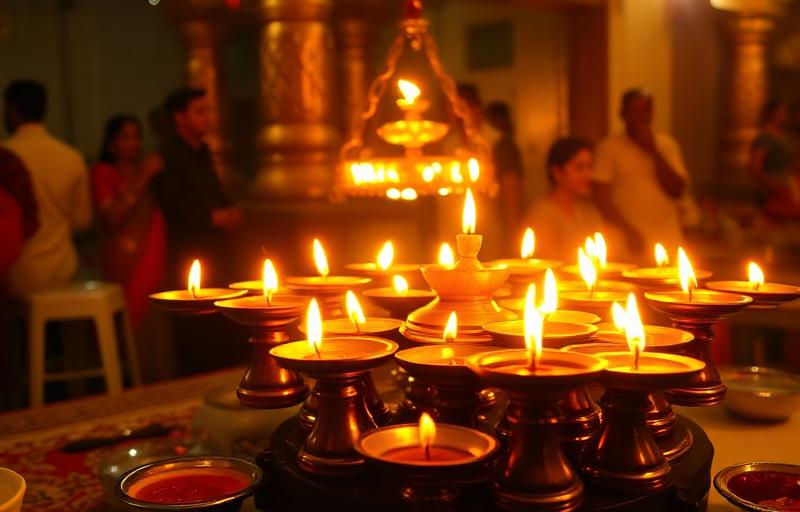
Garbo is the perforated earthen pot with a lamp inside that the circle goes around, and the word for the dance comes from it.
Garbi is the song form, and Dayaram is its master. A garbi can be sung during garba and is not the same thing as garba, and many of his are too intimate for a crowd of three hundred.
The voice
Almost always a woman's, and usually a young one.
A gopi. Radha. A girl talking to her friend, or to her own reflection, or to Krishna, or to herself about Krishna.
And what she is doing is almost always the same thing: trying to hold a position she has already lost.
The most famous one
Shyam rang samipe na javu.
I will not go near the colour Shyam.
Shyam means dark, and it is Krishna's name, and it is also just a colour, and the poem runs on that.
The girl announces that she is finished with all of it. She will not go near anything dark. She lists what she will therefore avoid, and the list goes on, and it becomes absurd, and every item on it turns out to be something she cannot actually avoid because the world is full of dark things.
And the poem never has her give in. It ends with the resolution intact and completely undermined, and that is the whole joke and the whole devotion at once.
Which is what he is good at
Not intensity. Gujarati already had Narsinh Mehta for intensity.
Wit.
His garbis are constructed like small comedies: a speaker with a position, a situation that dismantles it, and a last line that leaves her where she started but knowing it.
And they are singable, which is the reason a thousand of them are still in circulation two hundred years later in a state that sings for nine nights a year.
Other well known ones
- The garbis of complaint, in which she lists everything wrong with him, at length, with evident enjoyment
- The garbis of the friend's advice, in which a companion tells her to be sensible, and is ignored
- The viraha garbis, on absence, which are the serious ones
- And Rasikvallabh, which is not a garbi but is where he sets out what all of this is supposed to mean
A note on the erotic register
Because it is frank and because published translations often soften it.
Dayaram writes about the body, about desire, about jealousy and about wanting somebody, without embarrassment.
This is standard and it is old. Jayadeva's Gita Govinda, Vidyapati, Chandidas, the Ashtachhap poets and the whole madhurya stream do the same, and the theology behind it is explicit: the relationship between a person and God is being described in the only human vocabulary that has the right intensity in it.
And a reader is entitled to take them as love poems too. They work as love poems. The tradition has never required anybody to read them only one way, and pretending they are chaste allegory removes the thing that makes the allegory work.
The caution, which belongs here
And it is the one the Bhaktivinoda entry sets out at length.
Madhurya bhava, the devotional mode of the lover, has been used as cover.
Groups have existed, in Bengal and elsewhere, that treated the Radha Krishna material as an instruction to enact it, with a teacher deciding who participated with whom.
Reading a love poem is not that. Singing a garbi at Navratri is not that. A teacher who tells you that your practice requires you to sleep with them, or with somebody they nominate, is committing an offence, whatever poem they cite. Police 112. Women's helpline 181. Free legal aid 15100.
The Hard Parts
Two, and neither is usually mentioned.
One. He wrote sectarian polemic.
Dayaram was a committed Pushtimargi at a moment when Gujarat was religiously contested.
The Swaminarayan sampradaya was rising rapidly in Gujarat in his lifetime, and it was taking people, and the older Vaishnava establishments did not like it.
And Dayaram wrote against it, and against other traditions, in works that are polemical rather than devotional, and the tone in places is exactly what sectarian argument sounds like everywhere: the other people are wrong, their teacher is not what he claims, and their followers have been fooled.
How this article handles it
By saying it and not reproducing it.
Inter sect polemic was normal in that period and every large sampradaya produced some, and reading it now serves nobody. The Swaminarayan tradition is a substantial and living Hindu sampradaya, the Pushtimarg is a substantial and living Hindu sampradaya, and a nineteenth century argument about which one is correct is not a live question for a reader deciding what to sing at Navratri.
And the honest general observation is that a first rate lyric poet can be a third rate polemicist, and Dayaram is a clear case: the garbis are alive and the polemic is not, and the difference is that one of them was written out of love and the other out of institutional anxiety.
Two. Ratanbai.
A woman named Ratanbai appears in every account of his life.
She looked after him. She is described in the tradition as his devotee and attendant, she kept his household, and she was with him for a long period including at the end.
And there was gossip in his lifetime, and there has been speculation ever since, about what the relationship actually was.
This article is not going to adjudicate it.
Two reasons.
One. The material does not permit it. The sources are partisan, the period is early nineteenth century, and nobody now can establish what happened between two people in a house in Dabhoi.
Two. And it is not anybody's business.
A man who never married and a woman who lived in his household is a domestic arrangement, and the tradition's own habit of either insisting on her purity or hinting at the alternative is the same habit either way: treating a woman's relationship to a famous man as the interesting question about her.
What can be said
That she kept a poet alive and housed for years, that the work exists partly because somebody was cooking and managing the household while it was written, and that this is the position the Sarada Devi entry in the previous batch describes at length.
And that we know almost nothing else about her, which is the ordinary outcome, and is worth noticing rather than filling in.
Navratri, Practically
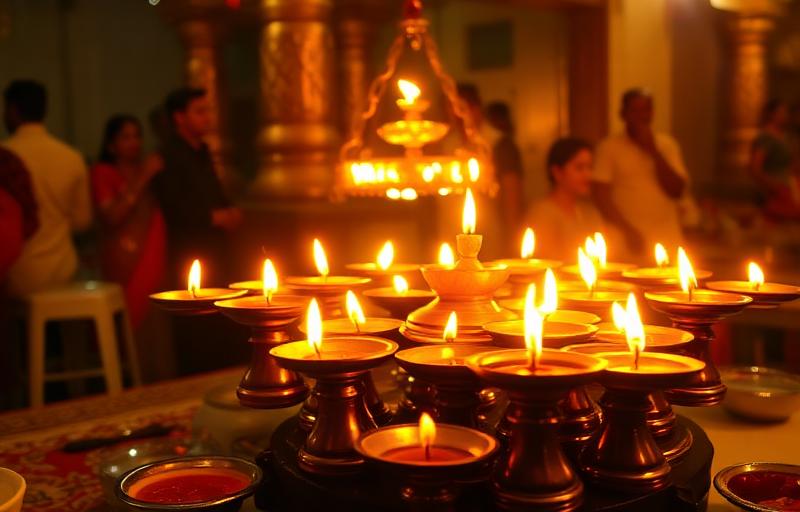
Dayaram's garbis are still sung during Navratri, so this section is the useful one.
What Navratri garba actually is
Nine nights, in Ashwin, usually September or October, in which Gujarat and the Gujarati diaspora dance in circles around a garbo, a perforated pot with a lamp inside, or around an image of the Devi.
The lamp inside the pot with holes in it is the whole symbol and does not need explaining: the light is inside, the body has openings, and what you see from outside is the light coming through.
Traditional garba is circular, communal, and slow at the start of the evening. Raas is the stick dance and is a different form. The modern commercial garba event with a sound system, a ticket and choreography is a third thing, and all three coexist.
Where Dayaram fits
His garbis are the lyrical end.
They are sung, they are known, and they are usually the quieter items rather than the high tempo ones. A person who wants to hear them should look for a traditional or sheri garba, a street or neighbourhood one, rather than a large commercial event, because that is where the older repertoire survives.
Now the health section, and it is needed
Because people have died at garba, and this is recent and documented.
Cardiac events during Navratri garba in Gujarat have been reported in numbers in recent years, including in young people, sufficient that the state health authorities have stationed ambulances at large venues, run public advisories, and pushed CPR training campaigns during the season.
Why it happens
Garba is strenuous aerobic exercise, done at night, for hours, often after fasting all day, frequently in heat and crowding, by people who are otherwise sedentary all year.
Every one of those is a risk factor and they stack.
What to do
One. If you have any cardiac risk, get checked before the season, not during it.
That means: known heart disease, high blood pressure, diabetes, high cholesterol, a family history of sudden cardiac death or early heart attack, obesity, or smoking. A conversation with a doctor and, if advised, an ECG or a stress test, in August, is the entire intervention.
Two. Do not dance through symptoms.
Stop immediately and get help for: chest pain, chest tightness or pressure, pain going into the jaw, neck, back or arm, breathlessness out of proportion to the effort, dizziness, palpitations, cold sweat, or nausea.
These are not stamina problems. The instinct to finish the round is the thing that kills people.
Three. Do not combine fasting and garba carelessly.
Navratri fasting and hours of dancing at night are a bad combination, and people faint. If you are fasting, take fluids, take something before you dance, and know that this is not the year to attempt both at maximum.
Specifically do not fast in this way if you are diabetic, pregnant, on medication that requires food, elderly, or recovering from illness, and take medical advice on how to fast safely if you intend to.
Four. Hydrate.
Water through the evening. Not only sugary drinks.
Five. Know what to do if somebody collapses.
This is worth knowing whether or not you go to garba.
- Check response and breathing. If unresponsive and not breathing normally, start chest compressions immediately
- Hard and fast in the centre of the chest, about a hundred to a hundred and twenty per minute, pushing down about five centimetres, and do not stop until help arrives
- Send somebody for an AED if the venue has one, and large venues increasingly do
- Call 108 at the same time
- Hands only CPR is enough for an untrained bystander and is far better than doing nothing, which is what usually happens
Six. The crowd
Large garba venues get very full. Agree a meeting point with your group, keep children physically with an adult, note where the exits are when you arrive, and leave before the end if the crowd is building rather than with it.
Where to go
- Dabhoi, Vadodara district, where he lived and died, and the building associated with him
- Chanod, on the Narmada, his birthplace, and the Chanod Karnali ghats
- Vadodara and Ahmedabad for traditional Navratri, and any sheri garba in a neighbourhood for the older repertoire
- Junagadh, for Narsinh Mehta, who is the other end of this literature
A daily practice from this entry
- Shri Krishna Sharanam Mama, which is the Pushtimarg formula
- One garbi, sung or played, and Shyam rang samipe na javu is the one to start with
- And the Navratri rule that matters more than any of it: if your chest hurts, stop dancing
The Short Version
Who: Dayaram Prabhuram Bhatt, 1777 to 1852, the conventional last figure of the medieval Gujarati poetic tradition. He was born at Chanod on the Narmada in what is now Vadodara district into a Nagar brahmana family, was orphaned young with his father dying when he was about twelve and his mother soon after, and is most strongly associated with Dabhoi where he lived and died. He became a Pushtimargi Vaishnava, took initiation in the Vallabha sampradaya whose object is Krishna as the child and the lover at Braj and whose mode is seva rather than austerity, made three long pilgrimages on foot across India by the traditional account, and never married.
What he wrote: over a thousand garbis, which is what he is loved for, along with pado and other song forms; and on the doctrinal side the Rasikvallabh, his major work of a hundred and eight verses setting out the Pushtimarg position, the Bhaktiposhan, the Prashnottarmalika, the Prabodh Battisi, and narrative works including the Ajamil Akhyan, Rukmini Vivah and Satyabhamavivah. Gujarati devotional literature has three names everybody knows: Narsinh Mehta in the fifteenth century, who is the beginning, Akho in the seventeenth, who is the objection, and Dayaram at the turn of the nineteenth, who is the end of the old order.
The garbi: a short sung Gujarati lyric, usually in a woman's voice, on Krishna. Three words get confused: garba is the circle dance, garbo is the perforated pot with a lamp inside that the circle goes around, and garbi is the song form. The voice is almost always a young woman, a gopi, Radha, a girl talking to her friend or to herself, and what she is doing is almost always trying to hold a position she has already lost. The most famous is Shyam rang samipe na javu, I will not go near the colour Shyam, in which she announces she is finished with all of it and lists what she will therefore avoid, and the list becomes absurd because the world is full of dark things, and the poem ends with the resolution intact and completely undermined. What he is good at is not intensity, since Gujarati already had Narsinh Mehta for that, but wit: his garbis are built like small comedies with a speaker, a situation that dismantles her position, and a last line that leaves her where she started but knowing it.
The erotic register: he writes about the body, desire and jealousy without embarrassment, which is standard and old, since Jayadeva's Gita Govinda, Vidyapati, Chandidas and the Ashtachhap poets do the same, and the theology is explicit, that the relation between a person and God is being described in the only human vocabulary with the right intensity. A reader may take them as love poems too. But the caution belongs here: madhurya bhava has been used as cover, groups have existed that treated the Radha Krishna material as an instruction to enact it with a teacher deciding who participated with whom, and reading a love poem is not that. A teacher who says your practice requires you to sleep with them or somebody they nominate is committing an offence whatever poem they cite. Police 112, women's helpline 181, free legal aid 15100.
The hard parts: he wrote sectarian polemic, against the rapidly rising Swaminarayan sampradaya and against other traditions, in works whose tone is what sectarian argument sounds like everywhere. This article says so and does not reproduce it: inter sect polemic was normal in that period, both sampradayas are substantial and living, and a nineteenth century argument about which is correct is not a live question for somebody deciding what to sing. A first rate lyric poet can be a third rate polemicist, and the garbis are alive while the polemic is not, because one was written out of love and the other out of institutional anxiety. And Ratanbai, who appears in every account, looked after him, kept his household and was with him for years including at the end, with gossip in his lifetime and speculation ever since. This article will not adjudicate it, because the material does not permit it and because it is not anybody's business, and the tradition's habit of either insisting on her purity or hinting at the alternative is the same habit either way. What can be said is that she kept a poet alive and housed for years and that the work exists partly because somebody was managing the household while it was written.
Navratri, practically: garba is strenuous aerobic exercise done at night for hours, often after fasting all day, in heat and crowding, by people otherwise sedentary all year, and every one of those is a risk factor that stacks. Cardiac events during Navratri garba in Gujarat have been reported in numbers in recent years including in young people, enough that state health authorities have stationed ambulances, run advisories and pushed CPR training. So get checked before the season if you have any cardiac risk, do not dance through chest pain, tightness or pressure, pain into the jaw, neck, back or arm, disproportionate breathlessness, dizziness, palpitations, cold sweat or nausea, since the instinct to finish the round is what kills people. Do not combine fasting and hours of dancing carelessly, and do not fast that way at all if diabetic, pregnant, on medication requiring food, elderly or recovering. Hydrate with water. And know hands only CPR: check response and breathing, start chest compressions immediately if unresponsive and not breathing normally, hard and fast in the centre of the chest at a hundred to a hundred and twenty a minute, do not stop, send for an AED, and call 108.
Reader Questions Answered
Who was Dayaram?+
Dayaram Prabhuram Bhatt, 1777 to 1852, the conventional last figure of the medieval Gujarati poetic tradition. He was born at Chanod on the Narmada in what is now Vadodara district into a Nagar brahmana family, was orphaned young, and is most strongly associated with Dabhoi where he lived and died. He became a Pushtimargi Vaishnava in the Vallabha sampradaya, made three long pilgrimages on foot across India by the traditional account, and never married. He wrote over a thousand garbis, which is what he is loved for, along with the doctrinal Rasikvallabh in a hundred and eight verses and several narrative works. Gujarati devotional literature has three names everybody knows: Narsinh Mehta, who is the beginning, Akho, who is the objection, and Dayaram, who is the end of the old order.
What is the difference between garba, garbo and garbi?+
Garba is the dance, done in a circle at Navratri around a lamp or an image. Garbo is the perforated earthen pot with a lamp inside that the circle goes around, and the word for the dance comes from it, and the symbol needs no explaining: the light is inside, the body has openings, and what you see from outside is the light coming through. Garbi is the song form, a short sung Gujarati lyric usually in a woman's voice, and Dayaram is its master. A garbi can be sung during garba but is not the same thing as garba, and many of his are too intimate for a crowd of three hundred. Raas is the stick dance and is a different form again, and the modern commercial garba event with a sound system, a ticket and choreography is a third thing, and all of them coexist.
What is Shyam rang samipe na javu about?+
It is Dayaram's most famous garbi and it means I will not go near the colour Shyam. Shyam means dark and is Krishna's name and is also just a colour, and the poem runs entirely on that. The girl announces that she is finished with all of it and will not go near anything dark, then lists what she will therefore have to avoid, and the list goes on and becomes absurd because every item on it turns out to be something she cannot actually avoid, since the world is full of dark things. The poem never has her give in: it ends with the resolution intact and completely undermined, which is the whole joke and the whole devotion at once. This is what Dayaram is good at, which is not intensity, since Gujarati already had Narsinh Mehta for that, but wit, with his garbis built like small comedies.
Why are Dayaram's poems so openly erotic?+
Because that is standard in the tradition and it is old. Jayadeva's Gita Govinda, Vidyapati, Chandidas, the Ashtachhap poets and the whole madhurya stream do the same, and the theology behind it is explicit: the relationship between a person and God is being described in the only human vocabulary that has the right intensity in it. Published translations often soften it, and pretending the poems are chaste allegory removes the thing that makes the allegory work. A reader is also entitled to take them simply as love poems, which they are, since the tradition has never required anybody to read them only one way. The caution that belongs with this is that madhurya bhava has been used as cover: groups have existed, in Bengal and elsewhere, that treated the Radha Krishna material as an instruction to enact it, with a teacher deciding who participated with whom. Reading a love poem is not that, and a teacher who says your practice requires you to sleep with them, or with somebody they nominate, is committing an offence whatever poem they cite. Police 112, women's helpline 181, free legal aid 15100.
Is garba dangerous for the heart?+
It can be, and this is recent and documented rather than alarmist. Cardiac events during Navratri garba in Gujarat have been reported in numbers in recent years, including in young people, sufficient that state health authorities have stationed ambulances at large venues, run public advisories and pushed CPR training campaigns during the season. The reason is that garba is strenuous aerobic exercise, done at night, for hours, often after fasting all day, frequently in heat and crowding, by people who are otherwise sedentary all year, and every one of those is a risk factor and they stack. So if you have known heart disease, high blood pressure, diabetes, high cholesterol, a family history of sudden cardiac death or early heart attack, obesity or a smoking history, get checked before the season rather than during it. Do not dance through chest pain, tightness or pressure, pain going into the jaw, neck, back or arm, breathlessness out of proportion to the effort, dizziness, palpitations, cold sweat or nausea: these are not stamina problems, and the instinct to finish the round is the thing that kills people.
Who was Ratanbai?+
A woman who appears in every account of Dayaram's life. She looked after him, is described in the tradition as his devotee and attendant, kept his household, and was with him for a long period including at the end. There was gossip in his lifetime and there has been speculation ever since about what the relationship actually was, and this article will not adjudicate it, for two reasons. The material does not permit it, since the sources are partisan, the period is the early nineteenth century, and nobody can now establish what happened between two people in a house in Dabhoi. And it is not anybody's business: a man who never married and a woman who lived in his household is a domestic arrangement, and the tradition's own habit of either insisting on her purity or hinting at the alternative is the same habit either way, treating a woman's relationship to a famous man as the interesting question about her. What can be said is that she kept a poet alive and housed for years, that the work exists partly because somebody was cooking and managing the household while it was written, and that we know almost nothing else about her, which is the ordinary outcome and is worth noticing rather than filling in.
About the author
Pandit Mahesh Trivedi · Festival Traditions & Panchang
Pandit Mahesh leads the festival-date and Panchang content on Vandnaa. He cross-references multiple regional panchangs (Drik, Vaishnava, Bengali, Marathi) for every festival date published on the site.
Meet the Vandnaa editorial team →