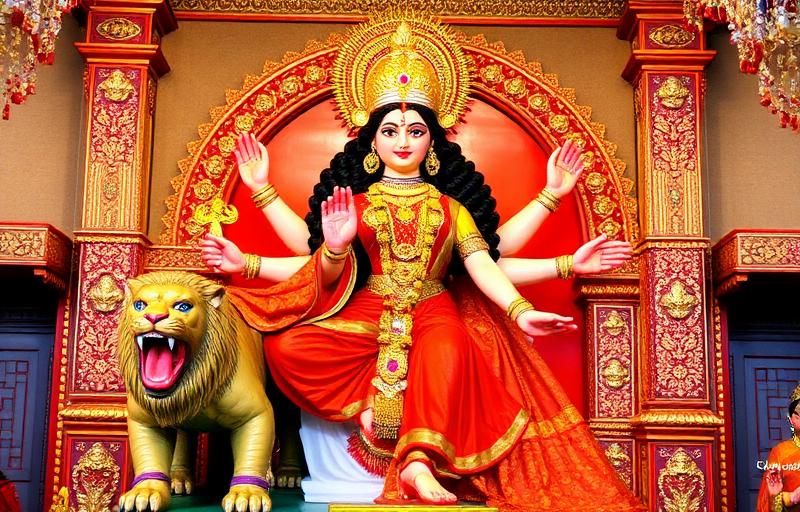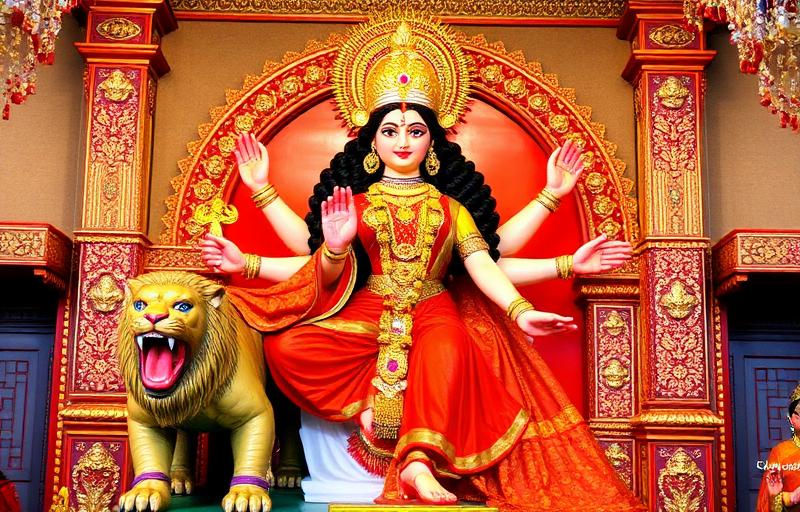
What Is the Durga Ashtottara Shatanamavali?
The Durga Ashtottara Shatanamavali is the traditional list of 108 names of Maa Durga. Ashtottara shata means 'one hundred and eight', and namavali means 'a garland of names'. Each name is usually chanted with the prefix Om and the ending namah, for example Om Durgayai Namah.
Every name reveals one aspect of the Goddess - her beauty, her power, her compassion, her victory over evil. To chant all 108 is to praise her completely, from the gentle mother to the fierce slayer of demons. The Shatanamavali is recited especially during Navratri, on Ashtami and Navami, and on any Tuesday or Friday dedicated to the Devi.
A Selection of the 108 Names (with Meaning)
Below are about 25 representative names from the full 108, with transliteration and a one-line meaning. This is a selection, not the complete list - the traditional Shatanamavali holds all 108 names in order.
1. दुर्गा (Durga) - she who removes difficulties 2. शिवा (Shiva) - the auspicious one, consort of Shiva 3. महालक्ष्मी (Mahalakshmi) - the great goddess of fortune 4. महागौरी (Mahagauri) - the radiant, fair one 5. चण्डी (Chandi) - the fierce one who destroys evil 6. सर्वमंगला (Sarvamangala) - the source of all auspiciousness 7. भवानी (Bhavani) - the giver of life, power of Bhava (Shiva) 8. अम्बिका (Ambika) - the divine mother 9. जगन्माता (Jaganmata) - mother of the universe 10. कात्यायनी (Katyayani) - daughter of sage Katyayana 11. कौमारी (Kaumari) - the ever-youthful 12. पार्वती (Parvati) - daughter of the mountain Himavan 13. दुर्गमा (Durgama) - hard to reach, the unconquerable 14. सत्ता (Satta) - pure being, existence itself 15. सत्यानन्दस्वरूपिणी (Satyanandasvarupini) - of the nature of truth and bliss 16. अनेकवर्णा (Anekavarna) - of many forms and colours 17. विद्या (Vidya) - the embodiment of knowledge 18. विष्णुमाया (Vishnumaya) - the divine power of Vishnu 19. त्रिनेत्रा (Trinetra) - the three-eyed one 20. शूलधारिणी (Shuladharini) - bearer of the trident 21. पिनाकधारिणी (Pinakadharini) - holder of the bow Pinaka 22. चन्द्रघण्टा (Chandraghanta) - she with the bell-shaped moon 23. महातपा (Mahatapa) - of great penance 24. कालरात्रि (Kalaratri) - the dark night that destroys all evil 25. भयविनाशिनी (Bhayavinashini) - destroyer of all fear
For the full and exact order of all 108 names, refer to a printed Durga Ashtottara Shatanamavali in the Vandnaa app or a trusted devotional source.
How to Chant the 108 Names (Jaap Vidhi)
1. Time: Early morning after a bath, or in the evening during the puja hour. Tuesday, Friday and Navratri days are especially powerful. 2. Seat: Sit facing east or north on a clean asan before an image of Maa Durga. Light a ghee or oil lamp and incense. 3. Sankalp: Offer red flowers, kumkum, akshat and water, and take a short sankalp of devotion. 4. Recite: Chant each name with the prefix Om and the suffix namah, offering a flower or akshat at each name if you wish. Move through all 108 in order. 5. Mala: Many use a 108-bead mala so that one full round equals the 108 names. 6. Close: End with the Durga aarti, a prayer for protection and peace, and distribute prasad.
Benefits of Chanting Durga's 108 Names
- Protection: The Devi is the supreme protector; her names are believed to shield the devotee from fear, negativity and harm.
- Courage and strength: Calling on the fierce forms (Chandi, Kalaratri) is said to grant inner courage in difficult times.
- Removal of obstacles: Durga means the remover of difficulties; her names invoke help in crisis.
- Peace and devotion: The gentle names (Shiva, Mahagauri, Sarvamangala) bring calm, purity and a steady, loving heart.
- Spiritual merit: Reciting the full 108 with faith during Navratri is considered highly auspicious for the whole family.
More than the result, the practice itself is the blessing - holding the Mother's many names on the tongue keeps the heart turned toward her grace.
Quick Answers
What is the Durga Ashtottara Shatanamavali?+
It is the traditional list of 108 sacred names of Maa Durga, each describing one of her forms or powers. The names are usually chanted with the prefix Om and the suffix namah, for example Om Durgayai Namah.
When is the best time to chant the 108 names?+
Early morning after a bath or during evening puja is ideal. Tuesday, Friday and the nine days of Navratri - especially Ashtami and Navami - are considered the most powerful days.
Do I need a mala to chant the names?+
A mala is helpful but not mandatory. A 108-bead mala lets one full round equal the 108 names. If you do not have one, you can simply recite all 108 names in order with devotion.
Is this the same as the Durga Saptashati?+
No. The Ashtottara Shatanamavali is a garland of 108 names of the Goddess. The Durga Saptashati (Chandi Path) is a larger scripture of 700 verses telling the story of her victory over demons. Both are recited in her worship.
About the author
Acharya Vinaya Kapoor · M.A. Sanskrit, Mantra & Stotra Studies
Acharya Vinaya holds an M.A. in Sanskrit from Banaras Hindu University and writes the mantra and stotra commentary on Vandnaa. Her focus is on accurate pronunciation, traditional context, and helping modern readers connect with classical texts.
Meet the Vandnaa editorial team →