Why No Single God Could Do It Alone
The scene comes from the Devi Mahatmya, the section of the Markandeya Purana that is the foundational text of Devi worship and the text most commonly recited during Navaratri and Durga Puja, and it opens with a problem the assembled gods cannot solve individually.
Mahishasura, the buffalo demon, had won a boon from Brahma making him unkillable by any man or god - a boon he had, like Hiranyakashipu and other demons who secure similar protections, assumed made him effectively invincible, since it did not occur to him that a boon phrased in those specific terms could still leave a female power outside its coverage entirely.
Having driven the devas out of heaven and taken Indra's own throne, Mahishasura left the gods with no individual champion capable of ending him. Their response was not to keep searching for one more powerful god, but to combine their fury into a single concentrated light: the text describes each god's anger and energy pouring out and merging into one blazing mass, from which Devi's form takes shape, built from the combined tejas, radiance, of the entire assembly rather than born in the ordinary way.
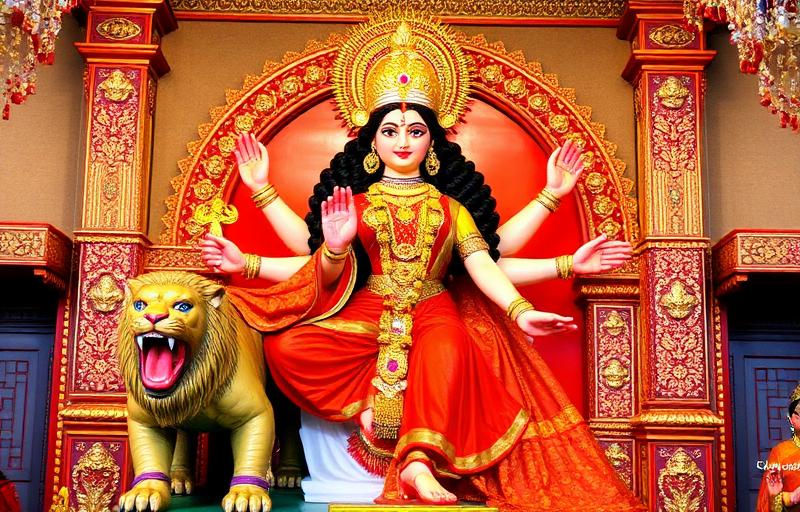
Her many arms, in this account, are not a stylistic flourish; they are the direct narrative consequence of the assembly's decision. A being formed from every god's combined power needed enough hands to actually hold what each of them was about to give her.
The Gift-Giving Itself
The Devi Mahatmya then describes each god presenting a specific weapon or object, and while later retellings and regional traditions vary slightly in the exact assignment, the core list has remained remarkably stable across centuries of recitation.
Shiva gave his trishul, the trident. Vishnu gave his Sudarshana Chakra. Varuna gave a conch shell and a noose, pasha. Agni gave a shakti weapon, a spear-like dart associated with fire. Vayu gave a bow and a quiver of arrows that would never run empty. Indra gave his vajra, the thunderbolt, along with a bell taken from his own elephant Airavata. Yama gave his danda, the staff associated with death and judgement. Kubera gave a mace, the gada. Brahma gave a kamandalu, a water vessel, and an akshamala, a rosary of beads, marking her connection to knowledge and austerity alongside war. Surya, the sun, gave his own rays, becoming a source of the radiance that surrounds her in every image. Kala, time itself, gave a sword and a shield. And Himavan, the mountain that is Parvati's own father in other stories, gave her a lion to ride, along with jewels for adornment.
What is notable in the text's own telling is that this is not framed as gods equipping a weaker ally for a fight they expect her to struggle through. It is framed as a recognition that her power already exceeded theirs individually and that the weapons were simply being returned to a form capable of using all of them at once, the way a set of separate instruments finally find the one musician able to play every one of them simultaneously.
Quick Answers
Why couldn't Mahishasura's boon protect him from Durga?+
His boon from Brahma specifically made him unkillable by any man or god - phrased in strictly male terms, since he could not conceive of a threat outside that category, which left a goddess entirely outside its protection.
Are all ten weapons always shown in every Durga idol?+
Most traditional ten-armed Mahishasura Mardini images follow the Devi Mahatmya's list closely, though regional and artistic variation means the exact object in a given hand can differ slightly from image to image, particularly outside the major Bengal Durga Puja tradition.
Which text is this story from?+
The Devi Mahatmya, a section of the Markandeya Purana, also known as the Durga Saptashati or Chandi Path - it is the central text recited during Navaratri and Durga Puja.
Did Durga exist before this episode, or was she created for it?+
The Devi Mahatmya presents this particular form, born from the combined tejas of the assembled gods, as arising specifically for this crisis, though the broader tradition also holds Devi as the eternal, uncreated source of all divine power, present before and independent of any single episode.
About the author
Pandit Mahesh Trivedi · Festival Traditions & Panchang
Pandit Mahesh leads the festival-date and Panchang content on Vandnaa. He cross-references multiple regional panchangs (Drik, Vaishnava, Bengali, Marathi) for every festival date published on the site.
Meet the Vandnaa editorial team →