A Word Said in Front of Others
This account of how Parvati came to be called Gauri, the fair or golden one, is found across several Puranic sources, most consistently in the Shiva Purana and the Devi Bhagavata Purana, and both versions keep the same basic shape even where the surrounding detail differs.
Parvati, in her original form as Sati's rebirth as Himavan's daughter, had a dark complexion, and the texts are direct about this rather than treating it as an incidental fact: her name in this earlier phase is often given as Kali or Shyama, the dark one, well before the fierce goddess most readers now associate with that name comes into the story separately.
One day, in company, Shiva referred to her using that description, calling her Kali in a way the texts treat as careless rather than deliberately cruel, more a habit of address than an insult meant to wound. Parvati did not respond in anger and did not argue the point in front of others. She said nothing at all in the moment.
But she took the remark as a genuine injury, and rather than ask Shiva to stop using the word, she decided the more direct answer was to change the fact itself. She left for the forest to undertake tapasya specifically for this purpose: not enlightenment, not a boon of any general kind, but a change to her own body.
The Penance and Brahma's Boon
The tapasya she undertook is described in terms consistent with the other great penances in the Puranas: extended fasting, exposure to the elements without shelter, and a fixed, unbroken concentration that eventually draws the attention of Brahma, since austerity of this intensity is understood to generate a heat that the universe itself has to answer.
Brahma appeared before her and asked what boon she wanted. She asked for a golden, radiant complexion in place of the dark one, specifically so that the word Shiva had used would simply cease to apply.
Brahma granted it. And in the more detailed tellings, particularly in the Devi Bhagavata Purana, the granting of the boon is handled carefully: the dark form she sheds is not destroyed or discarded as something shameful, but becomes a separate, independently powerful goddess in her own right, later identified with Kaushiki, and eventually with the fierce goddess Kali proper, who goes on to have her own distinct battles and her own worship.
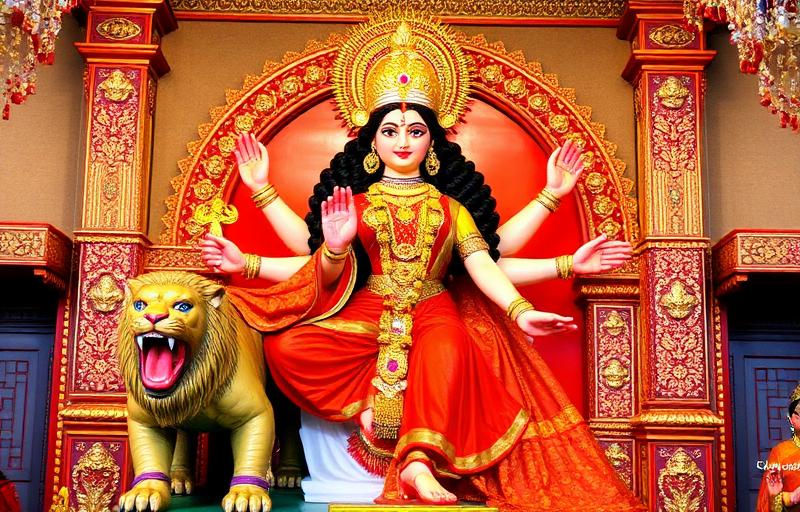
Parvati returned to Kailash with her new golden radiance, and it is from this point forward in the mythology that Gauri becomes one of her standing names, used specifically for her benign, auspicious, married aspect, distinct from both the young ascetic Parvati who did the penance and the dark Kali who emerged from what she left behind.
Two Names for One Goddess
The reason this story matters beyond its immediate plot is what it implies about how the tradition holds Devi's many names and forms together. Gauri and Kali are not presented as rivals or as a hierarchy of a gentler goddess above a fiercer one; they are the same being before and after a single episode, and the fierce form is not lesser for having been the one Parvati wanted to change.
Gauri Puja, observed in various regional forms including as part of Navaratri and, in Karnataka and Maharashtra, as Gauri Habba before Ganesh Chaturthi, invokes her specifically in this benign, married, prosperity-bringing aspect - the goddess who returns home, in the Ganesh festival's own household framing, as a daughter visiting her parents, which draws directly on the domestic, restorative tone of the Gauri story rather than on Kali's battlefield episodes.
Haldi, turmeric, used ritually across Hindu weddings and applied to brides specifically for its golden colour, is frequently connected in popular practice to this same idea of Gauri's complexion, though the textual link is looser than the Puranic penance story itself; what the tradition preserves clearly is the underlying association between the colour gold, the name Gauri, and married auspiciousness.
For a reader encountering this story for the first time, the useful thing to notice is what it refuses to do: it does not resolve Shiva's remark by having him apologise, and it does not make Kali's later, separate, considerably fiercer career a punishment or a demotion. It simply treats both forms as fully real and fully hers.
What People Ask Most
Was Shiva being deliberately cruel when he called Parvati Kali?+
The Puranic accounts generally present it as a careless remark rather than a deliberate insult, more a matter of habitual description said without thinking than an attack meant to wound - which is part of why Parvati's response is to act rather than to confront him.
Is the dark form Parvati sheds the same as the goddess Kali worshipped today?+
Different Puranas handle the connection differently, but the most common thread identifies it, eventually, with Kaushiki and then with the fierce goddess Kali who has her own major independent battles - the texts treat this as a real lineage rather than a coincidence of shared naming.
What is Gauri Habba?+
A festival, most prominently observed in Karnataka and among Marathi households, held just before Ganesh Chaturthi, welcoming Gauri (Parvati) home as a visiting daughter before her son Ganesha's own arrival is celebrated.
Does this story mean dark complexion was originally treated as inferior in the tradition?+
The story reflects a colourism embedded in the specific narrative rather than a single fixed doctrine - the tradition simultaneously reveres Kali, Krishna and other unambiguously dark-complexioned deities as supreme, so this particular Parvati episode is best read as one story among many rather than the tradition's whole position on the subject.
About the author
Anjali Mehta · Editor, M.A. Religious Studies
Anjali is the managing editor for Vandnaa and oversees the festival and vrat coverage. She holds an M.A. in Religious Studies and reviews every published article for accuracy, accessibility, and tradition-fidelity.
Meet the Vandnaa editorial team →