A Yajna for a Son, and a Daughter Instead
The story is told in the Halasya Mahatmya, a section of the Skanda Purana devoted to Madurai, and in the later Tamil retelling known as the Tiruvilaiyadal Puranam.
The Pandya king Malayadhwaja and his queen Kanchanamalai had no heir. They performed a putrakameshti yajna, the same class of fire sacrifice that gives Dasharatha his sons in the Ramayana, asking specifically for a son who could carry the kingdom after them.
What rose from the sacrificial fire was a girl. Not an infant either: the texts describe a three-year-old child, already formed, already fierce, and already unusual in one specific way. She had three breasts.
A voice from the sky, usually identified as Shiva's own, told the stunned king not to be afraid and not to abandon the child. Raise her as your heir, the voice said. The third breast will vanish the moment she meets the man she is destined to marry, and you will know him when it happens.
The king did as he was told. He named her Tadatakai, and raised her not as a hidden anomaly but as the crown princess of Madurai, trained in statecraft and in war.
When Malayadhwaja died, she took the throne and did exactly what a Pandya king was expected to do: she expanded the kingdom. She marched her armies through the eight directions in a digvijaya, a full circuit of conquest, defeating king after king with the third breast still there, still unremarked on by anyone who valued their life.
The conquest eventually took her north, toward the Himalayas, into the territory the Puranas treat as Shiva's own ground.
The Battle That Turned Into a Wedding
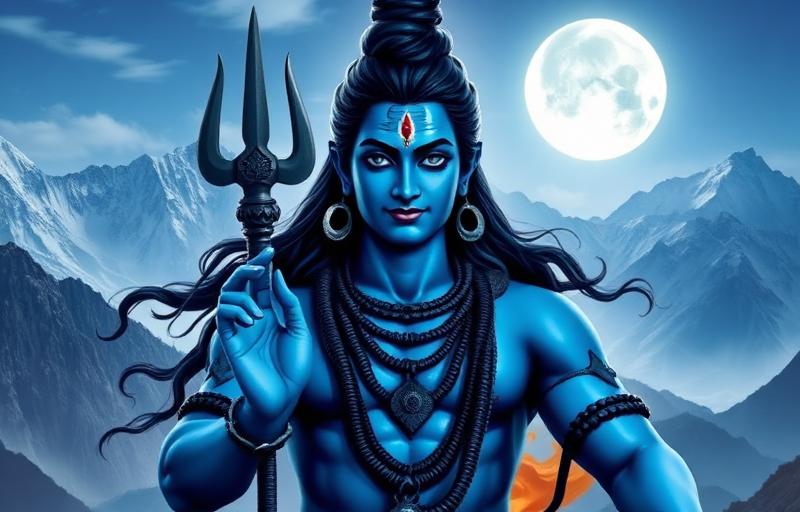
Tadatakai reached Mount Kailash and, following the same pattern that had worked in every other kingdom, challenged its ruler to battle. Shiva's attendants tried to stop her. She defeated them one by one.
Then Shiva himself came out to face her.
And the moment she raised her eyes to look at him, the third breast disappeared. She fell silent, overcome with a shyness that no army had ever produced in her, and understood at once what the voice at her birth had meant.
Shiva recognised her too, as an incarnation of Parvati herself, and told her to return to Madurai: he would come there to marry her formally, with her father's court and her people as witnesses, rather than claim her on a battlefield in the mountains.
The wedding at Madurai is, in the Tamil tradition, treated as an event of cosmic scale. Vishnu, described in this telling as Meenakshi's own brother, travels from Vaikuntha to give the bride away, arriving at nearby Alagar Kovil for the ceremony - which is why the Chithirai festival in Madurai still enacts, every year, Vishnu's journey to attend his sister's wedding to Shiva, now worshipped in this city as Sundareswarar.
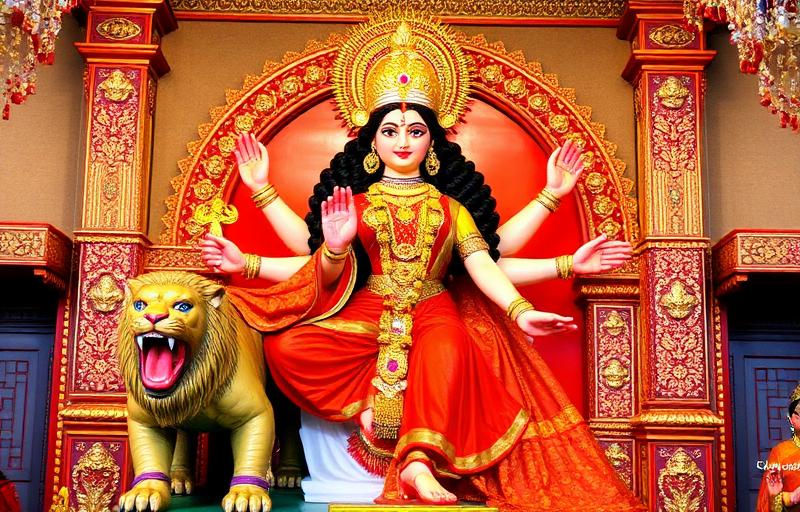
The name Meenakshi itself, meaning fish-eyed, refers to the particular shape prized in Tamil poetic convention as the most beautiful form a woman's eyes can take, and it becomes her enduring name once she is established as queen and goddess of Madurai together, ruling the city in her own right rather than only as consort.
The temple that stands in Madurai today, one of the largest functioning temple complexes in India, keeps Meenakshi as the primary deity, with Sundareswarar worshipped beside her, not above her; the daily ritual calendar still moves Shiva's image to her shrine each night, a small, repeated act of a marriage that the myth insists was always framed as her choice, made on her own ground, after her own conquest.
A Goddess Who Rules, Not Just Marries
What makes the Meenakshi story unusual among Devi narratives is the order of events. Most goddess-marries-Shiva stories, including Parvati's own long penance to win him, place the courtship first and any independent authority second. Meenakshi rules a kingdom, wins a war, and only then meets her husband, on ground she has already conquered and as a peer he has to formally recognise rather than a bride he goes searching for.
The Madurai Meenakshi Temple keeps that order visible in its ritual life. Meenakshi is not an attendant deity in her own complex; she is the primary sanctum, with her own separate shrine, her own priests, and her own daily processions, and Sundareswarar's nightly visit to her chamber is staged, deliberately, as a husband going to his wife rather than the reverse.
The Chithirai festival each April-May, one of the largest annual gatherings in Tamil Nadu, restages both halves of the story at civic scale: Meenakshi's coronation as queen on one day, and her wedding to Sundareswarar, with Vishnu arriving as her brother to conduct the ceremony, on another - the whole city functioning, for those weeks, as an extension of the temple's own narrative.
For a devotional reader, the useful thing to hold onto is that Tamil Shaivism has, in Meenakshi, a goddess whose divinity is not defined by her marriage. The third breast disappearing is not her losing something on meeting Shiva; it is the myth's own way of marking that the warrior-queen and the goddess were the same being all along, and that recognising her husband changed nothing about her rule.
Frequently Asked Questions
Is Meenakshi considered an incarnation of Parvati?+
Yes. The Halasya Mahatmya frames her birth as Parvati choosing to take form as the Pandya king's daughter, which is also why her recognition of Shiva at Kailash is instant rather than gradual.
Why does Vishnu give Meenakshi away at her wedding?+
The Tamil tradition holds that Meenakshi and Vishnu, in this telling worshipped as Alagar at the nearby Alagar Kovil, are siblings, and his journey to Madurai to conduct her wedding is reenacted every year during the Chithirai festival.
Does the Meenakshi Temple worship her above Shiva?+
Not above, but as an equal primary deity rather than a subordinate consort - she has her own separate sanctum, her own priesthood, and Sundareswarar's nightly procession to her chamber is deliberately staged as a husband visiting his wife.
Where is this story found in the original texts?+
Primarily in the Halasya Mahatmya section of the Skanda Purana, with the fuller, more elaborate Tamil retelling appearing later in the Tiruvilaiyadal Puranam, which is the source most Madurai temple traditions draw on today.
About the author
Anjali Mehta · Editor, M.A. Religious Studies
Anjali is the managing editor for Vandnaa and oversees the festival and vrat coverage. She holds an M.A. in Religious Studies and reviews every published article for accuracy, accessibility, and tradition-fidelity.
Meet the Vandnaa editorial team →