Why Ganeshotsav Spans 10 Different Days
Many people know Ganesh Chaturthi as a single-day event, install the idol, celebrate, immerse it. But for a very large number of households, especially in Maharashtra, Goa, Karnataka and parts of Andhra Pradesh and Telangana, the festival, known as Ganeshotsav, actually unfolds over a full ten days, ending on Anant Chaturdashi.
Why ten days specifically: Tradition holds that Lord Ganesha stayed among his devotees for ten days before returning to Mount Kailash, and households that choose the full ten-day observance are, symbolically, hosting him as an honoured guest for that entire period, not just a single evening.
Not every household does all ten days: It's worth knowing upfront that one-and-a-half day (Dedh Din), five-day, and seven-day observances are equally traditional and common, particularly for home installations where a small clay idol is immersed sooner. The full ten-day period is more commonly associated with larger sarvajanik (public) mandal installations and families with a long-standing ten-day tradition. Neither duration is more devout than the other; the length is a matter of family custom, idol type, and practical considerations like apartment space.
For 2026 specifically: With Ganesh Chaturthi falling on Monday, 14 September, the full ten-day observance runs from 14 September through Anant Chaturdashi on 23 September 2026.
What follows is a realistic look at how each phase of these ten days typically unfolds for a household that keeps the idol the full duration, useful whether you're planning your own first ten-day Ganeshotsav or simply curious what changes day to day beyond the two bookend events everyone already knows about.
Day 1 (14 September): Sthapana Day
Day 1 - Monday, 14 September 2026
The first day is, understandably, the most ritually elaborate, centred entirely on sthapana (idol installation), but here is how it fits into the broader ten-day arc.
Morning: Final cleaning of the home and puja area, last-minute decoration touches (flowers, lights, rangoli), and preparing the platform (chowki) where the idol will sit for the duration of the festival. Many households also finalise the daily puja roster on this morning, deciding who among the family will lead the aarti each day for the rest of the festival.
Madhyahna kaal (midday): The idol is formally installed and invoked through pran pratishtha, followed by the first full shodashopachara puja and aarti.
Evening: Many households host their first round of visitors, family and neighbours who come for darshan on installation day itself, often with a simple prasad distribution.
Who typically leads Day 1: For home installations, an elder family member or the household's regular puja-performer usually leads the sthapana, sometimes assisted by a purohit for the pran pratishtha mantras specifically. For sarvajanik mandals, a designated priest handles the full ceremony while committee members manage the surrounding logistics, decoration and crowd flow.
What makes Day 1 different from Days 2-9: This is the only day involving pran pratishtha (life-invocation) mantras. From Day 2 onward, the puja shifts to a daily maintenance rhythm, morning and evening aarti, fresh offerings, rather than repeating the installation ceremony.
A practical note for Day 1: Because this day involves the most steps, guests, and ritual complexity, many families deliberately keep the evening simple, a light dinner and early rest, rather than planning any additional events, saving the more social, festive evenings for the middle days of the ten-day period when the routine has settled and there's more energy for visitors and celebration.
Days 2-5: Settling Into the Daily Puja Rhythm
Days 2-5 (15-18 September)
Once the installation excitement settles, the festival moves into its most repetitive, and in many ways most peaceful, phase: a consistent daily rhythm that most households can sustain without exhaustion.
Morning aarti: Typically performed after bathing, before breakfast, involving a shortened puja compared to Day 1, cleaning the platform area, offering fresh flowers, lighting incense and a diya, and singing the Ganesh aarti ("Sukhkarta Dukhharta" is especially popular in Maharashtra).
Daily modak or sweet offering: While Day 1 often features the fullest spread, most households continue offering at least modak, or another sweet, along with fruit, on each of these middle days, since Ganesha is rarely worshipped without some form of sweet prasad.
Evening aarti: A second, shorter aarti session in the evening, often when family members return home from work or school, sometimes accompanied by visiting neighbours doing the rounds of multiple household installations in the area.
Durva grass replenishment: Fresh durva grass (considered one of Ganesha's most beloved offerings, alongside modak) is commonly refreshed every day or two, since it wilts quickly.
Community and mandal activity intensifies: For public installations (sarvajanik mandals), these middle days often feature cultural programs, bhajan sandhyas (evening devotional singing), and community events, since the pressure of Day 1 logistics has passed but Day 10's immersion planning hasn't yet begun.
A quieter, steadier devotional mood: Many long-time observers describe these middle days as the most personally meaningful part of Ganeshotsav, without the frantic energy of installation day or the emotional weight of visarjan, just a quiet daily practice of caring for the deity's presence in the home.
Days 6-8: Midpoint Traditions and Community Energy

Days 6-8 (19-21 September)
The middle-to-late stretch of Ganeshotsav often brings a noticeable rise in community energy, as neighbourhoods and mandals build toward the festival's final days.
Rishi Panchami observance: Some communities, particularly in Maharashtra, observe Rishi Panchami rituals honouring the Saptarishi (seven sages) around this period depending on the specific calendar overlap, adding another layer of ritual for especially observant households.
Peak visiting season: By these days, word has spread about which homes and mandals have installations, and this window typically sees the highest number of visitors coming for darshan, particularly on weekends that fall within this range.
Cultural programs intensify: For sarvajanik mandals, days 6-8 often host the most elaborate cultural events, dance performances, music competitions, and community feasts (bhandaras), since organizers have had time to plan while there's still enough of the festival left to justify a big event.
Decoration touch-ups: Flowers and light decorations from Day 1 often need refreshing by this point; many households and mandals do a mid-festival decoration refresh, replacing wilted garlands and re-arranging the display for the final stretch of visitors.
Preparing mentally for visarjan: For households doing the full ten days, this period often carries a quiet awareness that the immersion is approaching, prompting some families to spend a little more unhurried time in prayer or simply sitting with the idol in the evenings, a subtle shift in mood compared to the brisker energy of days 2-5.
This phase is where Ganeshotsav's community character is most visible, distinctly different from the more private, family-focused rhythm of the early middle days.
Day 9 (22 September): Final Preparations Before Visarjan
Day 9 - Tuesday, 22 September 2026
The second-to-last day carries a distinct emotional shift for many households, the quiet realisation that tomorrow brings visarjan, and the practical preparations for it begin in earnest.
Final elaborate puja: Many families perform a slightly more elaborate puja on Day 9 compared to the routine of days 2-8, treating it as a meaningful "last full day" with the idol, sometimes including a special bhog spread closer in scale to Day 1's offerings.
Visarjan logistics planning: This is when most households finalise practical details for the next day: which immersion site or designated artificial pond (in cities that have moved toward eco-friendly immersion infrastructure), what time the procession will leave, who will be joining, and what transport is needed for larger idols.
Gathering visarjan materials: Fresh flowers, a final garland, and any items for the farewell puja are typically procured on Day 9, since shops catering to Ganeshotsav needs are often busiest and best-stocked in the day or two immediately before Anant Chaturdashi.
Extended family gatherings: For many households, Day 9 evening is when extended family who couldn't visit earlier make a point of coming for a final darshan before the idol is immersed, making it one of the more socially significant evenings of the entire ten-day period.
Emotional preparation: It's common, and completely normal, for both children and adults to feel a mix of anticipation and mild sadness on Day 9, especially in households where the idol has become a genuine daily presence over the preceding week.
Day 10 (23 September): Anant Chaturdashi and Visarjan
Day 10 - Wednesday, 23 September 2026 (Anant Chaturdashi)
The final day of Ganeshotsav is both a celebration and a farewell, and its structure differs noticeably from every day that came before it.
Morning farewell puja: A final, elaborate puja is performed, often more emotionally weighted than any day since installation, including a full aarti, a generous final bhog offering, and often a small ceremony asking Ganesha's forgiveness for any errors made during the festival, a customary part of the visarjan ritual.
"Ganpati Bappa Morya, Pudhchya Varshi Lavkar Ya": This chant, meaning "Father Ganesha, come again soon next year," becomes the dominant sound of the day, echoing through streets and processions as families and communities move idols toward immersion sites.
The visarjan procession: For home idols, this can be a simple family walk to a nearby water body or designated immersion tank. For sarvajanik mandals, it often becomes a large, music-filled procession with dancing, drumming and thousands of participants, particularly dramatic in cities like Mumbai and Pune.
Immersion itself: The idol is gently immersed in water, traditionally symbolising Ganesha's return journey to Mount Kailash and the broader cycle of creation dissolving back into its source.
After immersion: Many families return home to a quieter evening, sometimes marked by a simple meal together reflecting on the ten days just completed, and a sense that the house feels different, notably emptier, without the idol's daily presence.
For households and mandals alike, Anant Chaturdashi closes the loop that began with sthapana ten days earlier, transforming what started as a ritual installation into a genuine, lived experience of hosting and bidding farewell to a beloved guest.
🎊 Track every day of your Ganeshotsav with daily puja reminders in the Vandnaa app.
Frequently Asked Questions
Does everyone celebrate Ganesh Chaturthi for all 10 days?+
No. One-and-a-half day, three-day, five-day and seven-day observances are equally traditional and very common, especially for smaller home idols. The full ten-day period is more associated with larger public (sarvajanik) mandal installations and families with a specific long-standing ten-day tradition. The duration is a matter of family or community custom, not religious obligation.
What is the main difference between Day 1 puja and the daily puja on Days 2-9?+
Day 1 uniquely includes pran pratishtha, the invocation ritual that formally installs the deity's presence in the idol, along with a full shodashopachara (16-step) puja. From Day 2 onward, the routine shifts to simpler morning and evening aartis, fresh flower and modak offerings, without repeating the installation mantras.
When is visarjan for Ganesh Chaturthi 2026 if observing the full 10 days?+
For households and mandals observing the complete ten-day Ganeshotsav starting 14 September 2026, visarjan takes place on Anant Chaturdashi, Wednesday, 23 September 2026.
What should be offered to Ganesha every single day during the ten days?+
At minimum, fresh flowers, durva grass (which wilts quickly and needs regular replenishing), and some form of sweet offering, ideally modak, along with morning and evening aarti. Households short on time can keep this simple and consistent rather than attempting an elaborate spread every single day.
Is it disrespectful to do a shorter observance, like 1.5 or 3 days, instead of the full 10?+
Not at all. Shorter durations are equally traditional and widely practised across India. What matters is the sincerity of the puja during whatever period is observed, not the number of days. Many families choose shorter durations for entirely practical reasons, like limited space or work schedules, without any reduction in devotion.
Do the mid-festival days (6-8) have any special rituals beyond the daily aarti?+
These days often see the highest number of visitors and, for public mandals, the most elaborate cultural programs and community feasts (bhandaras). Some communities also observe Rishi Panchami-related rituals around this period. For home pujas, though, the core daily aarti and offering routine generally continues without major additions.
About the author
Pandit Mahesh Trivedi · Festival Traditions & Panchang
Pandit Mahesh leads the festival-date and Panchang content on Vandnaa. He cross-references multiple regional panchangs (Drik, Vaishnava, Bengali, Marathi) for every festival date published on the site.
Meet the Vandnaa editorial team →Explore on Vandnaa
Related Articles
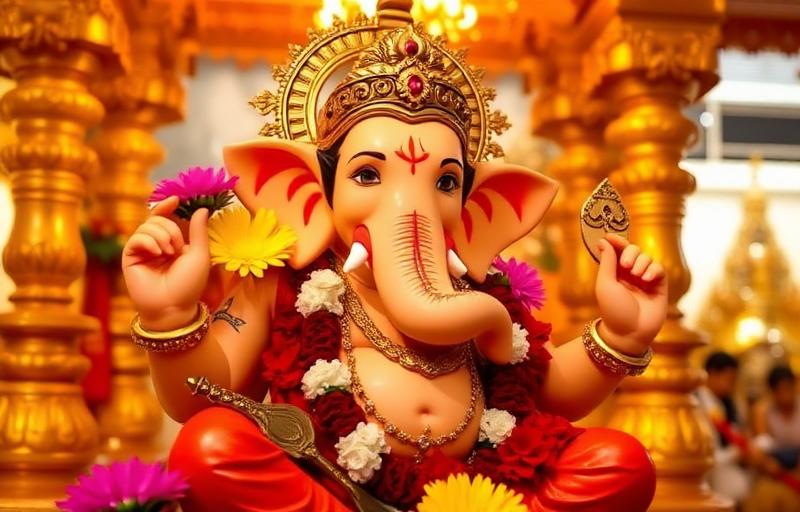
Ganesh Chaturthi 2026: The Exact Sthapana Muhurat for Your City
7 min read
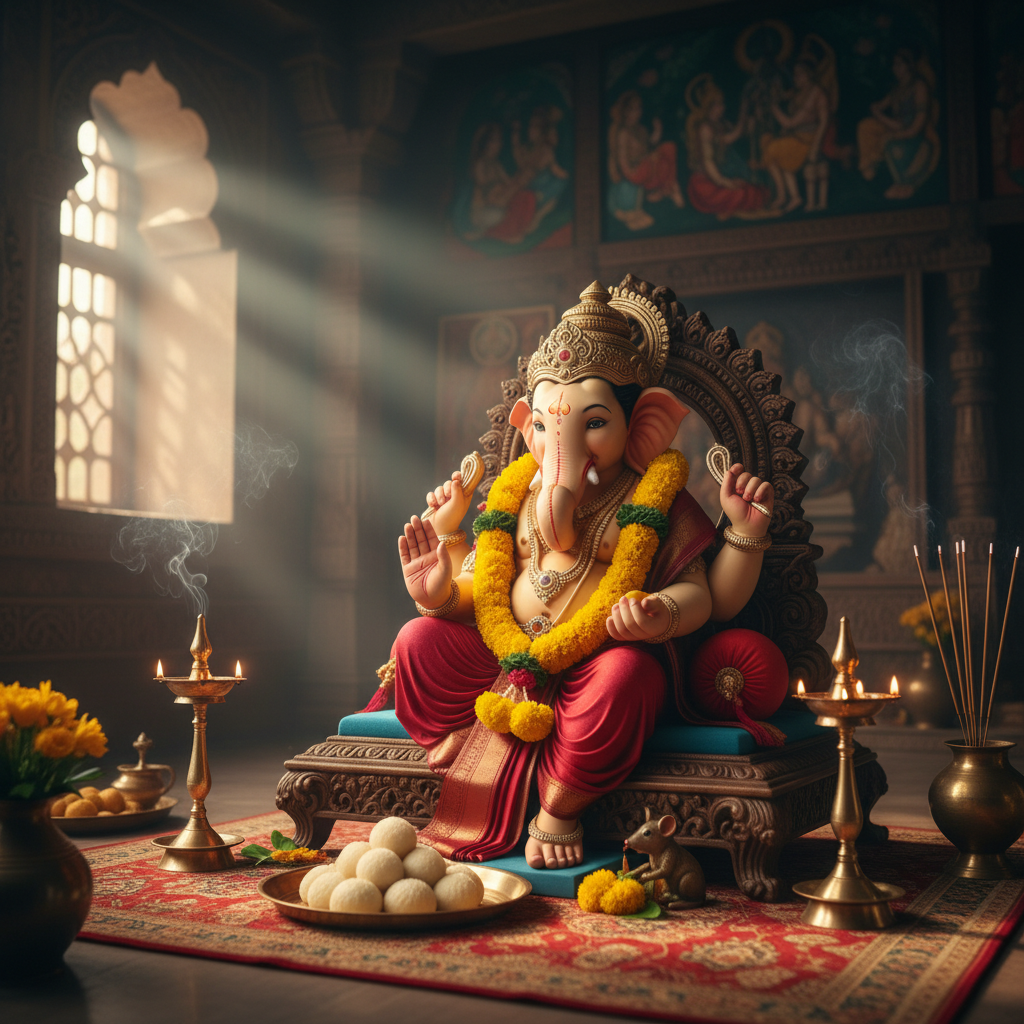
Eco-Friendly Ganesh Idols for 2026: What to Look for and Where to Find Them
7 min read
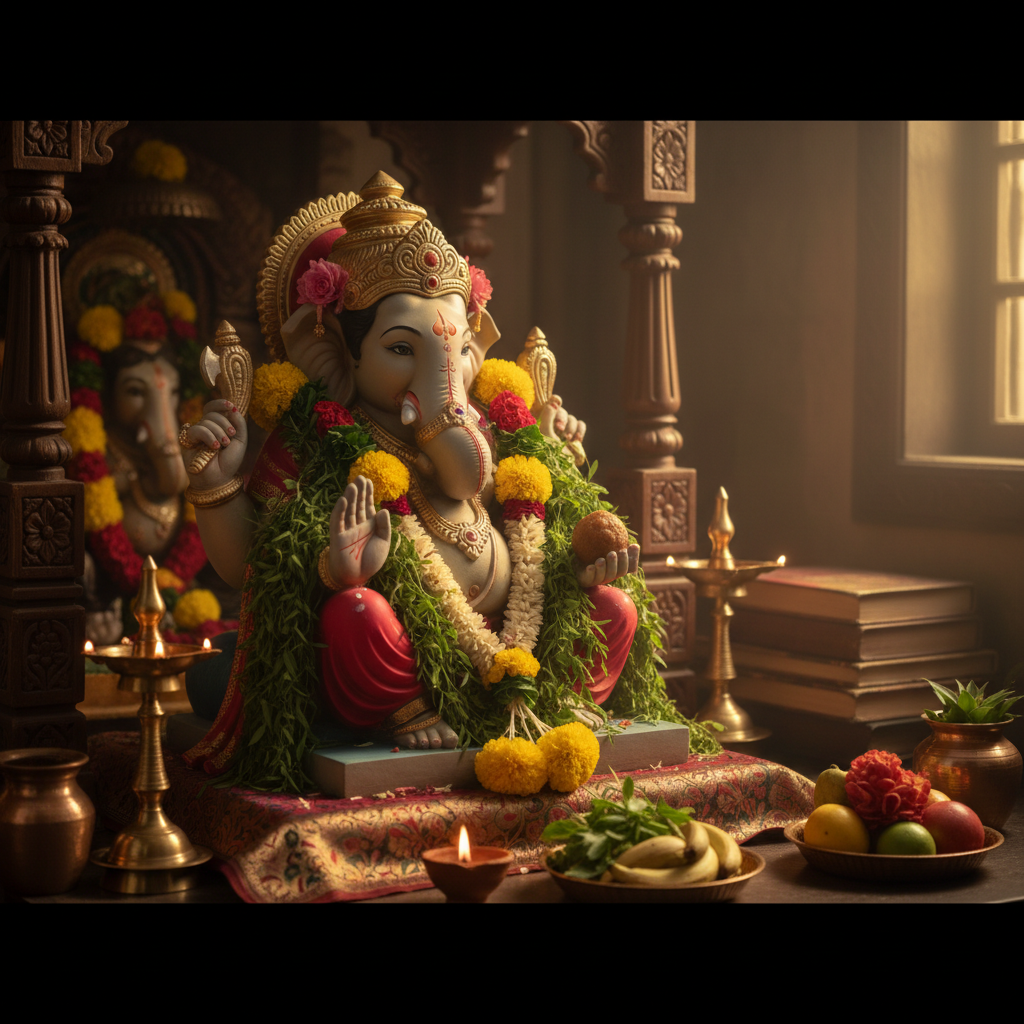
Ganesh Visarjan: The Tradition and Meaning Behind Bidding Farewell to Ganesha
6 min read
Ganesh Chalisa Lyrics & Meaning in Hindi (गणेश चालीसा)
9 min read