A Curse, a Boon and a Windborne Birth
Hanuman's mother Anjana was, in most Puranic accounts, an apsara named Punjikasthala who had been cursed to be born on earth as a vanara, a monkey woman, for offending a sage, with the condition that the curse would lift once she bore a son. She married the vanara chief Kesari and undertook long penance to Shiva for a child.
Her son's conception is tied by several Puranas to the same episode that produces Rama and his brothers: when Dasharatha performs the Putrakameshti yajna and receives the divine payasam to give his queens, a portion is, in some versions, carried off by a kite and dropped where Anjana is doing her own penance, or alternately Vayu, the wind god, delivers a share of it to her directly as his own contribution to the child, which is why Hanuman is also called Vayuputra, son of the wind, alongside being Anjana's son.
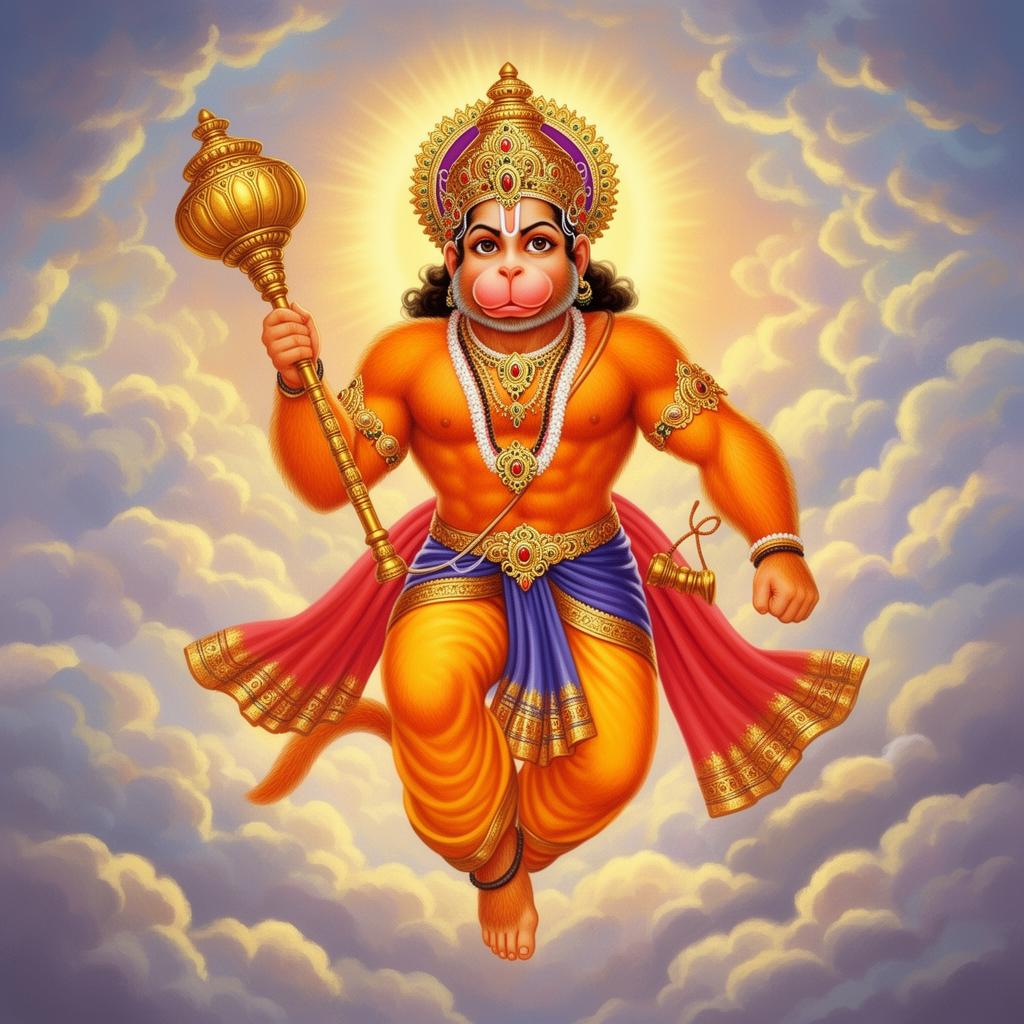
The result is a child born with genuinely unusual capability from birth, strength, the ability to change size, and a connection to the wind that made him fast and light in a way ordinary vanaras were not, all present before he had done anything to earn them, purely as a consequence of who his parents were.
The Infant Who Leapt at the Sun
The story most associated with his infancy comes largely from later texts like the Skanda Purana and various regional Hanuman traditions rather than Valmiki directly, but it is told everywhere Hanuman is worshipped. As an infant, hungry and seeing the rising sun as a large, round, red fruit, Hanuman leapt into the sky to eat it. His natural strength, already vast, carried him far enough that he actually reached the sun, and Surya, recognising the child's innocence rather than any threat, did not resist him.
The leap coincided, in most tellings, with Rahu, the eclipse-demon, also approaching the sun to cause an eclipse, and Hanuman, mistaking Rahu for another fruit, attacked him instead, disrupting the eclipse and drawing Indra's attention. Indra, protecting Rahu, struck the infant Hanuman with his Vajra, the thunderbolt, hitting him on the jaw, hanu, which knocked him unconscious and is given by several traditions as the origin of his name, Hanuman, one with the marked jaw.
Vayu, furious at the injury to his son, withdrew air from the entire universe in retaliation, causing panic among the gods, and it was only after Brahma and other deities intervened, reviving the child and each granting him a boon, invulnerability to weapons, longevity, and mastery of strength and shapeshifting among them, that Vayu relented and breath returned to the worlds. This episode is what accounts for the extraordinary set of boons Hanuman carries into the Ramayana proper, granted collectively by the gods in infancy rather than earned individually later.
The Curse That Made Him Forget
Because the infant Hanuman continued to be genuinely dangerous through sheer excess of energy and mischief among the ashrams of the forest, disturbing sages at their rites, several accounts describe irritated rishis placing a further curse or restriction on him: that he would forget the full extent of his own strength and abilities until a moment came when someone reminded him of them.
This detail matters later in the Ramayana proper, since it explains a real narrative puzzle: why Hanuman, who is capable of leaping across the ocean to Lanka, needs Jambavan to remind him of his own powers before he attempts it, rather than simply knowing his own capacity all along. The forgetting is not written as a flaw but as a kind of humility built into him by design, so that his enormous strength stays paired with restraint until dharma specifically calls for it.
Hanuman Jayanti, observed across different regions on different dates depending on whether the local tradition follows his birth or the day he met Rama, commemorates this infancy, and several of its rituals, particularly the offering of sindoor and the retelling of the sun-leap, are drawn directly from this early material rather than from his later, more famous feats in Lanka.
Reader Questions Answered
Why is Hanuman called Vayuputra if Anjana was his mother?+
Different Puranas describe Vayu, the wind god, as delivering the divine payasam or otherwise directly contributing to Hanuman's conception alongside Anjana's own penance to Shiva, which is why he carries both an association with Shiva's own power and the title son of the wind.
Where does Hanuman's name actually come from?+
Several traditions trace it to hanu, meaning jaw, referring to the injury he received from Indra's Vajra when struck while chasing Rahu near the sun, an event from his infancy rather than his adult feats.
Why does Hanuman need to be reminded of his own strength later in the Ramayana?+
A curse placed on him in childhood by sages irritated by his mischief made him forget the extent of his own powers until reminded, which is why Jambavan has to recount his abilities to him before he attempts the leap across the ocean to Lanka.
About the author
Anjali Mehta · Editor, M.A. Religious Studies
Anjali is the managing editor for Vandnaa and oversees the festival and vrat coverage. She holds an M.A. in Religious Studies and reviews every published article for accuracy, accessibility, and tradition-fidelity.
Meet the Vandnaa editorial team →