The Temple at Haripad
The Subrahmanya Swamy temple at Haripad stands in Alappuzha district, Kerala, in the backwater country.
What is there:
- A large temple in the Kerala style, with a walled compound and a very large tank
- The deity Subrahmanya, shown with four arms, which is unusual
- A koothambalam and the full apparatus of a major Kerala temple
- Grounds large enough for the festival crowds the temple draws
Where it stands. Haripad is among the oldest and largest Subramanya temples in Kerala, and it is the principal one in the state.
Who the deity is. Subrahmanya is Kartikeya, the son of Shiva, called Murugan in Tamil and Skanda in Sanskrit.
The regional difference is worth stating. In Tamil Nadu, Murugan is arguably the most beloved deity in the state, with the six Arupadai Veedu shrines and an enormous devotional literature.
In Kerala, he is important but does not occupy that position, and the state's great temples are mostly of Shiva, Vishnu, Bhagavathy and Ayyappa. Haripad is therefore the exception, and it draws Subramanya devotees from across Kerala and beyond.
What it is known for. Thaipooyam, the festival in the Malayalam month of Makaram, and the kavadi carried to it.
The Image From the Water
The temple's origin story concerns an image recovered from water, which is one of the commonest ways an Indian shrine explains itself.
As it is told:
- Sages of the region were performing a yaga, a fire ritual, and sought the presence of Subrahmanya
- The image was found in a river pool in the region, recovered from the water
- It was brought to Haripad and installed, and the temple grew around it
- The image is regarded as swayambhu, self manifest rather than made
Why so many Indian deities come out of water. This is worth noticing because it is a very widespread pattern.
- Images are found in rivers, tanks, wells and the sea across India, and each finding becomes a shrine
- The Jagannath tradition at Puri involves a log found in the sea. Sanwaliya Seth in Rajasthan was buried and recovered. Charbhuja at Garhbor was hidden in water and brought out. Vithoba, Ranganatha and countless local deities have similar accounts
- Kerala in particular has a great many images found in water or in groves
What explains it:
- Images were concealed in water in periods of danger, and recovered later, and the accounts preserve real events
- Water is the medium of purification, so an image emerging from it arrives already pure
- A found image needs no human maker, which strengthens its claim considerably. Swayambhu outranks installed
- It removes the awkward question of who commissioned it and when
The four arms. Subrahmanya is normally shown with two arms, or with six in his Shanmukha form with six heads.
A four armed Subrahmanya is uncommon, and it is one of the things that marks the Haripad image as distinctive. As at Idagunji with its two armed standing Ganapati, an image that departs from the standard iconography usually indicates either an early form or a specific local tradition, preserved because continuous worship does not update its images.
Thaipooyam
The temple's great festival is Thaipooyam, and it is one of the major Murugan observances anywhere.
When it falls:
- On the Pooyam asterism, Pushya, in the Malayalam month of Makaram, which is Thai in Tamil
- Generally in January or February
- The same festival is Thaipusam in Tamil Nadu and in the Tamil diaspora
Where it is observed:
- Haripad and other Kerala Murugan temples
- Palani and the Murugan shrines of Tamil Nadu
- Batu Caves near Kuala Lumpur, where the observance is enormous and draws over a million people
- Singapore, Mauritius, South Africa, and wherever Tamil communities settled
What the festival marks. Accounts vary. One common understanding is that it commemorates the day Parvati gave Murugan the vel, the spear, with which he defeated Surapadman.
What happens at Haripad:
- Very large numbers of devotees arrive, many having walked
- Kavadi are carried to the temple in procession
- The temple's full festival apparatus operates, with elephants, percussion and processions
- The grounds and the surrounding roads fill
Why Murugan draws this kind of devotion. It is worth asking, since the intensity of Murugan observance is distinctive.
- He is a young deity, and the iconography emphasises it. He is approached as a son and as a youth rather than as a patriarch
- He is the deity of those who are struggling, and his devotees frequently come with something specific and difficult
- The relationship is direct and physical rather than mediated. His observances involve walking, carrying, fasting and bodily discipline more than they involve texts
- The vel, the spear, is a straightforward image of a problem being dealt with
That combination produces a devotion that shows itself in what people do with their bodies, which is why the kavadi exists.
The Kavadi
The kavadi is Murugan's characteristic offering, and it needs describing accurately.
What it is:
- A burden carried on the shoulders, in its basic form a pole with a weight at each end
- The simplest is the pal kavadi, carrying pots of milk for the abhishek
- Elaborate forms have a decorated arched frame, with peacock feathers, carried on the shoulders
- The devotee carries it in procession to the temple, often over a considerable distance
- The carrying is accompanied by drumming and chanting
The katha behind it. The origin is attached to Idumban.
- The sage Agastya asked his disciple Idumban to carry two hills, Sivagiri and Sakthigiri, to the south
- Idumban carried them slung on a pole across his shoulders
- He set them down at Palani to rest, and afterwards could not lift one of them
- Murugan was standing on it, as a boy
- Idumban challenged him, was defeated, and then recognised him and became his devotee
- Murugan granted that anyone who came to him carrying a burden on their shoulders in this manner would receive what they asked for
What the practice means. The kavadi is one of the clearest examples in Indian religion of an offering whose whole value is the difficulty.
- You cannot buy it. You have to carry it
- The heavier and further, the greater the offering is understood to be
- The devotee arrives exhausted, and that is the point
On the more extreme forms. In some traditions, particularly in Tamil Nadu, Malaysia and Singapore, kavadi observance includes piercing, with skewers through the cheeks and tongue and hooks in the skin.
That needs stating plainly rather than avoided, and so does the practical position:
- Practices vary enormously by region and temple, and many kavadi observances involve no piercing at all
- Where it is done, it is done after preparation, including fasting and abstinence for a period beforehand, which practitioners regard as essential
- There are real medical risks, principally infection and bloodborne transmission from shared or unsterile implements
- If anyone is undertaking this, sterile single use equipment, clean hands, and a tetanus vaccination that is up to date are basic requirements, and a doctor should be consulted, especially by anyone with diabetes, a bleeding disorder or on blood thinners
- Nobody should be pressured into it, and the tradition does not require it
The milk pot carried barefoot for twenty kilometres is a complete kavadi. It always has been.
How Kerala Temples Work
Kerala's temple tradition differs from the rest of India in ways a visitor notices immediately, and they are worth setting out.
The architecture:
- The sreekovil, the sanctum, is often circular or square with a conical or pyramidal tiled roof, quite unlike the towered temples elsewhere
- Roofs are tiled or copper sheeted and steeply pitched, because the rainfall demands it
- A nalambalam, the enclosing structure around the sanctum, and a balikkalpura with the offering stone
- The koothambalam, a dedicated theatre for temple performance, which is a Kerala speciality
- Wood is used structurally and is carved, in a way it is not in stone temple traditions
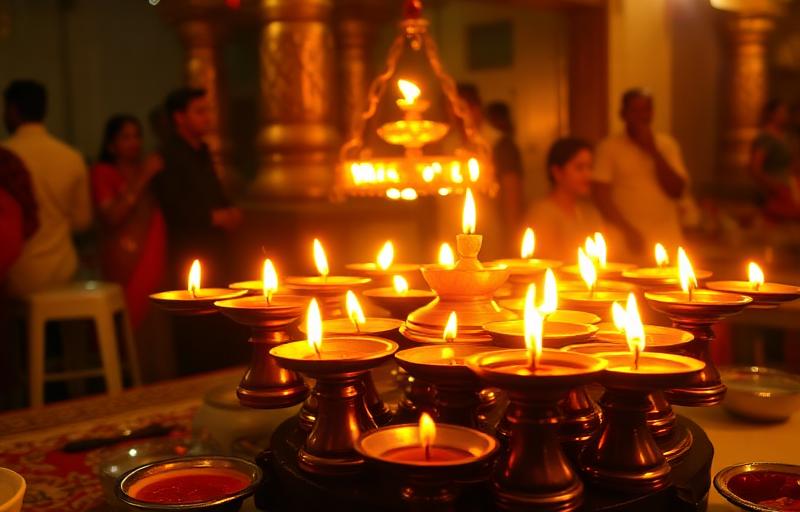
- The deepastambham and rows of oil lamps along the walls, which is why a Kerala temple at night looks the way it does
The practice:
- Temples open very early, often around four in the morning
- Oil lamps rather than electric light in the core areas
- Tantris and specific priestly families hold hereditary rights of service
- A strong tradition of temple arts, with Koodiyattam, Chakyar Koothu, Thullal and the percussion forms performed as offerings
- Elephants in festival processions, with the ceremonial umbrellas and the caparison
The rules, which are stricter than elsewhere and are enforced:
- Men remove upper garments and wear a mundu inside. Shirts and trousers are not permitted
- Women wear sari, set mundu or salwar
- Non Hindus are not permitted inside many Kerala temples. The rule is displayed and applied at the gate
- Photography inside is generally prohibited
- These are not suggestions, and a visitor who has not read them will be stopped
On the entry rule. It is genuinely restrictive and visitors find it difficult. It is also the current position of the temples that apply it, it is applied consistently rather than arbitrarily, and it is not a visitor's place to argue about it at the gate.
What can be said is that Kerala's history on temple entry, from the Vaikom Satyagraha to the Temple Entry Proclamation of 1936, shows that these rules have changed before after long argument, and the argument was conducted by people who belonged to the tradition.
Visiting Haripad
Getting there
- Haripad, Alappuzha district, Kerala
- Haripad has a railway station on the Ernakulam to Kollam line
- About 30 km from Alappuzha and roughly 100 km from Kochi
- Kochi and Thiruvananthapuram have the nearest airports
- Buses run frequently on the coastal highway
Timings
- The temple opens very early, before dawn, with morning and evening sessions and a long midday closure. Check locally
When to go
- October to February for the most comfortable weather
- Thaipooyam in Makaram, January or February, for the great festival, accepting very heavy crowds
- Chithira Aattam and the temple's other festival days
- Early morning on an ordinary day, which is when a Kerala temple is at its best
If you go for Thaipooyam
- Expect very large crowds and heavy pressure on roads and facilities
- Arrive early, keep your group together and agree a meeting point
- Carry water. Even in January it is warm and humid here
- Keep well clear of the elephants in processions, do not approach them, and follow the barriers
- If you are watching kavadi processions, give the carriers room. They are tired, they are carrying weight and they cannot stop easily
Dress and conduct
- Men must remove upper garments and wear a mundu inside. Trousers and shirts are not permitted
- Women should wear a sari, set mundu or salwar
- Non Hindus are not permitted inside. The rule is applied at the gate. Check before travelling if it affects your party
- Photography inside is not permitted
- Leave footwear and phones at the counters
Combining the visit
- Mannarasala, the great serpent shrine, is very close to Haripad and is one of the most remarkable temples in Kerala
- Alappuzha and the backwaters, about an hour away
- Ambalappuzha with its palpayasam, on the same road
- Karunagappally and Kollam to the south
Haripad, Mannarasala and Ambalappuzha can be done in a day, and between them they cover a Murugan temple, a serpent grove and a Krishna temple famous for a dessert, which is a fair sample of what Kerala's temple landscape contains.
A closing thought. Most religious offering in India involves handing something over at a counter. The kavadi does not. It involves picking up a weight where you live, walking with it to a temple that may be a long way off, and putting it down in front of somebody. As statements go it is very hard to misinterpret.
Common Questions From Devotees
Where is the Haripad temple?+
At Haripad in Alappuzha district, Kerala. Haripad has a railway station on the Ernakulam to Kollam line, is about 30 km from Alappuzha and roughly 100 km from Kochi, with Kochi and Thiruvananthapuram the nearest airports and frequent buses on the coastal highway.
What is Thaipooyam?+
The festival on the Pooyam asterism in the Malayalam month of Makaram, generally January or February, the same as Thaipusam in Tamil Nadu and the Tamil diaspora. One common understanding is that it commemorates the day Parvati gave Murugan the vel with which he defeated Surapadman.
What is a kavadi?+
A burden carried on the shoulders, in its basic form a pole with a weight at each end. The simplest is the pal kavadi, carrying pots of milk for the abhishek. Elaborate forms have a decorated arched frame with peacock feathers. The devotee carries it to the temple, often a considerable distance, and the difficulty is the whole value of the offering.
What is the katha behind the kavadi?+
Agastya asked his disciple Idumban to carry the hills Sivagiri and Sakthigiri to the south, slung on a pole across his shoulders. He set them down at Palani to rest and could not lift one again, because Murugan was standing on it as a boy. Idumban challenged him, was defeated, recognised him and became his devotee, and Murugan granted that anyone coming with a shoulder burden would receive what they asked.
Does kavadi require piercing?+
No. Practices vary enormously by region and temple, and many kavadi observances involve no piercing at all. Where it is done there are real medical risks, principally infection and bloodborne transmission from shared or unsterile implements. A milk pot carried barefoot for twenty kilometres is a complete kavadi and always has been.
What are the temple entry rules in Kerala?+
Men must remove upper garments and wear a mundu inside, and trousers and shirts are not permitted. Women wear sari, set mundu or salwar. Non Hindus are not permitted inside many Kerala temples, and the rule is displayed and applied at the gate. Photography inside is generally prohibited. These are enforced rather than advisory.
About the author
Pandit Ravindra Sharma · Vedic Rituals & Bhakti, 22+ years
Pandit Ravindra is the Vandnaa editorial team's resident specialist on aarti, chalisa, and daily devotion. He has performed home and temple pujas across Varanasi and Delhi for over two decades and contributes the bhakti-focused articles on this site.
Meet the Vandnaa editorial team →