The Temple and Its Payasam
The Ambalappuzha Sree Krishna temple stands at Ambalappuzha in Alappuzha district, Kerala, in the backwater country.
What is there:
- A temple in the Kerala style, with a walled compound and a tank
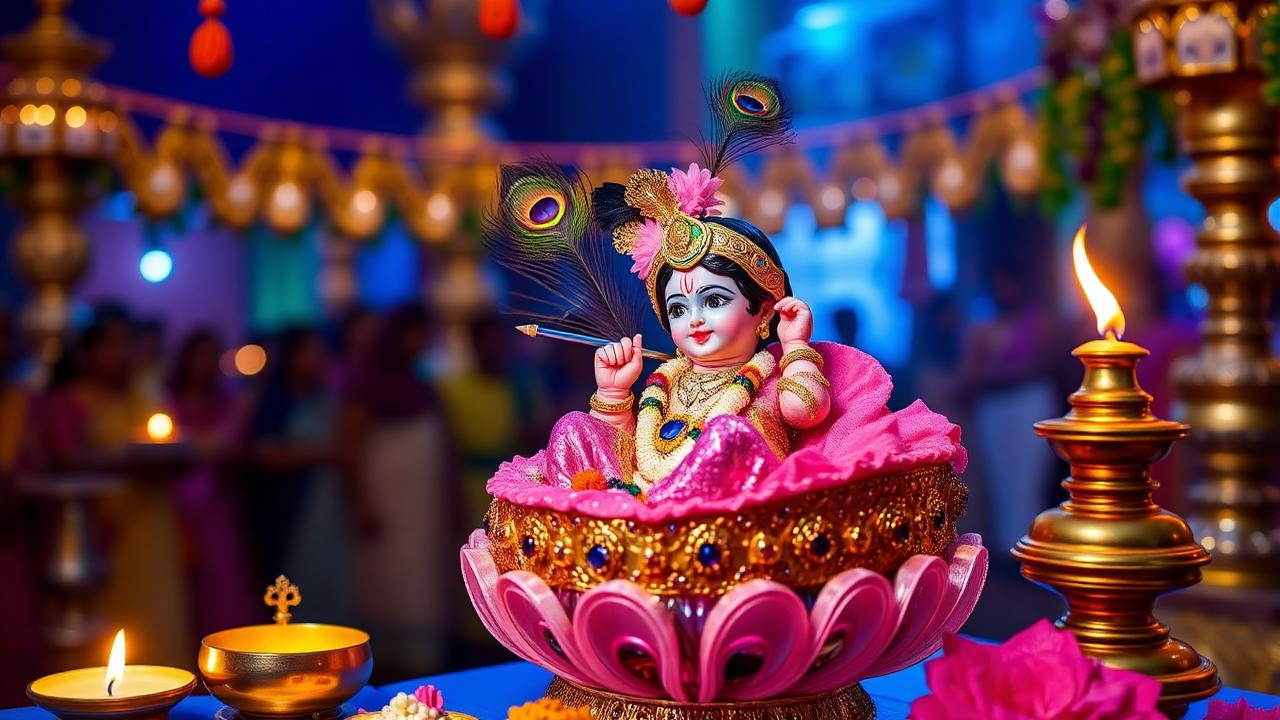
- The deity Krishna, in a standing form holding a whip and a conch
- A koothambalam, the temple theatre
- The kitchen, which is what the temple is chiefly known for
The palpayasam. This is what brings most people.
- Pal is milk and payasam is the sweet rice preparation, so palpayasam is the milk payasam
- It is made daily and offered to the deity, then distributed
- It is famous across Kerala, and people travel for it
- It is available in measures, and devotees also sponsor it as an offering
Why a temple is known for a dish. This is entirely normal in India. Tirupati has its laddu, Puri its mahaprasad, Guruvayur its payasam and Kashi its offerings, and in each case the food is not incidental but is one of the reasons the shrine has the standing it does.
What is unusual at Ambalappuzha is why the payasam is made, which is not a matter of the deity's preferences. It is a debt, incurred at a chessboard, and the daily preparation is the instalment.
The Game and the Grains
The katha is the most famous thing about this temple, and it is one of the best stories in Indian tradition because it is also a mathematics problem.
As it is told:
- The king of the region, of the Chembakassery line, was a keen player of chess
- A sage arrived and challenged him to a game. The sage was Krishna in disguise
- The king asked what the visitor wanted as a stake
- The sage asked for grains of rice, counted on the chessboard. One grain on the first square, two on the second, four on the third, and doubling on every square to the sixty fourth
- The king thought this a modest request and agreed
- He lost the game
What happened when they started counting:
- The first row was trivial. A few dozen grains
- By the twentieth square it was more than a million grains
- By the fortieth it was a granary
- By the sixty fourth the total exceeds eighteen quintillion grains, which is more rice than has ever been grown
- The king could not pay
How it was settled:
- Krishna revealed himself
- The king was told he could pay the debt over time
- The temple would serve palpayasam to devotees, daily, until the debt was cleared
- It is still being served
The mathematics. The total is two to the sixty fourth power minus one, and it is the standard illustration of exponential growth. The same problem appears in Persian and Arabic tradition and in European sources, usually with a king, a chessboard and an inventor.
That it appears at Ambalappuzha attached to Krishna, and that a temple kitchen has been running for centuries as the settlement, is a rather wonderful piece of localisation. Somebody took an abstract mathematical parable and turned it into a standing arrangement with a daily obligation.
Why the Story Works
The chessboard problem has survived across cultures for a thousand years, and it is worth asking why.
What it demonstrates:
- Human beings are very bad at exponential growth. We estimate it linearly, and we are wrong by an enormous margin every time
- The doubling looks harmless for the first half of the board and becomes absurd in the second half
- The insight cannot be had by thinking harder about the early squares. You have to run it out
Where the same failure shows up:
- Compound interest, which is the reason debt traps work and the reason long term saving works
- Epidemics, where a low case count doubling on a short interval is not a small problem
- Population and resource projections
- Anything that grows as a percentage of itself
What the story adds to the mathematics. It puts the problem in a setting where the loser is a king, which is the point.
- The king is not stupid. He is powerful, competent and used to being able to pay for things
- His error is a failure of imagination, not of arithmetic. He did not run the numbers because the request sounded small
- Anyone in his position would have agreed
The Indian versions of the parable. Chess itself is generally traced to India, through chaturanga, and moves west through Persia and the Arab world into Europe. It is fitting that the most famous problem about a chessboard travelled with it.
The Ambalappuzha version's contribution is the ending. In most tellings the story stops at the moment of realisation, with the king humiliated or the inventor executed depending on the version.
Here the debt is not cancelled and the king is not punished. It is restructured. The obligation stays real and gets paid down forever in daily instalments of milk pudding, which is a much more Indian resolution than either humiliation or forgiveness.
Ottamthullal and the Sleeping Audience
Ambalappuzha is the birthplace of one of Kerala's distinctive performing arts, and the story of how it began is worth telling.
Kunchan Nambiar, in the eighteenth century, was an accompanist at the temple. He played the mizhavu, the large drum used in Chakyar Koothu, the traditional solo narrative performance.
What happened:
- During a performance, Nambiar fell asleep at his drum
- The Chakyar, the performer, mocked him publicly for it in the course of the performance, which the form permits
- Nambiar was humiliated
- By the next day he had created a new performance form, Ottamthullal, and performed it at the temple
- The audience left the Koothu and came to watch
What Ottamthullal is:
- A solo performance, with the performer in costume and makeup, singing and dancing while narrating
- In Malayalam, not Sanskrit, and in a register anybody could follow
- Fast, direct and above all satirical
- Its targets were the powerful, the pompous, the corrupt and the socially pretentious, and Nambiar's verses are still quoted for their bite
Why this matters. Kerala's classical arts, Koodiyattam and Chakyar Koothu, were performed inside temple theatres, in Sanskrit, for audiences who could follow them.
Ottamthullal was a vernacular form, aimed at everybody, and its content was social criticism. It was created in a day by a man who had been humiliated, and it worked because it was funnier and more accessible than what it displaced.
What Nambiar left. His compositions are among the most widely known Malayalam verses, and Ottamthullal is still performed. The tradition of using it for satire on contemporary matters has continued.
The episode is remembered at the temple, and it is one of the better origin stories in Indian performance, because it is entirely about somebody being publicly embarrassed and responding by inventing something better.
The Guruvayur Connection and Velakali
Two further associations belong to Ambalappuzha and are worth knowing.
The Guruvayur image:
- Tradition holds that during a period of danger in the eighteenth century, when campaigns were moving through the region, the image from Guruvayur was brought to Ambalappuzha for safekeeping
- It remained here for a period before returning
- The two temples have a recognised relationship as a result
What that tells you about how temples operated. Images were moved when threatened, and this was normal practice rather than an exception.
Across India there are shrines whose deities spent periods elsewhere, hidden, buried or in the keeping of another temple. Charbhuja at Garhbor was concealed in water. Numerous Kerala and Tamil temples moved images during the campaigns of the eighteenth century.
The network of temples that would take in another temple's deity in an emergency is not something anyone wrote down as a system, but it clearly existed.
Velakali:
- A martial performance associated with this temple, performed by men in traditional warrior costume with sword and shield
- Performed to percussion, in formations, in the temple grounds and at the tank
- It is a temple art with a military origin, and the association is with the Nair martial tradition of the region
- It is performed at the temple's festivals
Why martial arts and temples go together in Kerala. Kalaripayattu, the martial tradition of Kerala, was practised in kalaris that had shrines in them, and the connection between combat training, temple service and ritual is old.
The same pattern appears in Karnataka with the garodis of Koti and Chennaya, in Tamil Nadu with silambam, and across India wherever communities had both a martial obligation and a temple.
A temple that fed people, staged satire and drilled swordsmen in its own courtyard was, in its time, doing about as much as a public institution can.
Visiting Ambalappuzha
Getting there
- Ambalappuzha, Alappuzha district, Kerala
- About 14 km from Alappuzha town and roughly 60 km from Kochi
- Ambalappuzha has a railway station on the Ernakulam to Kollam line
- Kochi has the nearest airport
- Buses run frequently along the coastal road
Timings
- The temple opens very early, before dawn, and has morning and evening sessions with a long midday closure. Check locally
- The palpayasam is offered at a particular time and is distributed after. Ask about the timing on the day, since it runs out
When to go
- October to February for the most comfortable weather
- Ambalappuzha Aarattu, the temple's festival, in the Malayalam month of Meenam, generally March or April
- Janmashtami, given the deity
- Early morning, which is when Kerala temples are at their best
The palpayasam
- It is available at the temple and is the reason many people come
- Devotees also sponsor it as an offering, which can be arranged at the temple office
- Go early if you want it. It is finite
Dress and conduct
- Kerala temple rules apply. Men must remove upper garments and wear a mundu, and trousers and shirts are not permitted inside
- Women should wear a sari, set mundu or salwar
- Non Hindus are not permitted inside many Kerala temples, and the rule is applied. Check before travelling if it affects your party
- Photography inside is not permitted
- Leave footwear and phones at the counters
Combining the visit
- Alappuzha for the backwaters, houseboats and the canals
- The Nehru Trophy snake boat race at Punnamada, held in August, if the timing falls
- Kumarakom across the lake
- Kollam and the southern backwaters
- Aranmula, with its own boat race and Parthasarathy temple, is within reach
On the backwaters generally. Alappuzha is the centre of the houseboat industry, and it is worth knowing that the boats have had a real environmental effect on the lake system through sewage and fuel.
If you take one, choose an operator with proper waste handling, and consider a day trip rather than an overnight, or a smaller country boat, which sees more and costs the lake less.
A closing thought. A temple that has been running a kitchen for several hundred years because a king once misjudged a doubling sequence is a very good argument for teaching children exponentials early.
Common Questions From Devotees
What is the palpayasam katha?+
The king of the region, a keen chess player, was challenged by a sage who was Krishna in disguise. The sage asked as stake for grains of rice on the chessboard, one on the first square and doubling on each thereafter. The king agreed, lost, and could not pay, since the total exceeds eighteen quintillion grains. Krishna allowed the debt to be paid over time as palpayasam served daily.
What does the chessboard problem demonstrate?+
That human beings are very bad at exponential growth, estimating it linearly and being wrong by an enormous margin. The doubling looks harmless for the first half of the board and becomes absurd in the second. The same failure shows up with compound interest, epidemics and anything that grows as a percentage of itself.
How is the palpayasam served?+
It is made daily, offered to the deity and then distributed, available in measures at the temple. Devotees also sponsor it as an offering, which can be arranged at the temple office. It is offered at a particular time and runs out, so go early and ask about the day's timing.
What is Ottamthullal and how did it begin here?+
A solo Malayalam performance, sung and danced in costume, fast, direct and satirical. Kunchan Nambiar, an accompanist at this temple in the eighteenth century, fell asleep at his drum during a Chakyar Koothu and was publicly mocked for it. By the next day he had created Ottamthullal and performed it at the temple, and the audience left the Koothu to watch.
What is Velakali?+
A martial performance associated with this temple, performed by men in traditional warrior costume with sword and shield, to percussion and in formations, in the temple grounds and at the tank. It is a temple art with a military origin, associated with the Nair martial tradition of the region, and is performed at the temple's festivals.
What is the Guruvayur connection?+
Tradition holds that during a period of danger in the eighteenth century, when campaigns were moving through the region, the image from Guruvayur was brought to Ambalappuzha for safekeeping and remained here for a period before returning. Moving images when threatened was normal practice rather than an exception.
About the author
Pandit Ravindra Sharma · Vedic Rituals & Bhakti, 22+ years
Pandit Ravindra is the Vandnaa editorial team's resident specialist on aarti, chalisa, and daily devotion. He has performed home and temple pujas across Varanasi and Delhi for over two decades and contributes the bhakti-focused articles on this site.
Meet the Vandnaa editorial team →