Who Hidimba Devi Is
Hidimba Devi, called Hadimba and Dhungri Devi locally, is worshipped at a wooden temple in a deodar grove above Manali in Himachal Pradesh. In the Mahabharata she appears as the sister of the rakshasa Hidimb, who confronted the Pandavas during their exile in the forest. Bhima defeated Hidimb, and Hidimba, who had fallen in love with Bhima, married him with Kunti's consent.
Their son was Ghatotkacha, the warrior who fought for the Pandavas at Kurukshetra and whose death turned the course of the war by drawing Karna's invincible weapon away from Arjuna.
What happens after that is the part the hills remember. Hidimba did not go with the Pandavas. She stayed in the mountains, raised her son and then, tradition says, undertook long and severe tapasya in the forest above the Beas until she attained the status of a devi. The people of the Kullu valley worship her not as a mythological character but as a living presence who chose to remain in their hills.
The Dhungri Temple: A Cave Instead of a Sanctum
The temple at Dhungri is one of the most distinctive structures in the western Himalaya, and much of its meaning is in the building itself.
- It is built in the pagoda style of Himachal, with a tall four tiered wooden roof rising over a stone base
- The walls are covered in carved wooden panels showing dancers, animals and the Devi's motifs, and the doorway carries some of the finest woodwork in the state
- The construction is credited to Raja Bahadur Singh in the sixteenth century, though worship at the site is understood to be much older
- Inside there is no conventional murti. The shrine is built around a rock and a natural cave, where the Devi is worshipped in the form of a footprint impression
- Outside stand old deodar trees treated as part of the temple, and a short walk away is the shrine of Ghatotkacha, worshipped at a tree
The absence of a sculpted image is important. Like several old Himalayan shrines, this one worships presence rather than form, and the cave is treated as the place where the Devi's tapasya took place.
Why Kullu Dussehra Waits for Her
Hidimba Devi is the kul devi of the erstwhile royal family of Kullu, and that gives her a role in the valley's biggest festival.
Kullu Dussehra begins when the rest of India's Dussehra ends, on Vijayadashami, and runs for about a week. Its central figure is Raghunath ji, the presiding deity of the valley, whose rath is pulled by thousands of devotees at Dhalpur maidan.
The custom is that the rath yatra does not begin until Hidimba Devi arrives. Her palanquin is carried down from Manali, received with honour, and only then does the procession move. Village devtas from across the valley, numbering in the hundreds, are also brought in palanquins to attend, each with its own drummers, standard bearers and gur.
This is one of the clearest expressions of how Himachal's devotion works. The valley has a presiding deity, but authority is shared with the older local deities, and precedence is remembered carefully. Hidimba's arrival is not ceremonial decoration. Without it the festival does not formally begin.
Festivals and How She Is Worshipped
Worship here follows the Himachali devta system rather than a standard temple routine.
- Dhungri Mela, held in the month of Vaishakh, is the temple's own festival. Women of the surrounding villages gather in traditional dress, and the celebration continues over several days.
- Hidimba Devi Jayanti is observed at the temple with special worship and offerings
- Kullu Dussehra in Ashwin, when the Devi travels to Dhalpur
- Navratri, when devotees come from across Himachal and from Punjab
The temple has a gur, a traditional oracle through whom the Devi is understood to speak on specific occasions, a practice common to Himachal's devta temples. Villagers bring questions about disputes, illness and family matters and receive guidance in this form.
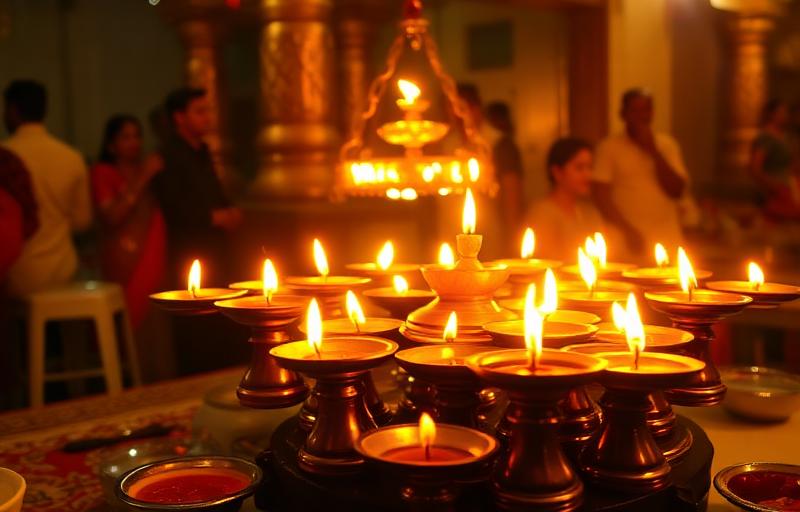
Common offerings are ghee lamps, red cloth, flowers, coconut, halwa and local grain. Older customs at some Himachal shrines included animal sacrifice, and this has been substantially reduced or replaced across the state, with fruit, coconut and grain offerings now standard for most visiting devotees.
Why a Rakshasi Became a Goddess
The question visitors ask most often at Dhungri is how a character introduced in the epic as a rakshasi came to be worshipped as a devi. The tradition answers it directly, and the answer is one of the more interesting ideas in Hindu devotional thought.
- Birth does not decide status. Hidimba is described as choosing dharma over her brother's violence, protecting the Pandavas and marrying with Kunti's consent. Tradition treats that choice, not her lineage, as decisive.
- Tapasya changes standing. The hills hold that she attained divinity through severe penance in the forest, the same route by which many figures in Hindu tradition rise from human or asura origins.
- Motherhood and sacrifice matter. She raised Ghatotkacha alone and sent him to fight for the Pandavas, where he gave his life. Devotees in Kullu speak of her as a mother who gave her son to a war that was not hers.
That combination is why she is invoked in the valley for courage, for the protection of children and for strength in situations a family cannot control. Her worship is not a footnote to the Mahabharata but a continuing local relationship.
Visiting the Temple
The temple sits in the Dhungri forest about two kilometres above Manali's mall road, reachable by a short drive or an easy uphill walk of about twenty minutes.
- Timings - generally open through the day, with morning hours quietest. Winter mornings are cold and the grove holds snow, so carry warm clothing.
- What to carry - flowers, a coconut, a red chunri if you are offering one, and cash for the small local offerings. Photography is allowed outside but not inside the sanctum.
- Footwear - removed before the platform. The ground can be cold, so socks are useful.
- Nearby - the Ghatotkacha shrine at the large tree a few minutes away, the Manu temple at old Manali, and Vashisht temple with its hot springs across the Beas
- Local courtesy - the deodar grove around the temple is protected by custom. Do not pluck branches, do not carve on trunks, and do not feed or pose with the animals brought there for photographs
The best time overall is the Dhungri Mela in Vaishakh or the Dussehra week in Ashwin, when the Devi's palanquin travels and the valley's older devotional order becomes visible in public.
Common Questions From Devotees
Who is Hidimba Devi?+
Hidimba Devi is worshipped in Manali as a goddess who, in the Mahabharata, married Bhima and became the mother of Ghatotkacha. Tradition holds that she remained in the Kullu hills and attained divinity through severe tapasya in the forest.
Why is there no murti inside the Hidimba temple?+
The temple is built around a rock and a natural cave where the Devi's tapasya is believed to have taken place. She is worshipped there in the form of a footprint impression rather than a sculpted image, as at several old Himalayan shrines.
What is Hidimba Devi's role in Kullu Dussehra?+
She is the kul devi of the former royal family of Kullu, and the Raghunath ji rath yatra at Dhalpur traditionally does not begin until her palanquin arrives from Manali and is received with honour.
Where is the Ghatotkacha shrine in Manali?+
A short walk from the Hidimba temple, Ghatotkacha is worshipped at a large tree in the same deodar grove. Devotees usually visit both together, since he is her son.
When is the Dhungri Mela held?+
The Dhungri Mela is held at the temple in the month of Vaishakh, when women of the surrounding villages gather in traditional dress. Kullu Dussehra in Ashwin is the other major occasion associated with the Devi.
What do devotees ask Hidimba Devi for?+
She is invoked in the Kullu valley for courage, for the protection of children and for strength in situations a family cannot control, drawing on her katha as a mother who gave her son to a war that was not her own.
About the author
Pandit Mahesh Trivedi · Festival Traditions & Panchang
Pandit Mahesh leads the festival-date and Panchang content on Vandnaa. He cross-references multiple regional panchangs (Drik, Vaishnava, Bengali, Marathi) for every festival date published on the site.
Meet the Vandnaa editorial team →