What Namkaran Is and Why It Matters
Namkaran, literally the act of giving a name, is one of the sixteen traditional samskaras (sacraments) that mark a Hindu individual's journey through life, and it holds a special place among them as the ceremony that formally welcomes a newborn into family and community identity. Before Namkaran, a baby is typically referred to informally within the household; the ceremony marks the point where a name is spoken aloud, blessed, and adopted as the child's identity going forward.
The underlying idea is not merely administrative. In Hindu thought, a name is believed to carry vibration and meaning that can shape a person's temperament and life path to some degree, which is why the ceremony historically involved careful selection based on astrological timing rather than being left to preference alone. The name chosen at Namkaran was traditionally distinct from pet names used at home, and families often selected a more formal name for use in religious and social contexts.
Namkaran typically involves close family, sometimes a priest, and centres on a short puja followed by the whispering of the chosen name into the baby's right ear, a moment considered the ceremonial heart of the ritual. It is usually a warm, low-key occasion compared to some of the more elaborate samskaras, making it approachable even for families who want to keep the observance simple while still honouring the tradition.
This guide walks through when Namkaran is traditionally held, how names are chosen using the baby's nakshatra (birth star), what the classical ritual involves, and how a modern family without access to a full traditional setup can still observe it meaningfully at home.
Traditional Timing: The 11th or 12th Day
Classical texts most commonly place Namkaran on the eleventh day (some traditions specify the twelfth) after birth, a timeline connected to the belief that the mother and child complete a foundational period of postnatal rest and purification (sutika period) by around this point, after which the household resumes fuller ritual and social activity. This is also why Namkaran often coincides with, or closely follows, other early postnatal observances in some communities.
In practice today, families follow this window with considerable flexibility, and there is no single rigid rule observed everywhere.
- Many families hold Namkaran on day 11 or 12 exactly as prescribed, especially where a priest and extended family are closely involved
- Some families wait until the mother is more fully recovered, choosing a date within the first month based on convenience and an auspicious muhurat
- A few traditions favour naming on day 10, 16, or even on a date chosen purely by astrological suitability regardless of the exact day count
- Premature births, medical complications, or a baby in the NICU commonly push the ceremony later without any loss of religious significance
When families do follow strict timing, they typically consult a family priest or a panchang to identify not just the correct day but also an auspicious muhurat (time window) within that day, avoiding periods considered inauspicious such as Rahu Kaal. For most modern households, the more important principle is that the ceremony happens when mother, baby and family are genuinely ready, rather than treating the 11th or 12th day as an inflexible deadline.
Naming by Nakshatra: How the Traditional System Works
The most distinctive feature of traditional Hindu naming is its connection to the baby's nakshatra, the specific lunar constellation the moon was transiting at the moment of birth. Vedic astrology divides the sky into 27 nakshatras, and each nakshatra is further divided into four padas (quarters), with each pada assigned a specific starting sound or syllable considered auspicious for a name beginning with that sound.
A family consulting this system, typically through a priest or an astrologer working from the baby's birth chart, would identify the exact nakshatra and pada active at the birth time, then select a name beginning with the corresponding syllable. For example, a baby born under the pada assigned the sound "chu" might be given a name like Chandan, while one under "ka" might receive a name like Kavya or Karan. This is why many Hindu names across a single extended family may share a starting sound tied to their individual birth charts rather than following a family naming pattern.
- The moon's nakshatra at birth, not the sun sign, drives this system
- Each of the 27 nakshatras has 4 padas, giving 108 possible starting-sound combinations
- A priest or astrologer typically provides this starting sound from the birth chart (janam kundali)
- Families are free to choose any name beginning with the suggested sound; it need not be a traditional or religious name
Many modern families blend this system with personal preference: they ask an astrologer or a trusted app for the nakshatra-based starting sound, then choose a name they genuinely like that begins with it, honouring the tradition without feeling constrained to an unfamiliar or old-fashioned option. Others skip the nakshatra system altogether and choose a name purely on meaning or family significance, which is an equally accepted modern practice with no lesser sentiment behind it.
The Traditional Vidhi, Step by Step

A full traditional Namkaran ceremony, conducted with a priest present, generally follows a recognisable sequence, though specific elements vary by region and family tradition.
- Purification and sankalp: the space is cleaned, a small havan kund or puja area is set up, and the father (or parents together) take a sankalp, a formal statement of intent to perform the ceremony for their child's wellbeing
- Ganesh and Kul Devta puja: prayers open with an invocation to Lord Ganesh for an auspicious beginning, followed by worship of the family's kul devta (family deity), if one is followed
- Havan: a small sacred fire ceremony is performed, with the priest reciting Vedic mantras, and family members offering ghee, til (sesame) and rice into the fire
- Whispering the name: the father, or the priest guiding the father, whispers the chosen name into the baby's right ear three times, often adding a longer, more formal version of the name that includes the nakshatra and gotra for religious record-keeping
- Blessings and aarti: elders bless the baby, typically with a tilak and a small gift, followed by an aarti to close the formal ritual
- Jhula ceremony: in many communities, the baby is gently placed in a decorated cradle (jhula) for the first time as the name is sung or announced aloud, sometimes accompanied by a lullaby composed for the occasion
The ceremony usually closes with a shared meal among family and close friends, and in many households doubles as the baby's first formal introduction to extended family who may not have visited since the birth. The tone throughout tends to be celebratory rather than solemn, distinguishing it from some of the more austere samskaras later in life.
A Simplified Modern Approach
Many families today, particularly those living away from extended family, in nuclear households, or without easy access to a priest, still want to honour Namkaran without organising the full traditional setup. A simplified, sincere version is entirely valid and does not diminish the ceremony's meaning.
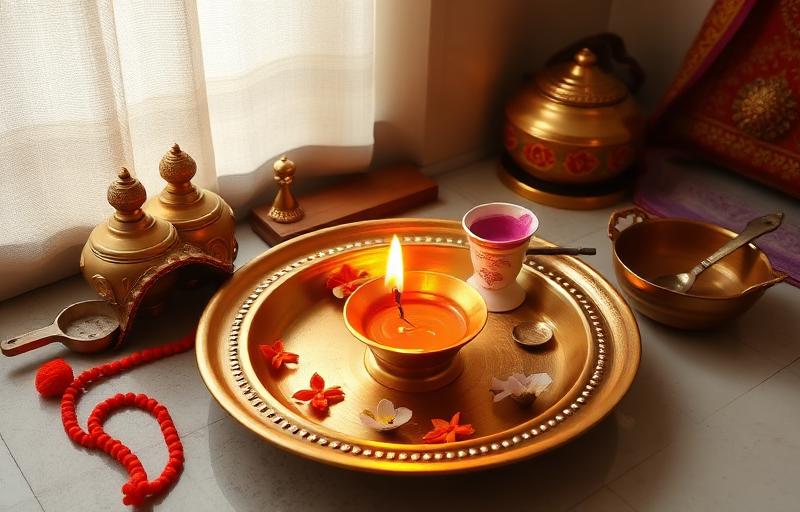
A practical, scaled-down Namkaran can include just a few essential elements: a small puja at the home altar with a diya and simple offerings to Ganesh, a short prayer or a recorded mantra played respectfully, and the father or both parents whispering the chosen name into the baby's ear, followed by a family gathering, even a small one over video call, to formally share and celebrate the name. This preserves the ceremony's emotional and spiritual core, the intentional, blessed act of naming, without requiring a havan, a full priest-led ritual, or a large guest list.
🙏 For families who want guided support, Vandnaa's app includes a simple Namkaran puja vidhi, the naming mantras, and a nakshatra-based name-letter lookup, so you can plan a meaningful ceremony at home even without a priest on hand.
- A home puja corner, a diya, and a few flowers are enough for the setting
- Recorded or app-guided mantras are an accepted substitute when a priest is not available
- The whispering of the name remains the emotional centrepiece even in a simplified version
- Many families still choose to consult an astrologer only for the nakshatra-based starting letter, then handle the rest of the ceremony themselves
- A simple sweet distributed to neighbours or close family is a common, low-effort way to mark the occasion socially
What matters most across both traditional and simplified versions is the sincerity behind the moment: a name spoken with love and blessing, formally welcoming a new member into the family's story.
Practical Things to Keep in Mind
A few practical considerations help the ceremony go smoothly, regardless of whether it is elaborate or simple.
- Confirm the exact birth time: nakshatra calculation depends on precise birth time, so keep the hospital-recorded time handy if you plan to consult an astrologer or app
- Decide on the formal name early: if you intend to use the nakshatra-based name for official documents like the birth certificate, finalise it before registration deadlines, since changing a name later involves extra paperwork
- Check baby's readiness: for a ceremony involving a havan or a longer gathering, time it around the baby's feeding and sleep schedule rather than a fixed clock hour, even if a muhurat window is chosen
- Involve grandparents where possible: elders often hold family naming conventions, gotra details, or a preferred kul devta that are useful to confirm before the ceremony
- Keep documentation of the full name: the ceremonial name (nakshatra-based, often longer) and the name used in daily life and official records can differ; note both clearly for family records
- Health first: if the baby or mother is unwell around the traditional 11th or 12th day, there is no religious objection to postponing; wellbeing takes precedence over timing
Namkaran, at its heart, is less about strict procedure and more about a family consciously, joyfully choosing how a new member will be known and blessing that choice together. Whether marked with a full havan or a quiet moment at a home altar, the ceremony carries the same intention: a name given with care, spoken for the first time as a blessing.
What People Ask Most
On which day is Namkaran traditionally performed?+
Namkaran is traditionally performed on the 11th day after birth, though some families follow the 12th day. Many modern families choose any auspicious date within the first month based on convenience and the health of mother and baby.
What is nakshatra-based naming and is it mandatory?+
It is a traditional system where the moon's position at birth determines an auspicious starting sound for the baby's name. It is a respected custom but not mandatory; many families today choose names based purely on meaning or personal preference.
Can Namkaran be performed without a priest?+
Yes. A simplified home version, with a small puja, a prayer, and the parents whispering the name into the baby's ear, is a widely accepted and sincere way to observe Namkaran without a priest or full traditional setup.
Does the name whispered at Namkaran have to be the child's legal name?+
Not necessarily. Some families use a longer, formal nakshatra-based name for the ceremony and religious records, while using a shorter or different name in daily life and on official documents. Both names can coexist without conflict.
What happens if a baby is born prematurely or has health complications around day 11?+
There is no religious objection to postponing Namkaran. Family health and wellbeing take precedence over exact timing, and the ceremony can be held whenever mother, baby and family are genuinely ready, even weeks or months later.
About the author
Pandit Ravindra Sharma · Vedic Rituals & Bhakti, 22+ years
Pandit Ravindra is the Vandnaa editorial team's resident specialist on aarti, chalisa, and daily devotion. He has performed home and temple pujas across Varanasi and Delhi for over two decades and contributes the bhakti-focused articles on this site.
Meet the Vandnaa editorial team →