The Fifth Head and the Lie It Told
Brahma is described in several Puranic accounts as originally possessing five heads, having grown a fifth specifically to keep watching Shatarupa, a form of his own creation he had become obsessively attached to, even as she tried to move away from his gaze in different directions.
Different tellings connect what follows to different specific offences - in one common version, Brahma's fifth head speaks arrogantly during a dispute with Shiva over which of them is the supreme deity, or, in another, Brahma lies about having found the top of Shiva's infinite Lingam of light during a separate contest with Vishnu (the same Lingodbhava episode covered elsewhere in this series), falsely claiming success to win the argument.
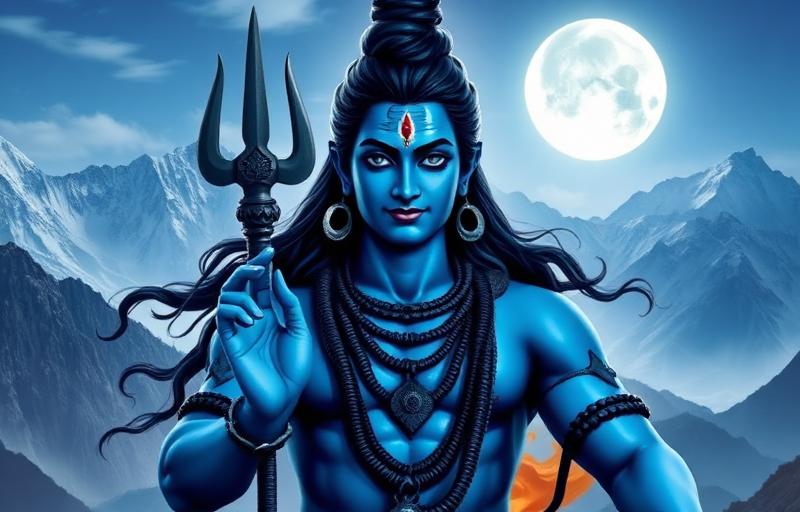
Shiva, angered by the fifth head's arrogance or falsehood in either version, manifests Kalabhairava, a fierce form of himself specifically for this act, who severs Brahma's fifth head - reducing Brahma to the four heads he is conventionally depicted with today, one for each direction, without the fifth that had caused the offence.
The Curse of Killing a Brahmin, Even for a God
Because Brahma is himself a Brahmin in the highest possible sense, the act of severing his head, even for genuine cause and even performed by Shiva, incurs Brahmahatya, the specific and severe sin of killing a Brahmin, one of the gravest categories of transgression recognised in Dharmashastra literature, applicable in principle regardless of the killer's own status.
The severed head, in this telling, attaches itself to Kalabhairava's hand and will not release its grip, a physical manifestation of the guilt that must now be carried and worked through rather than simply dismissed by virtue of Shiva's own divine status.
Kalabhairava is instructed to wander the earth as a mendicant, begging for alms with Brahma's skull as his begging bowl, for as long as it takes to be freed from the sin - a state that, in most tellings, lasts until he reaches Kashi (Varanasi), where the skull finally falls away and the sin is dissolved, a resolution that establishes Kashi's own special sanctity as a place capable of releasing even a god from Brahmahatya.
Guardian of Kashi and a Distinct Object of Worship
Having gained release from the sin at Kashi, Kalabhairava is established by tradition as the city's own guardian deity (Kotwal, or chief of police, in a common colloquial framing), responsible for maintaining order and dispensing strict justice, and no visit to major Kashi temples is traditionally considered complete without also visiting the Kalabhairava shrine, understood as necessary to gain permission or protection for the pilgrimage itself.
Kalabhairava is worshipped as a genuinely distinct deity in his own right across much of India, not merely as a footnote to Shiva's broader mythology - with dedicated temples, an associated set of eight forms (Ashta Bhairava), and strong devotional traditions particularly in Nepal, Karnataka, and parts of North India, often invoked specifically for protection, justice, and the removal of fear.
The episode as a whole is read theologically as establishing an important, recurring principle across Shiva mythology: that even righteous violence carries real consequence requiring genuine atonement, and that divine status does not exempt an act from its moral weight - a severity the tradition applies to Kalabhairava himself in a way it rarely applies to other gods after similarly justified acts of destruction.
Frequently Asked Questions
Why does Brahma have only four heads if he was originally described with five?+
Shiva, through his fierce form Kalabhairava, severed the fifth head due to its arrogance or falsehood, which is why Brahma is conventionally depicted today with only four heads, one for each cardinal direction.
Why couldn't Shiva simply be exempt from the sin of Brahmahatya as a god?+
The episode establishes a recurring principle across Shiva mythology that even righteous or divinely sanctioned violence carries real moral consequence requiring genuine atonement, rather than being automatically excused by the actor's status.
Why is a visit to the Kalabhairava temple considered necessary in Kashi?+
Kalabhairava is regarded as the city's guardian deity, and tradition holds that visiting his shrine is necessary to gain permission or protection for the broader pilgrimage to Kashi's other major temples.
About the author
Anjali Mehta · Editor, M.A. Religious Studies
Anjali is the managing editor for Vandnaa and oversees the festival and vrat coverage. She holds an M.A. in Religious Studies and reviews every published article for accuracy, accessibility, and tradition-fidelity.
Meet the Vandnaa editorial team →