Asked to Volunteer as Living Rope
When the devas and asuras agree to jointly churn the ocean of milk to extract amrita, the nectar of immortality, along with the fourteen other treasures that emerge in the process, two practical problems present themselves immediately: what to use as the churning rod, and what to use as the rope to turn it.
Mount Mandara is uprooted and used as the rod, resting on the back of Vishnu's Kurma (tortoise) avatar to keep it from sinking into the ocean floor, but the rope requires something both immensely strong and long enough to wrap fully around the mountain - and Vasuki, king of the Nagas and among the most powerful serpent beings in existence, is approached and agrees to serve in this role himself.
This is a genuine act of self-sacrifice presented with relatively little fanfare in most tellings: Vasuki offers his own body to be wound around the mountain and pulled back and forth by two entire opposing armies for as long as the churning takes, fully aware of what this would cost him physically.
Pulled by Both Head and Tail for a Thousand Years
The churning itself, described across different tellings as lasting anywhere from a very long single session to symbolically a thousand years, requires the devas to take Vasuki's tail while the asuras take his head, or vice versa in some versions - a positioning that itself carries an unequal burden, since the head end, closer to the venom glands, is understood as the more taxing and dangerous position to hold.
Some tellings note that the asuras insisted on taking the head end out of pride, believing it to be the position of honour, while the devas, following Vishnu's quiet guidance, accepted the tail end - a choice that unknowingly spared them the worst of the ordeal, since Vasuki's venom, agitated by the friction and effort of the churning, began to seep from his mouth and cause the asuras holding that end genuine harm and exhaustion throughout the process.
Vasuki endures the full duration of the churning as both rope and, in effect, an equal participant in the labour rather than a passive object, his body absorbing the mountain's friction directly as it turns against him thousands of times over.
The Rope Who Also Rests on Shiva's Neck
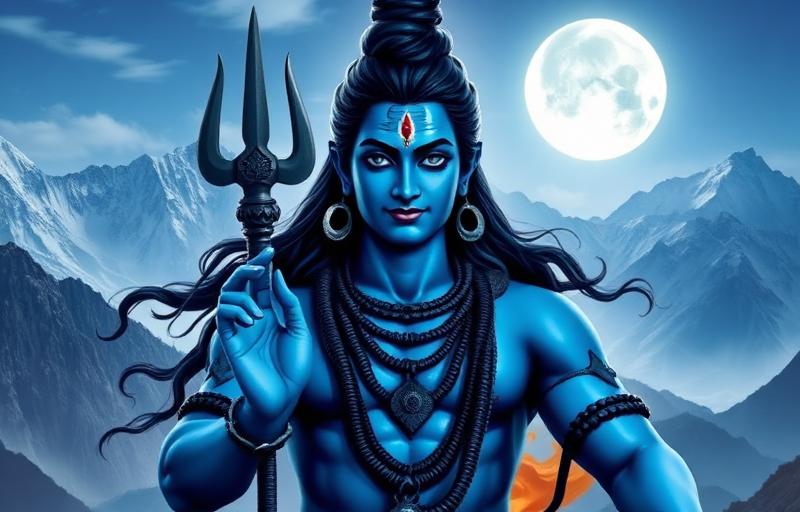
Beyond the Samudra Manthan episode, Vasuki holds a distinct, ongoing devotional identity as the serpent Shiva wears coiled around his neck, one of Shiva's most recognisable iconographic elements, symbolising Shiva's mastery over fear, death, and the poison of existence itself - an association distinct from, though sometimes conflated with, Shesha Naga (who bears Vishnu) or Takshaka (associated with the Astika and Janamejaya narratives covered elsewhere in this series).
Vasuki is also credited in some tellings with drinking a portion of the Halahala poison that emerged during the churning before Shiva ultimately consumed the majority of it himself, a detail underscoring Vasuki's role throughout the episode as an active, self-sacrificing participant rather than a passive tool being used by more powerful figures on either side.
Naga worship across India, particularly during festivals like Naga Panchami, draws on this broader tradition of serpent beings as figures of genuine power, dignity and cosmic significance rather than as merely dangerous animals, and Vasuki's specific willingness to serve as the literal connective tissue of one of Hindu mythology's most consequential cooperative undertakings is frequently cited as a model of selfless service performed at real personal cost.
Frequently Asked Questions
Why did the devas take the tail end of Vasuki rather than the head?+
Following Vishnu's quiet guidance, they accepted the tail end while the asuras, out of pride, insisted on the head end - a choice that unknowingly spared the devas the worst effects of Vasuki's venom, which seeped out under the strain and harmed those holding the head.
Is Vasuki the same serpent Shiva wears around his neck?+
Yes - Vasuki is specifically identified as the serpent coiled around Shiva's neck in traditional iconography, distinct from Shesha Naga, who bears Vishnu, and from Takshaka, who appears in other Puranic narratives.
How long did the Samudra Manthan actually take according to the tradition?+
Different tellings vary considerably, with some describing it as symbolically lasting a thousand years, reflecting the scale and difficulty of the undertaking rather than a literal, uniformly agreed timeframe.
About the author
Anjali Mehta · Editor, M.A. Religious Studies
Anjali is the managing editor for Vandnaa and oversees the festival and vrat coverage. She holds an M.A. in Religious Studies and reviews every published article for accuracy, accessibility, and tradition-fidelity.
Meet the Vandnaa editorial team →