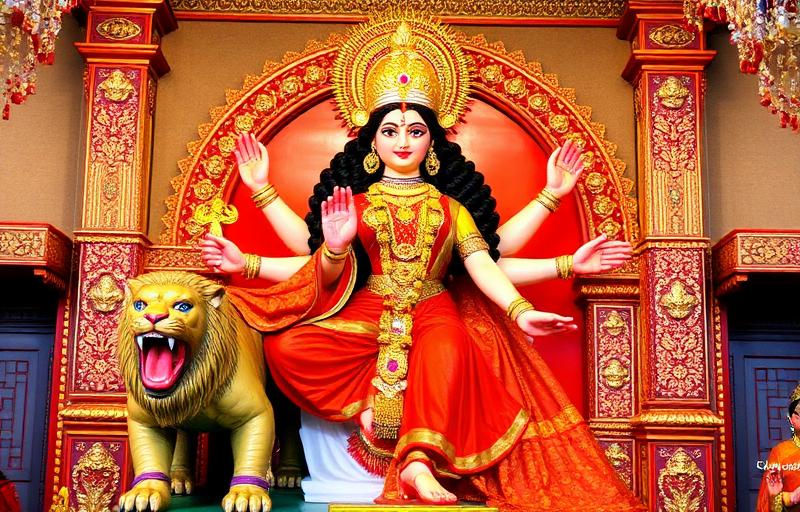
What Is a Shakti Peetha, and Why Kamakhya Matters
Across the Indian subcontinent, a network of sacred sites known as Shakti Peethas mark locations where, according to Puranic tradition, parts of the Goddess's form fell to earth, sanctifying each spot as a place of concentrated divine feminine energy. Kamakhya, situated atop Nilachal Hill on the southern bank of the Brahmaputra river in Guwahati, Assam, is counted among the most significant of these Peethas, revered not merely as one shrine among many but as a primary seat of Shakti worship in the entire eastern region of India.
What sets Kamakhya apart even within this already distinguished category is the nature of its sanctum. Rather than housing a carved image of the Goddess in a conventional sense, the inner sanctum shelters a naturally occurring rock formation, kept perpetually moist by an underground spring, which devotees revere as a direct, aniconic representation of the Goddess's generative and creative power. This form of worship, honoring the divine through a natural feature rather than a sculpted icon, connects Kamakhya to some of the oldest, pre-classical layers of goddess worship found across South Asia.
For devotees of the Shakta tradition, which holds the Divine Mother as the supreme, primary reality underlying all creation, Kamakhya is often regarded as one of the most powerful and important pilgrimage destinations in the country, spoken of with a reverence comparable to how Shaiva pilgrims regard the Jyotirlingas. Its significance draws pilgrims not only from Assam and the wider Northeast but from Shakta devotees across India and among the global Hindu diaspora, many of whom consider a Kamakhya pilgrimage a significant, once-in-a-lifetime devotional milestone.
The Legend of Sati and Shiva's Grief
The origin story shared across all Shakti Peethas begins with the tragic tale of Sati, daughter of King Daksha and the first consort of Lord Shiva. When Daksha organized a grand yajna and pointedly excluded Shiva out of long-standing resentment toward him, Sati, unable to bear the insult directed at her husband, is said to have immolated herself at the sacrilege, or in some tellings, given up her life through yogic power in protest at her father's disrespect.
Overwhelmed with grief and rage, Shiva is said to have carried Sati's body across the cosmos in an inconsolable, destructive dance of sorrow, the Tandava, threatening the stability of the universe itself. To bring an end to this cosmic anguish, Lord Vishnu is said to have used his Sudarshana Chakra to cut Sati's body into pieces, which fell to earth at various points across the subcontinent, each becoming a Shakti Peetha sanctifying that location forever.
At Kamakhya, tradition holds that it is the yoni, symbolizing the womb and the generative, reproductive power of the divine feminine, that fell upon Nilachal Hill, making this site particularly associated with fertility, creation and the life-giving aspect of Shakti. This is precisely why Kamakhya is worshipped without a carved idol, the natural rock formation and its perpetual moisture are understood as a direct, unmediated symbol of this creative power itself, rather than requiring a sculpted representation.
This legend gives Kamakhya a distinctive theological weight within Shakta philosophy, framing the temple not simply as a monument to a mythological event but as an ongoing, living embodiment of the very creative force the story describes, understood by devotees as continuously active rather than merely commemorated.
Worship Without an Idol: The Sanctum's Unique Character
Visitors entering the inner sanctum of Kamakhya Temple for the first time often find themselves surprised by what they encounter, a dimly lit, cave-like chamber reached by a descent of stone steps, where the object of worship is not a statue but a natural, yoni-shaped cleft in the rock, perpetually kept moist by a spring that flows through it. Devotees offer flowers, vermillion and other traditional items directly at this rock formation, and priests conduct rituals adapted specifically to this unusual, aniconic form of the divine.
The temple's present superstructure, distinguished by its beehive-shaped shikhara typical of the Nilachal or Assam style of temple architecture, is itself the result of extensive reconstruction over the centuries, following periods when earlier structures were damaged. Substantial rebuilding is associated with regional royal patronage during the medieval period, reflecting the site's continuous importance to successive ruling dynasties of the region even through periods of disruption.
Because of the cave-like descent into the sanctum and the sheer volume of pilgrims especially during festival periods, visiting Kamakhya can involve significant waiting and a fairly intense, close-quarters devotional atmosphere, quite different from the more spacious sanctums found at many other major Hindu temples. Devotees generally regard this intensity as fitting rather than inconvenient, an appropriately raw, unmediated encounter with a form of the Goddess that has never been softened into a more conventional sculpted image.
Outside the main sanctum, the wider temple complex includes shrines to various other forms of the Goddess and associated deities, making Kamakhya not a single shrine but a complex of interconnected sacred spaces spread across the hill.
Ambubachi Mela: Celebrating the Earth's Fertility

Each year, typically during the monsoon month of June, Kamakhya Temple hosts the Ambubachi Mela, one of the most significant and distinctive festivals in the Shakta calendar, drawing hundreds of thousands of pilgrims, sadhus and Tantric practitioners from across India. The festival is grounded in the belief that the Goddess undergoes her annual menstrual cycle during this period, a symbolic representation of the earth's own fertility and the generative power of nature awakening with the monsoon rains.
During the main days of the festival, the temple doors are traditionally closed to visitors, a period of ritual rest observed with the same respect any devotee would extend to a woman during this natural biological process. When the temple reopens, it does so with considerable celebration, and pilgrims receive a piece of red cloth, believed to have absorbed the Goddess's blessing during the closed period, along with prasad, as a treasured token of the festival.
Ambubachi draws a particularly striking gathering of sadhus, including many Tantric and Aghori practitioners who otherwise remain secluded for much of the year, making the mela grounds outside the temple a rare public glimpse into ascetic traditions not commonly visible to ordinary devotees. The atmosphere during these days is intense, crowded and deeply devotional, combining elements of pilgrimage, spiritual gathering and cultural festival.
What makes Ambubachi particularly significant to understand respectfully is what it represents philosophically, an unusually direct, unembarrassed celebration within mainstream Hindu tradition of menstruation and fertility as sacred rather than something to be hidden, a perspective that sets Kamakhya's devotional culture apart from many other major pilgrimage traditions.
✨ Vandnaa's festival calendar helps you track significant observances like Ambubachi well ahead of time, so your pilgrimage planning stays stress-free.
Kamakhya's Place in Tantric and Shakta Tradition
Beyond its status as a Shakti Peetha, Kamakhya holds a distinguished position as one of the most important centers of Tantric practice within Hindu tradition, with Assam itself historically recognized as a significant region for Tantric learning and scholarship, sometimes referred to in older texts by the term Kamarupa, closely linguistically related to Kamakhya's own name.
Tantra, often misunderstood in popular culture, is within its authentic tradition a sophisticated body of philosophy and ritual practice focused on realizing the divine through the material world rather than by renouncing it, treating the body, senses and natural forces as vehicles for spiritual realization rather than obstacles to it. Kamakhya's manner of worship, honoring the Goddess through a natural rock formation representing generative power, aligns closely with this Tantric orientation toward embracing rather than transcending the physical world.
Historically, the temple and its surrounding region attracted scholars, practitioners and pilgrims specifically interested in Tantric study, and this scholarly and ascetic tradition continues in various forms to the present day, visible especially during gatherings like the Ambubachi Mela. Numerous smaller shrines dedicated to the ten Mahavidyas, powerful aspects of the Divine Mother central to Tantric worship, are also found across Nilachal Hill, further cementing the site's comprehensive importance to Shakta philosophy.
For visiting devotees unfamiliar with this dimension of the temple, it is worth understanding Kamakhya not simply as a pilgrimage stop but as living heritage site for one of Hinduism's most intellectually rich and frequently misunderstood spiritual traditions, one that rewards approaching with genuine curiosity and respect rather than sensationalized assumptions.
Visitor Guide: Reaching and Experiencing Kamakhya
Kamakhya Temple sits atop Nilachal Hill on the outskirts of Guwahati, Assam's largest city and the primary gateway to the Northeast, making the temple considerably more accessible than its remote-sounding location might suggest. The temple generally welcomes devotees of all backgrounds, and its accessibility has made it a well-established stop for both dedicated pilgrims and cultural travelers exploring the Northeast.
- How to reach: Guwahati has its own international airport, Lokpriya Gopinath Bordoloi International Airport, along with Guwahati railway station, well connected to major Indian cities; local taxis and shared vehicles run regularly from the city up to the temple
- Darshan timings: The temple typically opens quite early in the morning and remains accessible through the day with a midday interval; timings can shift around Ambubachi and other major festival periods, so checking current schedules ahead of travel is recommended
- Expect queues: Given the temple's popularity, wait times for the inner sanctum can be considerable, particularly on weekends, auspicious days and during Ambubachi Mela
- Dress and conduct: Modest clothing is appropriate, and visitors should expect a fairly intense, crowded atmosphere near the sanctum entrance, especially during peak periods
- Nearby sites: Umananda Temple on a river island in the Brahmaputra and the Navagraha Temple are commonly combined with a Kamakhya visit for pilgrims spending extra time in Guwahati
For devotees planning a visit, arriving early in the morning generally offers a calmer, more contemplative darshan experience before the crowds build through the rest of the day. Local guides near the base of the hill can also be genuinely helpful for first-time visitors unfamiliar with the temple's layout and rituals.
Frequently Asked Questions
What is a Shakti Peetha and why is Kamakhya one of them?+
Shakti Peethas mark sites where, per Puranic legend, parts of Sati's body fell after Vishnu's chakra divided it. Kamakhya, where the yoni is believed to have fallen, is considered one of the most significant of these sites.
What is worshipped inside the Kamakhya sanctum since there is no idol?+
The sanctum shelters a natural, perpetually moist rock formation revered as a direct, aniconic symbol of the Goddess's generative and creative power, rather than a sculpted image.
What is Ambubachi Mela?+
Ambubachi Mela is Kamakhya's major annual festival, usually in June, marking the Goddess's symbolic annual fertility cycle. The temple closes for the main days and reopens with celebration and blessed red cloth for pilgrims.
Is Kamakhya Temple connected to Tantric tradition?+
Yes, Kamakhya and the wider Assam region have long been recognized as important centers of Tantric philosophy and practice, with shrines to the ten Mahavidyas found across the surrounding Nilachal Hill.
Is the Kamakhya Temple open to all visitors?+
Kamakhya generally welcomes devotees of all backgrounds. As with most major Hindu temples, modest dress and respectful conduct are expected, and visitors should be prepared for significant crowds, especially during festivals.
How do I reach Kamakhya Temple?+
The temple sits on Nilachal Hill just outside central Guwahati, which has its own international airport and railway station, with taxis and shared vehicles readily available for the short trip up to the temple.
About the author
Pandit Ravindra Sharma · Vedic Rituals & Bhakti, 22+ years
Pandit Ravindra is the Vandnaa editorial team's resident specialist on aarti, chalisa, and daily devotion. He has performed home and temple pujas across Varanasi and Delhi for over two decades and contributes the bhakti-focused articles on this site.
Meet the Vandnaa editorial team →