Kalna
Kamalakanta Bhattacharya, roughly 1769 to 1821, is the second great poet of Shyama Sangeet after Ramprasad Sen, and in the view of many Bengali readers the better technician of the two.
Where: born at Channa, in Bardhaman district, West Bengal, and settled at Kalna, on the Ganga.
His family: brahmana, and learned. He had a full Sanskrit education, which shows in his work: his songs are more formally accomplished than Ramprasad's and use a more literary vocabulary, without losing the directness.
His position: he became the court pandit and the guru of Maharaja Tejchandra of Bardhaman, one of the largest zamindari estates in Bengal.
What that means practically: he had patronage, security and standing, which Ramprasad largely did not, and he built a Kali temple at Kalna with the Maharaja's support.
His practice: he was a sadhaka in the full technical sense, trained in Shakta ritual, and his work on practice, Sadhak Ranjan, is a manual rather than a devotional text.
His works:
- Kamalakanter Padavali, the songs, which is the body of work he is known for
- Sadhak Ranjan, on sadhana
- Nirvana Vilasa and other shorter pieces
- Several hundred songs in total, in the Shyama Sangeet and Agamani genres and in the Vaishnava padavali form
The unusual thing about him: he composed to Kali and to Krishna both, and did not treat that as a contradiction. A number of his songs are straightforwardly Vaishnava, and Bengal has never found this odd.
Compared with Ramprasad
Ramprasad is rougher, more direct, and closer to speech. He complains, argues, and uses agricultural and household imagery.
Kamalakanta is more polished, more philosophically loaded, and more interested in paradox. His songs frequently turn on a conceptual problem rather than an emotional complaint.
Both are sung constantly and most Bengali listeners do not particularly separate them.
Is She Actually Black
His most famous song, and it is a piece of argument disguised as a devotional lyric.
Its opening, in substance:
Everybody says Kali is black. But is my mind's Kali black?
And then it goes on:
Sometimes she is red like a hibiscus. Sometimes she is white. Sometimes she is blue. Sometimes she is yellow. I have contemplated her in every colour there is, and I cannot say which one she is. The people who say she is black are describing a colour, and Kamalakanta says: they have not looked.
What the song is doing
Kali means black, and the name is a description. Bengal's images of her are black or dark blue. The colour is not incidental; it is what she is called.
And he is disputing it, on the basis of his own practice.
The argument has three moves:
One. The colour you see is the colour you were shown, and you were shown an image.
Two. In actual practice, in meditation, she is not a fixed colour. She appears in different colours at different times, which every Shakta practitioner would confirm, and the tantric systems specify different colours for different forms.
Three. Therefore the statement Kali is black is a statement about images, not about her, and people who repeat it are repeating what they were told.
Why the song matters beyond the specific point
Because it is a general procedure.
Take a thing everybody says, which is repeated so often that it has stopped being a claim. Ask how they know. Check it against what you have actually experienced. Report the difference.
And it does not end in scepticism. The song is not saying there is no Kali or that the image is wrong. It says the description has been mistaken for the thing, which is a much more interesting position and is the standard one in the Shakta tantric systems.
His other paradox songs
He returns to this move repeatedly.
- Songs asking who is dancing on whom, given that Kali stands on Shiva and both are the same reality
- Songs on whether the mother is separate from the child at all
- Songs on the boat and the boatman, in which the person being ferried and the ferry and the river turn out to be one thing
- A famous one addressed to the boatman: take my boat across, I have no money, and you are not the sort who charges
And a very well known one whose refrain is that his desire has not been satisfied, that he has not finished looking at her, and that he came into this life to see her and the life has gone and he has not.
The Agamani Songs
His other great contribution, and it is the one that makes people cry.
What Agamani songs are
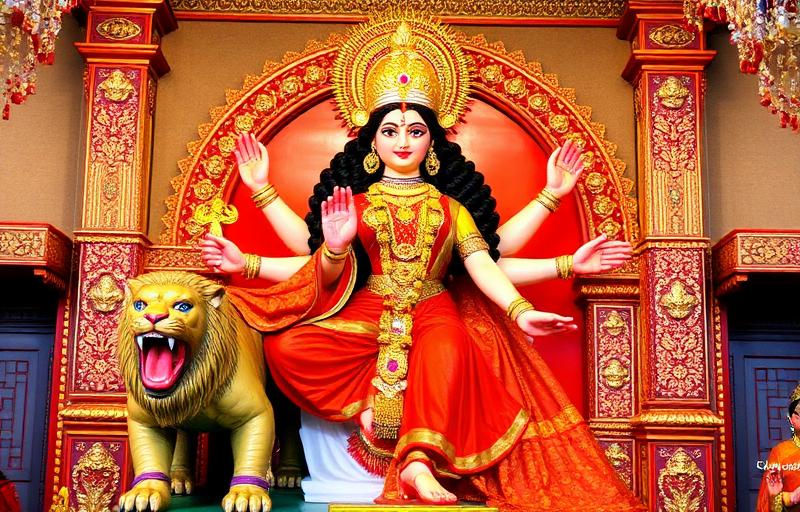
Bengal's Durga Puja is not, in the popular imagination, primarily the story of a goddess killing a demon.
It is a daughter coming home.
The frame: Uma, also Gauri or Parvati, is the daughter of Menaka and Himalaya. She is married to Shiva, who lives on a mountain, has no money, wears ashes and animal skins, keeps bad company and is generally not what a mother wants for her daughter.
Uma comes home for four days in Ashwin, and then goes back.
That is Durga Puja. Shashthi, Saptami, Ashtami, Navami, and then Dashami, when she leaves.
Agamani songs are the songs of her coming. Vijaya songs are the songs of her leaving.
What the Agamani songs contain
They are almost entirely domestic and they are in Menaka's voice.
The recurring content:
- Menaka telling Himalaya to go and fetch her daughter, and being angry that he has not gone yet
- Menaka dreaming that Uma came
- Menaka complaining about her son in law: he has no house, no income, he begs, he wears ashes, he keeps ghosts and goblins for company, he took her daughter to a burning ground
- Menaka looking at Uma when she arrives and saying she has got thin
- Menaka asking whether she gets enough to eat there
- Uma reassuring her mother, and lying about it
- A neighbour reporting that Uma was seen begging with him
And the Vijaya songs, on Dashami, are worse:
- Menaka refusing to let her go
- Menaka asking for one more day
- Menaka saying she will not survive the year
- The moment of the actual departure
Why this works
Because it is the situation of every married daughter in the society that produced it.
A girl married out of her natal home, going to her husband's family, seen once a year, coming back thinner, saying everything is fine. A mother who cannot do anything about it and counts the months.
The songs put the goddess in that position and the emotion is entirely real, because everybody singing them and everybody listening has either been that daughter or that mother.
And on the last day of the puja, when the image goes into the river, the whole thing lands at once.
Both Ramprasad and Kamalakanta wrote them, and Kamalakanta's are generally considered the finest.
A well known one has Menaka saying that Uma has come and she will not let her go this time, that she will hide her, that Shiva can come and ask but she will say she is not here, and then, in the last verse, letting her go.
How to use them
- They are sung during Durga Puja, in Ashwin, generally September or October, and in the Mahalaya broadcast that precedes it
- The Mahishasura Mardini broadcast on All India Radio at dawn on Mahalaya, which has run since the 1930s, includes them, and it is the single most listened to piece of religious broadcasting in India
- Recordings by Pannalal Bhattacharya and others are widely available
- They are worth knowing even if you have no connection to Bengal, because they are the clearest example in Indian devotion of a theological festival being carried entirely by a domestic emotion
What to Take From Him

One. Everybody says she is black.
The procedure: take something everybody says, notice that it has stopped being a claim and become a noise, ask how they know, check it against what you have actually seen, and report the difference.
And notice what the song does not do. It does not conclude that there is nothing there. It concludes that the description has been mistaken for the thing, which is a different and more useful finding.
Two. He held two traditions at once.
He wrote to Kali and to Krishna, in the Shakta and Vaishnava idioms both, and Bengal has never found that strange.
The relevant general point: the sectarian boundaries matter much more to institutions than to practitioners, and a large proportion of the poets in this series moved across them without comment.
Three. The Agamani songs.
The most theologically loaded festival in Bengal is carried, emotionally, by a mother worrying that her daughter is not being fed properly at her in laws' house.
What that tells you about how devotion actually works: the doctrine is the frame and the domestic feeling is the content. People are not moved by the destruction of Mahishasura. They are moved by Menaka asking whether Uma has got thin.
And there is a real observation about family in it. The Agamani and Vijaya songs are, at bottom, about a woman who was married away and is seen once a year and says everything is fine.
If you have a daughter, a sister or a mother in that position, the songs are about you, and the appropriate response to them is a phone call.
Four. My desire has not been satisfied.
One of his best known refrains is that he has not finished looking, that he came for this and the life is going, and that he still has not seen what he came to see.
It is not a despairing song. It is a statement that the thing is not finished, made by a man who kept at it for fifty years, and it is more honest than a song claiming arrival would be.
A daily practice from this entry:
- Jai Ma or Om Krim Kalikayai Namah
- One Agamani song during Durga Puja, with a translation if you do not have Bengali
- The Mahalaya broadcast at dawn, which is free everywhere
- On Dashami, when the image goes to the water, the Vijaya songs
- And the colour question, applied once a week to something you have been repeating
A closing thought
A court pandit at Bardhaman, secure, patronised and thoroughly trained, wrote a song pointing out that everybody says Kali is black, and asking how they would know, and reporting that in his own practice she had been red and white and blue and yellow, and that the people repeating the description had not looked.
And then he wrote the songs Bengal sings when the image comes home in Ashwin, which are not about a goddess at all but about a mother who has not seen her daughter for a year, asking her whether she is getting enough to eat and being told, untruthfully, that everything is fine.
The Short Version
Who: Kamalakanta Bhattacharya, roughly 1769 to 1821, born at Channa in Bardhaman district, West Bengal, and settled at Kalna on the Ganga. The second great poet of Shyama Sangeet after Ramprasad Sen, and in many Bengali readers' view the better technician.
His position: court pandit and guru of Maharaja Tejchandra of Bardhaman, with patronage, security and standing that Ramprasad largely did not have. He built a Kali temple at Kalna with the Maharaja's support and was a trained Shakta sadhaka.
His works: Kamalakanter Padavali, the songs; Sadhak Ranjan, a manual on practice; and several hundred songs across the Shyama Sangeet, Agamani and Vaishnava padavali forms. He composed to Kali and to Krishna both and did not treat that as a contradiction.
His most famous song: everybody says Kali is black, but is my mind's Kali black? Sometimes red like a hibiscus, sometimes white, sometimes blue, sometimes yellow. The people who say she is black are describing a colour and have not looked. It is a general procedure: take what everybody repeats, ask how they know, check it against what you have seen, and report the difference.
The Agamani songs: his other great contribution. In Bengal, Durga Puja is not primarily the killing of a demon; it is Uma, daughter of Menaka and Himalaya, coming home for four days in Ashwin from her husband Shiva, who has no money and lives on a mountain. The Agamani songs are her coming and the Vijaya songs are her leaving on Dashami. They are almost entirely in Menaka's voice: complaining about her son in law, saying Uma has got thin, asking whether she gets enough to eat, and refusing to let her go.
Why they work: they put the goddess in the position of every married daughter in the society that produced them, and everybody singing and listening has been that daughter or that mother.
Where to hear them: the Mahalaya broadcast at dawn before Durga Puja, and the Pannalal Bhattacharya recordings.
Quick Answers
Who was Kamalakanta Bhattacharya?+
A Bengali Shakta poet, roughly 1769 to 1821, born at Channa in Bardhaman district and settled at Kalna on the Ganga. He is the second great poet of Shyama Sangeet after Ramprasad Sen and is often considered the better technician of the two, having had a full Sanskrit education. He was court pandit and guru of Maharaja Tejchandra of Bardhaman, and wrote several hundred songs along with Sadhak Ranjan, a manual on practice.
What is the song about Kali's colour?+
His most famous song, which begins by observing that everybody says Kali is black, and then asks whether his mind's Kali is black. It goes on: sometimes she is red like a hibiscus, sometimes white, sometimes blue, sometimes yellow, and he has contemplated her in every colour there is and cannot say which she is. The people who say she is black are describing a colour and have not looked. The argument is that Kali means black, that the statement is about images rather than about her, and that the description has been mistaken for the thing.
What are Agamani songs?+
Songs of Uma's coming home, sung at Durga Puja. In Bengal the festival is not primarily the story of a goddess killing a demon; it is a daughter coming home for four days. Uma is the daughter of Menaka and Himalaya, married to Shiva who has no money, lives on a mountain, wears ashes and keeps bad company. The Agamani songs are almost entirely in Menaka's voice: telling Himalaya to go and fetch her, complaining about her son in law, saying Uma has got thin, and asking whether she gets enough to eat. The Vijaya songs, on Dashami, are her leaving.
Why are the Agamani songs so moving?+
Because they describe the situation of every married daughter in the society that produced them: a girl married out of her natal home, going to her husband's family, seen once a year, coming back thinner and saying everything is fine, and a mother who cannot do anything about it and counts the months. The songs put the goddess in that position, so the emotion is entirely real, because everybody singing them and everybody listening has either been that daughter or that mother. The doctrine is the frame and the domestic feeling is the content.
How does Kamalakanta differ from Ramprasad?+
Ramprasad is rougher, more direct and closer to speech, complaining and arguing and using agricultural and household imagery, and he had no patronage for most of his life. Kamalakanta had a full Sanskrit education and was a court pandit with security and standing, and his songs are more polished, more philosophically loaded and more interested in paradox, frequently turning on a conceptual problem rather than an emotional complaint. Both are sung constantly and most Bengali listeners do not particularly separate them.
Where can I hear the Agamani songs?+
In the Mahishasura Mardini broadcast on All India Radio at dawn on Mahalaya, which has run since the 1930s and is the single most listened to piece of religious broadcasting in India, and in recordings by Pannalal Bhattacharya and others, which are widely available. They are sung throughout Durga Puja in Ashwin, generally September or October, and the Vijaya songs on Dashami when the image goes into the water. They are worth knowing even with no connection to Bengal, as the clearest example in Indian devotion of a theological festival carried entirely by a domestic emotion.
About the author
Pandit Mahesh Trivedi · Festival Traditions & Panchang
Pandit Mahesh leads the festival-date and Panchang content on Vandnaa. He cross-references multiple regional panchangs (Drik, Vaishnava, Bengali, Marathi) for every festival date published on the site.
Meet the Vandnaa editorial team →