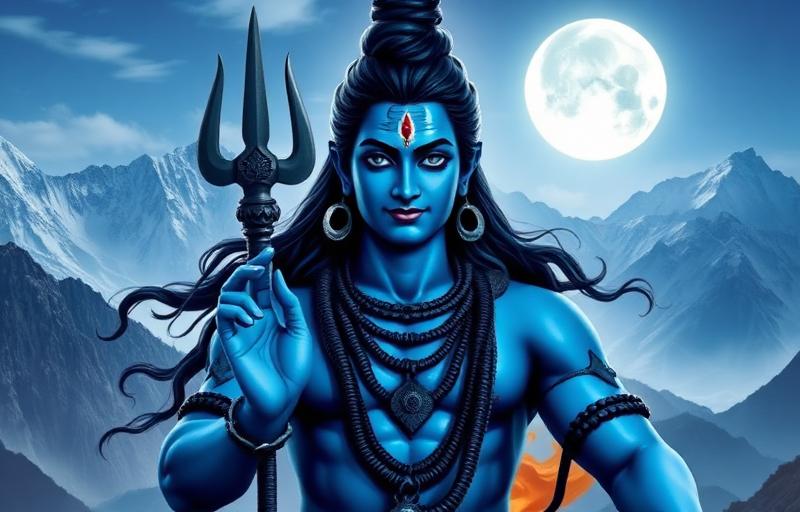
The Deity of the Lake
Deo Kamrunag is among the most important deities of Mandi district in Himachal Pradesh, worshipped at a temple beside a small lake high in the hills, at roughly three thousand three hundred metres.
In Himachal's devta system, deities have defined domains and defined powers. Kamrunag's are specific:
- He is regarded as a deity of rain, and villages in Mandi have long petitioned him when the monsoon fails
- He is counted among the senior devtas of the Mandi region, with a recognised position in the district's devta hierarchy
- His seat is the lake itself, and the water is treated as belonging to him
- He participates in the Mandi Shivratri fair, when the district's deities gather
What makes him known beyond Himachal is the tradition of offering. For as long as anyone can account for, devotees reaching the lake have thrown gold, silver, coins and ornaments into the water as an offering.
Nothing is taken out. There is no collection, no counting, no retrieval. The offerings are given to the lake and stay in it, and the tradition treats the water as the deity's treasury.
That single practice tells you more about Himachal's relationship with its deities than any description of ritual could.
The Barbarik Connection
Local tradition in Mandi identifies Kamrunag with a figure from the Mahabharata, and the identification is worth following because it connects Himachal to a deity worshipped a thousand kilometres away.
The Mahabharata episode:
- Barbarik, grandson of Bhima through Ghatotkacha, was a warrior of extraordinary power who came to Kurukshetra intending to fight
- Asked which side he would join, he said he would fight for whichever side was losing, which would have made the war unwinnable for anyone
- Krishna asked him for his head in charity, and Barbarik gave it
- In return he was granted the boon of watching the entire war, and of being worshipped in the age to come
In Rajasthan, that figure is worshipped as Khatu Shyam ji, one of the most followed deities of the state.
In Mandi, tradition identifies Kamrunag with the same figure, and describes him as having chosen this hill as the place from which to watch, remaining there afterwards as the region's deity.
Devotees on both sides know this. Families from Himachal who visit Khatu Shyam are aware of the connection, and Mandi's own tradition holds it firmly.
What it illustrates is how Indian devotional geography actually works. A single episode from the epic produces a deity in the Rajasthan desert and a deity at a Himalayan lake, worshipped completely differently, by communities who may never meet, both understood locally as the same presence.
The Treasure in the Water
The offering tradition at Kamrunag lake is unusual enough that visitors ask about it before anything else.
How it works:
- Devotees reaching the lake offer gold, silver, coins, ornaments and money by dropping them into the water
- The offering is made after darshan at the temple beside the lake
- Offerings accumulate over generations, and the tradition holds that they have never been removed
- The lake is treated as the deity's own possession, and taking anything from it is unthinkable within the tradition
What this depends on is not security arrangements but consensus. The tradition holds among the villages of the region, has held for a very long time, and is maintained by the same devta system that governs everything else in Mandi's religious life.
Devotees describe the reasoning simply. What is given to a deity is no longer yours, and it was never given on condition of being counted. A donation box is emptied, banked and spent. Something dropped into a lake is not.
For visitors, the etiquette follows from this:
- Do not attempt to retrieve anything, look for anything in the shallows or make jokes about it
- Do not photograph in a way that suggests searching
- Offer if you wish, in whatever measure is right for you, and understand that the offering ends there
- Treat the lake water as part of the shrine rather than as a swimming or picnic spot
The Trek and the June Mela

Kamrunag is reached on foot, and the walk is a real hill trek rather than a stroll.
- The usual base is Rohanda, reachable by road from Mandi, with the walk to the lake taking several hours
- Approaches also exist from Kandha and other villages on the ridge, and local advice on the current best route is worth taking
- The path climbs through deodar and oak forest before opening onto high meadow near the lake
- Weather changes fast at this altitude, and the ridge is exposed in the last stretch
The annual mela is held in the middle of June, and it is the largest gathering of the year at the lake. Devotees from across Mandi and beyond climb for it, camp near the temple, and the offering into the lake is made in large numbers over those days.
Other things to know:
- Best time is May to October. Snow closes the route in winter and lingers into spring at this height.
- Facilities are minimal. Carry water, food and warm layers regardless of the season.
- Accommodation near the lake is basic, with local arrangements during the mela
- The temple is wooden, in the Himachali style, and the setting is high open meadow with the lake beside it
As at all high altitude shrines, go early, do not attempt the walk in bad weather, and carry your waste back down. The meadow and the lake are the shrine, and both are easily damaged by the numbers that now reach them.
Kamrunag in Mandi's Devta System
To understand Kamrunag you have to understand how Himachal's devta system works, because it is unlike temple religion in the plains.
- Every village or group of villages has a devta or devi, with a defined territory
- The deity has a rath or palanquin, carried by bearers, in which the deity travels
- A gur serves as the traditional oracle through whom the deity is understood to speak
- A kardar and other office holders manage the deity's affairs, which historically included land, disputes and village decisions
- Deities have relationships with each other, ranks, alliances and precedence, and these are remembered and observed
- Deities travel to festivals, and their meetings are the substance of Himachal's great fairs
The two occasions when this becomes visible on a large scale are Kullu Dussehra, where the valley's deities gather at Dhalpur, and the Mandi Shivratri fair, where the deities of Mandi district are brought to the town in procession.
Kamrunag holds a senior place in the Mandi order, and his participation in the Shivratri fair is part of the district's traditional protocol rather than a ceremonial appearance.
For a visitor, this is the thing worth carrying away. In Himachal, a deity is not only worshipped. A deity holds a position, travels, speaks through a gur, meets other deities and is owed specific courtesies. Kamrunag's lake full of gold makes sense inside that system and looks inexplicable outside it.
Planning the Climb
This is a trek to a high altitude shrine, and it should be planned as one.
- Base - Rohanda, reached by road from Mandi. Confirm the current road head and route locally before setting out.
- Walk - several hours each way, through forest and then open ridge, with the lake and temple at the top
- Fitness - moderate hill fitness needed. Those with heart or breathing conditions should take advice.
- Season - May to October. The June mela is the biggest occasion. Winter is closed by snow.
- Carry - water, food, warm layers, rain protection, a torch and cash for offerings
- Stay - basic arrangements near the lake, more comfortable options at Mandi or Rohanda
Combine with:
- Mandi town, with the Bhootnath and Panchvaktra temples on the Beas
- Parashar lake and temple, another high altitude Mandi site with a three storeyed pagoda
- Shikari Devi, the roofless shrine on another ridge in the same district
- Mandi Shivratri fair in Phalgun, when the district's deities gather in town
One closing note for anyone going. The lake is not a viewpoint with a temple next to it. It is a deity's residence into which people have been giving away valuables for generations, on trust, without any mechanism enforcing that trust. Standing there and understanding what that means is what devotees describe as the point of the climb.
Reader Questions Answered
Who is Deo Kamrunag?+
Deo Kamrunag is a senior deity of Mandi district in Himachal Pradesh, worshipped at a temple beside a high altitude lake. He is regarded as a deity of rain, and local tradition identifies him with Barbarik of the Mahabharata.
Why do devotees throw gold into Kamrunag lake?+
The lake is treated as the deity's own possession, and devotees have offered gold, silver, coins and ornaments into the water for generations. Nothing is ever removed, and the tradition holds because the villages of the region maintain it, not because of any security arrangement.
How is Kamrunag connected to Khatu Shyam?+
Local tradition in Mandi identifies Kamrunag with Barbarik, the grandson of Bhima who gave his head to Krishna and was granted the boon of watching the war and being worshipped. The same figure is worshipped in Rajasthan as Khatu Shyam ji.
How do you reach Kamrunag lake?+
The usual base is Rohanda, reached by road from Mandi, with a walk of several hours to the lake through forest and open ridge. Approaches also exist from Kandha and other villages, and local advice on the current route is worth taking.
When is the Kamrunag mela?+
In the middle of June, when devotees from across Mandi and beyond climb to the lake, camp near the temple and make their offerings. It is the largest gathering of the year at the shrine.
What is the Himachal devta system?+
Each village or group of villages has a deity with a defined territory, a palanquin in which the deity travels, a gur who serves as the traditional oracle and office holders who manage the deity's affairs. Deities have ranks and relationships, and they gather at fairs such as Kullu Dussehra and Mandi Shivratri.
About the author
Anjali Mehta · Editor, M.A. Religious Studies
Anjali is the managing editor for Vandnaa and oversees the festival and vrat coverage. She holds an M.A. in Religious Studies and reviews every published article for accuracy, accessibility, and tradition-fidelity.
Meet the Vandnaa editorial team →Explore on Vandnaa
Related Articles
Shikari Devi: The Himachal Shrine That Has Refused a Roof for Centuries
8 min read

Khatu Shyam Katha - Barbarika's Devotion and Krishna's Boon
8 min read
Bijli Mahadev: The Kullu Linga That Is Struck by Lightning and Rebuilt With Butter
8 min read
Hidimba Devi of Manali: From Bhima's Wife to the Goddess Kullu Cannot Begin Without
8 min read