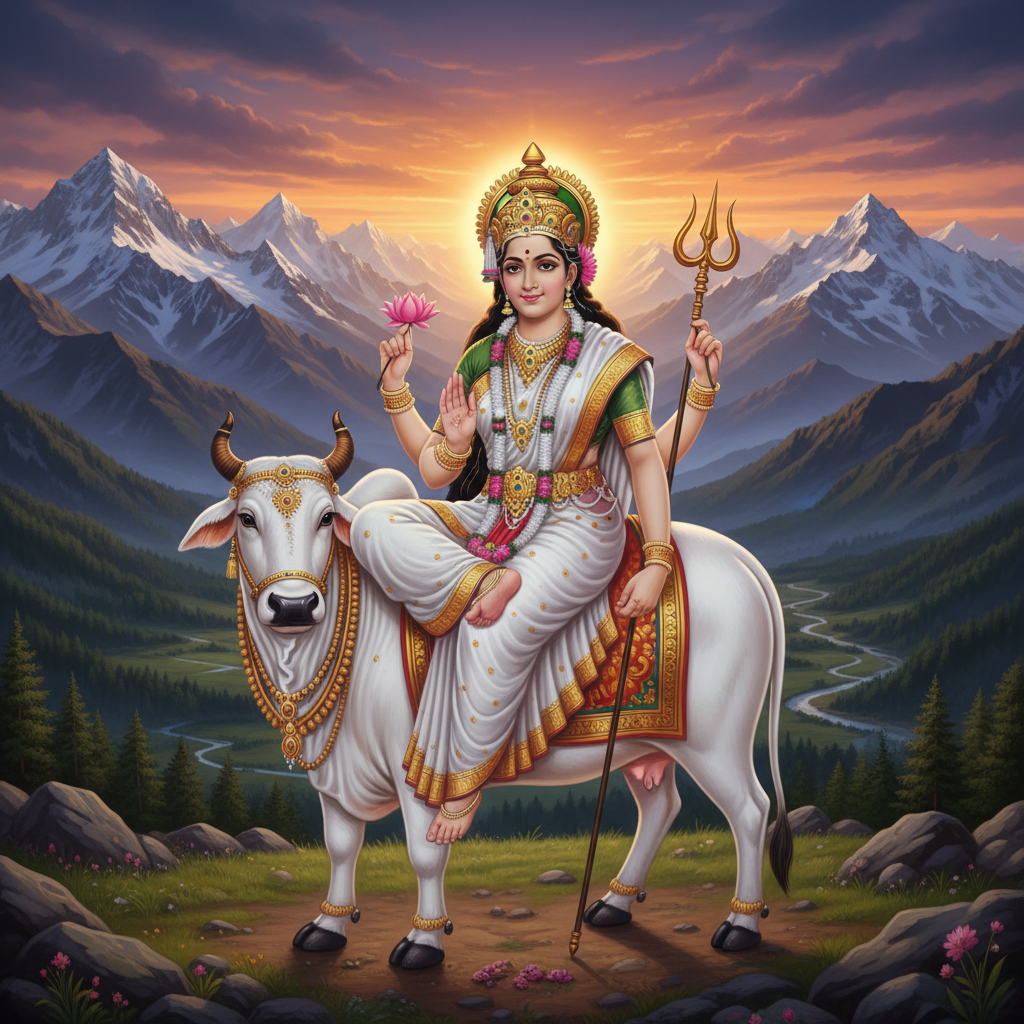
A Shrine With the Sky for a Roof
Shikari Devi is worshipped at the top of a ridge in Mandi district of Himachal Pradesh, at close to two thousand eight hundred and fifty metres, and the first thing every visitor notices is what the temple does not have.
There is no roof. The Devi's stone murtis sit within a low walled enclosure, open to the sky, exposed to sun, rain and heavy winter snow. Tradition in the region holds that roofing the shrine has been attempted more than once and has never held, and that the Devi does not wish to be covered.
Devotees add a second observation that they treat as confirmation. Even in deep winter, when the ridge is under snow, the snow is said not to settle over the murtis themselves.
What this produces is one of the most unusual devotional experiences in the western Himalaya. There is no sanctum in the ordinary sense, no dark interior, no lamp filled chamber. Worshippers stand in the open, at the highest point for a long way in any direction, with the murtis in front of them and the ranges of Mandi, Kullu and Karsog visible on all sides.
Himachal has many hill shrines, but few make the landscape so directly part of the darshan.
The Pandavas, Markandeya and the Name
Three strands of tradition are attached to this shrine, and local families will usually mention all of them.
The Pandava strand. The Pandavas are said to have spent part of their exile in these hills and to have worshipped the Devi here. The Mandi and Karsog region carries several such associations, and Shikari Devi is among the most repeated.
The Markandeya strand. Rishi Markandeya, remembered in Puranic tradition for the Markandeya Purana that contains the Devi Mahatmya, is said to have performed tapas on this ridge. That connection places the shrine within the wider Shakta tradition rather than only in local devta worship.
The name. Shikar means hunt. In an earlier period, when these ridges were hunting country, the Devi was invoked by those going out for the hunt, and the name has stayed. Local tellings say that hunters who worshipped here returned successful, and that those who came with the wrong intention did not.
That last strand carries an irony worth noting. The forest around the shrine is now the Shikari Devi Wildlife Sanctuary, where hunting is prohibited and the area is protected for its wildlife and old growth forest. The goddess of the hunt now presides over land where hunting is not allowed at all, and local devotees mention this without any sense of contradiction, since the Devi is understood to protect whatever the land needs protecting from.
Getting There: Janjehli, Karsog and the Last Climb
Shikari Devi is a genuine hill journey rather than a roadside temple, and that is a large part of why devotees value reaching it.
- The usual base is Janjehli, in Mandi district, reached by road from Mandi town through Gohar. From Janjehli the climb to the temple is a walk of several kilometres.
- A second approach is from the Karsog side, and local roads reach closer to the ridge in some seasons, shortening the walk considerably
- The path runs through dense deodar, oak and rhododendron forest before opening onto the exposed ridge for the final stretch
- Weather is the main variable. The ridge is clear and beautiful in season, and dangerous in a storm.
Best months are May to June and September to early November. Winter closes the higher approaches with snow, and while devotees do reach the shrine in winter, it requires local guidance and preparation. The monsoon brings cloud, leeches in the forest stretch and slippery ground.
What to carry: warm layers regardless of season, rain protection, water, food for the walk, and a torch if you plan an early start. Facilities at the top are minimal, and mobile network is patchy across the route.
Go with a local guide or in a group if you are unfamiliar with the area, and always start early enough to be back down before dark.
Worship at an Open Air Shrine

Worship here is stripped down by the conditions, and devotees say that is part of its character.
- Offerings are simple: flowers, red cloth, a coconut, sweets and a lamp, all carried up
- There is no elaborate abhishek or long ritual sequence, since the shrine is exposed and the weather does not always permit standing for long
- Local families come after harvest and before major family events, as at other Himachal shrines
- Navratri, in both Chaitra and Ashwin, brings the largest gatherings, with groups walking up together
- Villages of the surrounding area maintain the shrine collectively, in the way Himachal's hill temples are usually looked after
The absence of a roof also means the absence of the usual arrangements that come with one. There is no long queue system, no separate darshan lines and no interior for the priest to control access to. Devotees walk up, approach the enclosure, offer, and stand for as long as the weather allows.
One request from those who look after the site is worth passing on. Because the shrine is open and remote, whatever is carried up stays up unless visitors take it back. Plastic, packaging and bottles should come down with you. The ridge is inside a wildlife sanctuary, and keeping it clean is treated locally as part of the darshan rather than as an instruction from outside.
Shikari Devi in Mandi's Temple Country
Mandi district is often called the Varanasi of the hills for the number of temples in and around the town, and Shikari Devi sits at the wild end of that landscape.
- Bhootnath and Panchvaktra temples, Mandi town - old Shiva temples on the Beas, at the centre of the town's Shivratri festival
- Tarna Devi and Shyama Kali, the hill shrines above Mandi town
- Kamrunag, another high altitude shrine in the district, famous for the lake into which devotees have offered valuables over generations
- Parashar lake and temple, with its three storeyed pagoda beside a floating island
- Shikari Devi, the highest and most exposed of them
- Karsog valley temples, including Mamleshwar and Kamaksha, on the other side of the ridge
The Mandi Shivratri fair is the district's largest religious event, when hundreds of village deities are brought in palanquins to Mandi town, and it is the single best occasion to see how the devta system of this region works.
For a devotional trip, a practical route is Mandi town first for the Shiva temples, then Janjehli for Shikari Devi, and Karsog or Parashar depending on how many days you have. The distances are short on the map and long on the road, so plan generously.
Why Devotees Make This Climb
Shikari Devi does not offer what most well known shrines offer. There is no grand architecture, no long ritual programme, no famous prasad and no crowd management. What it offers instead is the thing devotees keep returning for.
The reasons people give are consistent:
- The climb is the offering. Reaching a shrine on foot is understood across the Himalaya as the substance of the pilgrimage, not the preliminary to it.
- The Devi is unprotected, like the people who worship her. A shrine that sits through snow and storm without a roof reads, to hill families, as a deity who lives in the same conditions they do.
- It is a place to ask plainly. With no ritual apparatus in the way, devotees say what they have come to say and leave.
For visitors from outside the region, the useful thing to understand is that this is not a scenic viewpoint that happens to have a temple. It is a working shrine that happens to have an extraordinary view, and it is treated by local families with the seriousness that implies.
If you go, go early, carry your own supplies, take your waste back down, and give yourself time to sit at the top for a while. Almost everyone who has made the walk says the same thing about that part of it.
Common Questions From Devotees
Why does the Shikari Devi temple have no roof?+
Tradition in Mandi district holds that attempts to roof the shrine have never held, and that the Devi does not wish to be covered. Devotees also say snow does not settle over the murtis even in deep winter.
What does the name Shikari Devi mean?+
Shikar means hunt. In earlier times those going out to hunt in these ridges invoked the Devi here. The forest around the shrine is now the Shikari Devi Wildlife Sanctuary, where hunting is prohibited.
How do you reach Shikari Devi temple?+
The usual base is Janjehli in Mandi district, reached by road from Mandi town through Gohar, followed by a climb of several kilometres. An approach from the Karsog side shortens the walk in some seasons.
What is the best season to visit?+
May to June and September to early November. Winter snow closes the higher approaches, and the monsoon brings cloud, leeches in the forest stretch and slippery ground.
Which traditions are associated with the shrine?+
The Pandavas are said to have worshipped here during their exile, and Rishi Markandeya is said to have performed tapas on the ridge, which connects the shrine to the wider Shakta tradition alongside local devta worship.
What should visitors carry and be careful about?+
Warm layers in any season, rain protection, water, food and a torch for an early start. Facilities at the top are minimal, network is patchy, and all plastic and packaging must be carried back down since the ridge lies inside a wildlife sanctuary.
About the author
Pandit Ravindra Sharma · Vedic Rituals & Bhakti, 22+ years
Pandit Ravindra is the Vandnaa editorial team's resident specialist on aarti, chalisa, and daily devotion. He has performed home and temple pujas across Varanasi and Delhi for over two decades and contributes the bhakti-focused articles on this site.
Meet the Vandnaa editorial team →Explore on Vandnaa
Related Articles

Bijli Mahadev: The Kullu Linga That Is Struck by Lightning and Rebuilt With Butter
8 min read
Hidimba Devi of Manali: From Bhima's Wife to the Goddess Kullu Cannot Begin Without
8 min read
Hateshwari Mata Temple, Hatkoti: History and Guide
7 min read
Renuka Ji Lake and Temple: Legend, Mela and Guide
8 min read