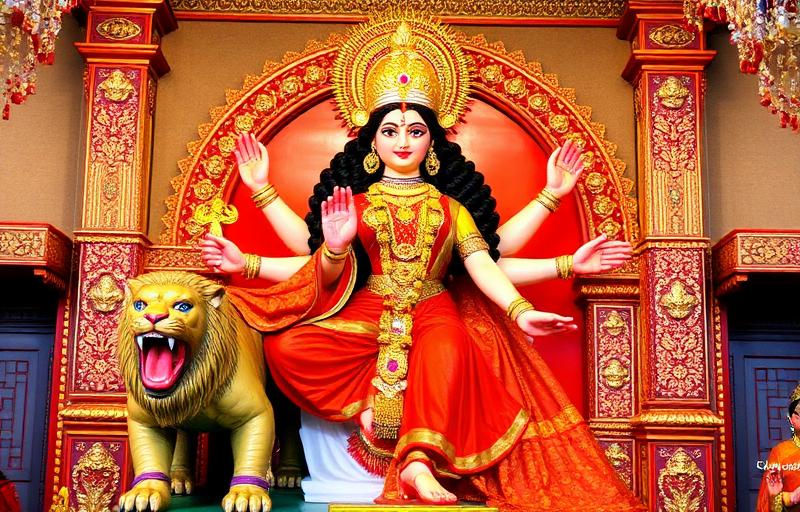
A Careless Remark About Complexion
In one Puranic account, distinct from but thematically related to Parvati's own earlier penance to win Shiva's affection covered elsewhere in this series, Shiva, in a moment of teasing or careless remark depending on the telling, referred to Parvati using the term Kali, meaning the dark one, a comment about her complexion that, whether intended affectionately or not, wounded her deeply.
Rather than simply expressing hurt, Parvati withdrew to undertake her own penance specifically to transform her complexion, and through this austerity, she released from her own body a separate, dark-hued form, retaining a golden, radiant complexion for herself afterward, from which the epithet Gauri, the fair or golden one, derives as one of her subsequent names.
A New Goddess Emerges Fully Formed
The dark sheath released from Parvati's body did not simply dissipate but coalesced into an independent, fully formed goddess, Kaushiki, named either for her fierce, warrior-like nature or, in some tellings, for a connection to the sage Kaushika, an alternate name for Vishwamitra covered elsewhere in this series, though the etymological connection between the two figures varies by source and is not firmly established across all tellings.
Kaushiki emerged with formidable independent power, understood in several Puranic and Devi-focused texts as the goddess who subsequently battles and defeats the demon brothers Shumbha and Nishumbha, a significant episode within the Devi Mahatmya tradition, establishing her not as a diminished or secondary aspect but as a fully capable, independently significant form of the goddess in her own right.
Why Separating a Trait Produces a Goddess Rather Than a Loss
Kaushiki's origin story fits within a broader pattern this series has traced across Devi-focused mythology, where aspects of the goddess separated out, whether through anger, insult, or deliberate withdrawal, do not represent diminishment but rather independent manifestations carrying full divine power, similar in structural logic to how Kali emerges from Durga's fury during the Raktabija confrontation covered elsewhere in this series.
The episode is also notable for how it treats the original insult: rather than the goddess simply enduring or forgiving a careless remark about her appearance, the text has her respond with a transformation so complete it produces an entirely new, formidable deity, reframing what could have been a small domestic slight into the origin story of a major independent goddess with her own significant mythology and worship tradition in parts of the country, particularly regions where Kaushiki is venerated under various regional names connected to river goddesses bearing similar etymological roots.
Reader Questions Answered
Is Kaushiki the same figure as the river goddess Kaushiki in some regional traditions?+
There is overlap and connection in some regional traditions, particularly in eastern India, though the exact relationship between the warrior goddess of this myth and river-associated Kaushiki worship varies and is not treated as fully identical across every source.
Did Shiva apologise or respond after Parvati's transformation?+
Different tellings vary on this detail; the primary narrative focus generally remains on Parvati's own transformation and Kaushiki's subsequent independent role rather than on an extended reconciliation scene between Shiva and Parvati.
Is Kaushiki's battle with Shumbha and Nishumbha part of the Devi Mahatmya text?+
Yes, this confrontation is a significant episode within the Devi Mahatmya, the core text of Durga worship found within the Markandeya Purana, covered elsewhere in this series, where the goddess in various forms confronts multiple demon threats across the text's three main episodes.
About the author
Anjali Mehta · Editor, M.A. Religious Studies
Anjali is the managing editor for Vandnaa and oversees the festival and vrat coverage. She holds an M.A. in Religious Studies and reviews every published article for accuracy, accessibility, and tradition-fidelity.
Meet the Vandnaa editorial team →