Why Krishna's 108 Names Suit a Japa Practice
Krishna's Ashtottara Shatanamavali, his set of 108 names, is already well documented elsewhere for its meanings, from Achyuta (the infallible) to Yogeshwara (lord of yoga). What is less often addressed is how to actually turn that list into a working daily habit, which is the gap this guide fills.
The number itself is not incidental to japa practice. A traditional japmala (prayer bead necklace) carries exactly 108 beads plus a sumeru, the guide bead marking the start and end of a round. This means Krishna's 108 names map onto a single complete mala round with mathematical precision, one name, one bead, one full circuit. Few name-lists align this cleanly with the mala itself, which is part of why this particular set has remained such a popular choice for structured japa across generations of devotees.
Unlike chanting a single mantra 108 times, reciting 108 different names keeps attention naturally engaged; each bead brings a new word, a new attribute of Krishna to briefly hold in mind; Achyuta's steadiness, Govinda's tenderness toward cows and cowherds, Madhava's sweetness, Damodara's playful, bound-by-love form as a child. This variety is genuinely useful for beginners who find single-mantra repetition prone to the mind wandering; a changing name every few seconds gives the mind something fresh to track.
This guide assumes you already have access to the list of 108 names in some form, whether a printed card, an app or a book, and focuses entirely on what to actually do with it: how to structure the sitting, which time of day works best, how to use the mala correctly, and how to build this into a habit that survives busy weeks rather than fading out after the initial enthusiasm of week one.
Building the Habit: Start Smaller Than You Think
The single biggest reason a new japa practice fails is not lack of devotion, it is starting at full intensity and burning out within two weeks. A full round of 108 names, chanted with any attention, typically takes 10 to 15 minutes. That is a realistic daily commitment for many people, but not for everyone, and it is far better to start smaller and succeed than start big and quit.
A graded approach that works well:
- Days 1-3: Chant just 27 names (a quarter round), reading slowly from your list, simply to get comfortable with pronunciation and the physical rhythm of moving a bead with each name.
- Days 4-7: Move to 54 names (a half round), still reading from the list as needed, no pressure to memorize anything yet.
- Week 2: Attempt a full round of 108, allowing yourself to read from the list throughout, the goal at this stage is completion, not memorization.
- Week 3 onward: Continue the full round daily; by now, many devotees find the most frequently repeated or personally resonant names (Krishna, Govinda, Gopala, Madhusudana, Achyuta) are sticking in memory naturally, without deliberate effort, simply from repetition.
This staged build matters because it respects a basic truth about habit formation: consistency at a small scale beats intensity that collapses after a fortnight. A devotee who reliably does 27 names daily for a month has built a stronger foundation than one who does 108 for four days and then stops entirely from exhaustion or guilt.
It is worth naming directly: there is no traditional requirement to complete all 108 in a single sitting from day one, or ever, if your life circumstances do not allow it. Sincerity and consistency, not volume, are what tradition consistently emphasizes.
Best Time and Setting for This Practice
Timing affects consistency more than most devotees expect, choosing a slot that competes with a busy part of the day quietly dooms a new habit before it starts.
Brahma muhurta, the period roughly 90 to 96 minutes before sunrise, is traditionally considered the most powerful window for any japa practice, the mind is naturally quieter and less cluttered by the day's demands. For Krishna specifically, this timing also carries a devotional resonance with his identity as Bala Gopala, the divine child associated with dawn, cows and the fresh start of a new day.
That said, brahma muhurta is not realistic for everyone's schedule, and tradition offers a genuinely useful second-best answer: consistency of slot matters more than the specific hour. A devotee who reliably chants at 9 PM every night builds a stronger habit than one who aspires to brahma muhurta but manages it only twice a month. Choose the time you can actually protect, not the time that sounds most impressive.
For setting:
- A fixed physical spot helps, a corner of a room, a chair near your altar, even a particular spot on your bed if that is genuinely the only quiet option available.
- Facing east or north is traditionally preferred, though this is a refinement to add once the core habit is stable, not a prerequisite for starting.
- Minimize interruption sources for the 10 to 15 minutes, phone on silent in another room if possible, family members aware this is your protected time.
- Some devotees prefer chanting aloud (vaikhari japa), others prefer a whisper (upanshu) or silent mental repetition (manasika), all three are traditionally valid; choose whichever keeps you most genuinely present rather than assuming louder is automatically more devout.
The honest goal is a slot you will actually protect on an ordinary Tuesday, not just on a peaceful Sunday morning.
How to Use the Mala Correctly
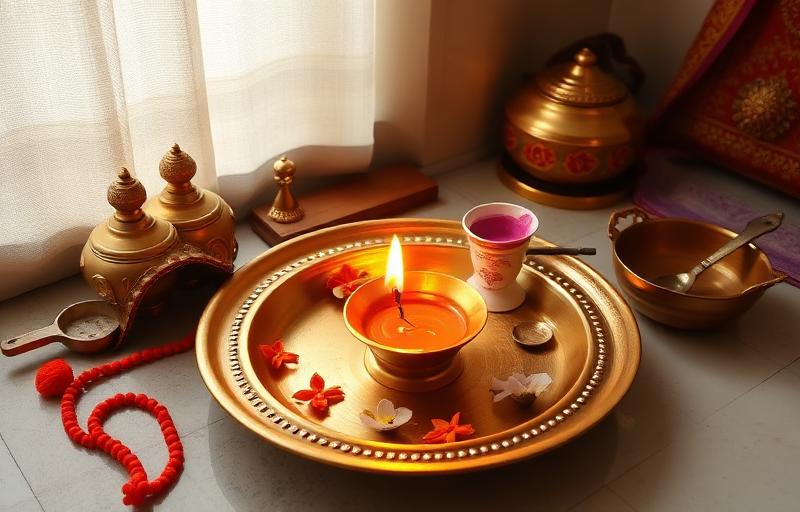
A japmala is a simple tool, but a few practical points make the practice smoother, especially for someone using one regularly for the first time.
- Starting position: Begin just after the sumeru, the slightly larger guide bead (often marked with a tassel), and move in one consistent direction around the mala, traditionally toward yourself rather than away, though the specific direction convention varies slightly by lineage and is not a point to worry over as a beginner.
- One bead, one name: Move each bead using the thumb, pushing it toward you while the middle finger holds the mala steady, avoiding the index finger, which is traditionally considered less suited for this purpose, though this too is a refinement rather than a strict rule.
- Never cross the sumeru mid-round: When you complete 108 names and reach the sumeru again, if you intend to do a second round, turn the mala around rather than crossing over the sumeru bead, a small traditional gesture of respect for the completed round.
- Tulsi mala for Krishna specifically: While any mala is acceptable, a tulsi wood mala carries particular significance for Krishna and Vishnu worship, since the tulsi plant itself is considered dear to Krishna; using one is a common but not mandatory refinement.
- No mala available? Counting on finger segments (there are twelve segments across the four fingers of one hand, excluding the thumb, allowing you to track sets of twelve toward 108 across nine rounds) or simply using a printed checklist with 108 boxes to tick works perfectly well while you acquire a mala.
A mala kept exclusively for this practice, rather than shared across many uses, and stored respectfully, wrapped in a small cloth pouch when not in use, is a small but meaningful way many devotees mark this practice as distinct from casual routine.
A Sample 4-Week Progression Plan
Bringing the earlier sections together, here is a complete sample plan a beginner can follow exactly, or adapt as needed:
Week 1: Familiarity. Chant 27 to 54 names daily, reading slowly from your list, at whatever time slot you have chosen. Focus entirely on correct pronunciation and comfort with the mala's mechanics, not speed or memory.
Week 2: Full Round. Attempt the complete 108 names daily, still reading from the list. Expect this to take close to 15 minutes at this stage; that is normal and will shorten with practice.
Week 3: Consolidation. Continue the daily full round. Begin noticing which names you no longer need to read, most devotees find 20 to 30 names sticking naturally by this point, particularly the most frequently used ones like Krishna, Govinda, Gopala, Vasudeva and Madhusudana.
Week 4: Rhythm. The practice should now feel like a settled part of your day rather than an effort. Consider adding a brief moment of reflection after completing the round, a minute of silence, or a short prayer in your own words, rather than immediately moving to the next task.
Beyond Week 4: Many devotees choose to maintain a single daily round indefinitely, a sustainable, meaningful long-term practice on its own. Others gradually increase to two or three rounds on special days (Janmashtami, Ekadashi) while keeping one round as the steady daily baseline.
If a week is disrupted by travel, illness or an unusually demanding stretch at work, simply resume at whatever week's pace feels comfortable rather than restarting from Week 1; the plan is a scaffold for building the habit, not a test to pass or fail.
Tracking Progress and Staying Consistent
A practice that repeats daily benefits enormously from some form of tracking, not for the sake of measurement itself, but because visible continuity is genuinely motivating and helps a devotee notice patterns in their own consistency.
Simple tracking methods that work well:
- A physical calendar with a mark for each day completed, kept near your puja space, gives an immediate visual sense of an unbroken streak, or an honest picture of where gaps tend to occur (often weekends, or particularly busy weekdays).
- A small notebook noting the date and a one-line reflection, which name felt most meaningful that day, whether the mind was scattered or focused, builds a personal record of the practice's evolution over months, not just a completion checkbox.
- A dedicated app-based counter removes the friction of manual tracking entirely and can send a gentle daily reminder, useful during the exact early weeks when the habit is most fragile and most likely to be forgotten rather than abandoned.
When consistency slips, and it will occasionally, the traditional guidance is straightforward: resume without guilt or dramatic self-criticism. Missing a day is not a spiritual failure requiring elaborate correction; it is simply a gap to close by returning the next day. Devotees who treat an occasional miss as catastrophic often quit the entire practice out of discouragement, while those who treat it as ordinary tend to sustain the habit for years.
A final, practical tip: pair the practice with an existing daily anchor, right after your morning tea, right before you check your phone for the day, right after brushing your teeth at night. Habits that attach to an existing routine survive irregular weeks far better than habits that depend on finding a fresh window of free time each day.
Quick Answers
How long does it take to chant all 108 names of Krishna?+
A full round typically takes 10 to 15 minutes for a beginner reading from a list, and often shortens slightly with practice as pronunciation becomes more familiar and natural.
Do I need to memorize all 108 names to do this practice?+
No. Reading from a printed list or app is completely acceptable, including long term. Many names do get memorized naturally through repetition over weeks, but memorization is a welcome side effect, not a requirement to begin or continue.
What is the best time of day to chant Krishna's 108 names?+
Brahma muhurta, roughly 90 minutes before sunrise, is traditionally considered ideal. However, a consistent time you can reliably protect every day, even if it is evening, builds a stronger habit than an ideal time you can rarely keep.
Can I do this practice without a japmala?+
Yes. Counting on finger segments or using a printed checklist with 108 boxes works well while you acquire a mala. A tulsi wood mala is traditionally preferred for Krishna worship but is a refinement, not a requirement.
What if I miss a day in my daily japa practice?+
Simply resume the next day without guilt. Tradition emphasizes consistency over an unbroken streak; treating an occasional missed day as ordinary rather than a failure helps sustain the practice for the long term.
About the author
Acharya Vinaya Kapoor · M.A. Sanskrit, Mantra & Stotra Studies
Acharya Vinaya holds an M.A. in Sanskrit from Banaras Hindu University and writes the mantra and stotra commentary on Vandnaa. Her focus is on accurate pronunciation, traditional context, and helping modern readers connect with classical texts.
Meet the Vandnaa editorial team →Explore on Vandnaa
Related Articles
Krishna 108 Names (Ashtottara) - Meaning, Japa Vidhi & Benefits
11 min read
Krishna Aarti Lyrics in Hindi & English - Aarti Kunj Bihari Ki
9 min read
Krishna Ashtottara Shatanamavali - Complete 108 Names of Krishna with Meaning & Benefits
12 min read

Ram Raksha Stotra as a Daily Protection Practice: How to Begin
7 min read