The Manual
Krishnananda Agamavagisha, Bengal, roughly the late sixteenth and early seventeenth century, associated with Navadvip in Nadia, and the author of the book that Bengali ritual runs on.
The dates are loose. He is placed in the generations after Chaitanya, the sources are late, and precise years are not available. What he wrote is not in doubt.
Brihat Tantrasara
The essence of the tantras, at length.
What it is: a compendium. Krishnananda read across a very large body of tantric literature, most of it scattered, much of it repetitive, a great deal of it obscure, and he extracted from it a working procedure.
What is in it
- Mantras, for a wide range of deities, with the rules for their use
- Yantras, with construction
- Puja krama, the order of a rite, step by step, in the sequence a person actually performs it
- Kavachas and stotras
- Nyasa, the placing of mantras on the body
- Purascharana, the disciplines that qualify somebody to use a mantra
- Timing, materials, substitutions, and what to do when the prescribed thing is unavailable
Which is to say it is a handbook.
Why that mattered
Because before it there was no single place to look.
The tantras are many, they disagree, they are written in deliberately compressed language, and a great deal of their content assumes a teacher standing next to you. A priest in a Bengali town in 1650 who needed to perform a specific rite correctly had a genuine research problem.
The Tantrasara solved it, and it solved it well enough that it displaced the alternatives, and it is still in use. Bengali purohits open it. Editions are in print. It is the standard reference.
Which makes Krishnananda one of the most quietly consequential figures in this entire series: he did not found anything, he did not have visions anybody records, and he standardised the practice of a region for four hundred years by compiling well.
A note on what a manual does
It settles things.
Before a standard reference, practice varies by teacher, by village and by memory. After one, practice converges on the book, and the variants that were not in the book start to die.
That is a gain and a loss at the same time, and it is the same event as the printing of a scripture or the fixing of a raga, and it happens once and cannot be undone.
Where the Image Came From
And this is the story he is actually known for.
The problem he had
He wanted to establish the worship of Kali in a public, householder form, and he needed an image, and the descriptions available in the texts were various and did not resolve into one figure that a craftsman could make.
What the tradition says happened
He was told, in a dream or a vision depending on the telling, that he should take as the model the first thing he saw the following morning.
And what he saw was a woman.
Dark, ordinary, at work, plastering cow dung cakes on the wall of her house to dry, which is a job done at dawn and was done by women in every village in Bengal.
Her left arm was raised to press a cake against the wall. One foot was forward. And when she noticed a man standing and staring at her she was embarrassed and bit her tongue.
And Krishnananda took that.
What the resulting image is
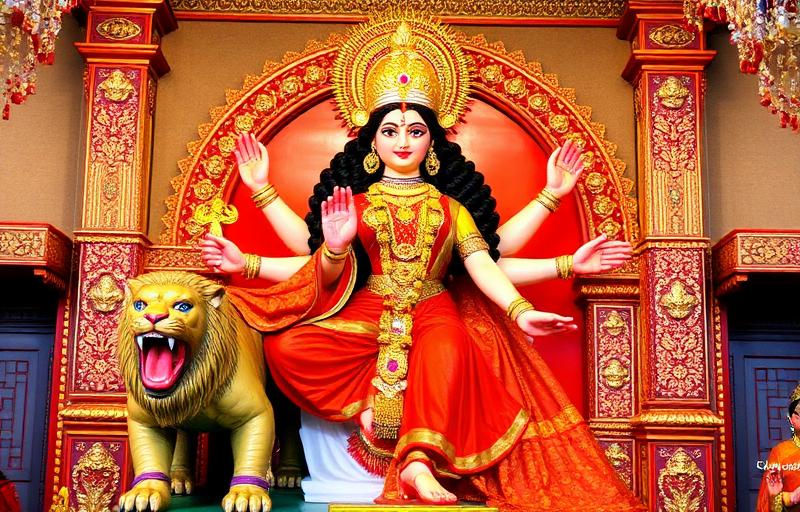
The Dakshina Kali of Bengal, which is now so standard that most people do not know it had an author.
- Dark, and the darkness is the point rather than a defect
- Four arms, two in the boon and protection gestures, two holding the sword and the severed head
- The garland of heads and the girdle of arms
- Standing on Shiva, who lies beneath her
- The left foot forward, in most Bengali images, which is the mark that distinguishes Dakshina Kali
- The tongue out
The tongue
And this is where two readings sit side by side and both should be given.
The Bengali household reading is lajja, embarrassment. She has stepped on her husband and stopped, and the tongue is the gesture an Indian woman makes when she has done something she should not have, and it is exactly the gesture the woman on the wall made.
The older iconographic reading is not that. A protruding tongue in fierce goddess imagery is a blood motif, it appears across a wide range of terrible forms, and it long predates any story about embarrassment.
Which means the lajja reading is a domestication, and that is not a criticism of it. Bengal took a terrifying figure and made her a mother, deliberately, over centuries, and the tongue was reinterpreted as part of that, and the result is that a Bengali household worships a goddess standing on a corpse in a garland of heads and calls her Ma without any sense of contradiction.
Which is one of the more remarkable pieces of theological work anybody has done, and it is largely anonymous, and Krishnananda's image is where it becomes visible.
What he set up
Public Kali Puja in Bengal, in a form ordinary households could hold, is credited to him in the tradition, with the later expansion under Raja Krishnachandra of Nadia in the eighteenth century.
And what you see every autumn in Bengal descends from it: the neighbourhood pandal, the clay image made at Kumartuli, the night of the puja, the immersion.
A note on the woman
She is not named.
The most reproduced sacred image in eastern India was modelled on a specific person who was doing unpaid domestic work at dawn and was embarrassed to be looked at, and nobody wrote down who she was.
Which is worth sitting with for a moment, and it is the same observation this series made about Salabega's mother two entries ago: the tradition runs through women who are not in the record, and it is not a coincidence that they are not in it.
What Tantra Is, and What Is Sold Under the Name
This section is the reason a devotional site should cover Krishnananda at all, because his name is attached to a word that is now mostly used to defraud people.
What the Tantrasara actually contains
Liturgy.
Open it and you find: how to sit, how to purify, how to place mantras on the body, what to offer, in what order, what to say, how many times, on which day, and what to substitute when something is unavailable.
It is a ritual procedure manual, and the overwhelming majority of tantric literature is exactly this. It is closer to a priest's order of service than to anything the word suggests in popular use.
What tantra is not
One. It is not primarily about sex.
There is a stream, vamachara, in which ritual transgression including sexual ritual appears, it is a real part of the literature, it is a minority of it, it was always restricted, and it was never what most practitioners did.
The modern presentation of tantra as a sexual technique is a marketing construction, assembled in the twentieth century largely outside India, and it has almost no relationship to the Tantrasara or to what a Bengali purohit does with it.
Two. It is not a system for controlling other people.
And this is the important one, because it is where the money is.
The fraud economy
Look at any classified page, any late night channel, any set of search results for a problem, and you will find these:
- Vashikaran. Bringing a specific person under your control. Get your love back in three days. Making somebody marry you
- Removal of black magic allegedly done to you by a named relative or neighbour
- Enemy destruction, business rival removal, court case victory
- Guaranteed results, with a fee, and a larger fee when the first one does not work
All of it is fraud, and the mechanism is always the same.
Somebody arrives in distress. A marriage is failing, a child is unwell, a business is collapsing, someone has left. They are told the cause is supernatural interference, usually by a person they already resent. A remedy is priced. It does not work. The failure is explained by the strength of the opposing magic, and a larger remedy is priced. This continues until the money is gone.
And the specific things to know
Nobody can control another person's mind. No mantra, no yantra, no ritual, no fee. If somebody has left you, they have left you, and a person who takes money to change that is stealing.
A demand for escalating payment is the diagnostic. One fee that does not work followed by a larger fee is not a spiritual matter. It is a recognised scam pattern.
Report it. Cybercrime helpline 1930 and cybercrime.gov.in for anything transacted online, police 112 otherwise, and the consumer helpline 1915.
Abhichara
Being straight about this rather than pretending it is not in the texts.
The tantras do contain the shatkarma, the six acts, and they include marana, uchatana and vidveshana: killing, driving away, and causing enmity.
This article will not describe them and will not point at where to find them.
And the position on them is simple. Attempting to harm another person is wrong whether or not it works, it is wrong at the moment of intending it, and a devotional practice aimed at hurting somebody has stopped being a devotional practice at that moment.
And if you commission somebody to harm another person, what happens next may involve actual acts and actual offences, and you will be responsible for them.
Human sacrifice
This has to be said plainly because it still happens.
There are documented cases in India, every year, of people killed for ritual purposes, and the victims are disproportionately children and people from poor and marginalised families.
So: anybody who tells you that a ritual requires a person's blood, a child's presence, a body part or a life is planning a murder.
Call police 112 immediately. Childline 1098 if a child is involved. Do not investigate. Do not confront. Do not wait to be sure.
And several states have specific laws against this class of practice, including Maharashtra's Anti Superstition and Black Magic Act of 2013 and Karnataka's Act of 2017, alongside the ordinary criminal law which covers murder everywhere.
Witch hunting
The other end of the same vocabulary, and it kills more people.
Women are accused of witchcraft and killed in India, in numbers, principally in Jharkhand, Bihar, Odisha, Chhattisgarh and Assam.
The accusation is very often about something else: a widow with land, a woman who refused somebody, a family dispute, an unexplained death that needs a cause. The accusation is the weapon and the belief is the cover.
States have legislated, including Bihar 1999, Jharkhand 2001, Chhattisgarh 2005, Odisha 2013 and Assam 2015, and the killings have continued.
If a woman near you is being called a dain or a tonhi, that is the emergency and not a rumour. Police 112, women's helpline 181, 1098 for children in the household.
What is left when you take all that out
A very large, serious, technical literature about ritual, mantra and the structure of worship, of which Krishnananda's Tantrasara is the most usable digest, and an autumn night in Bengal when a neighbourhood stays up with a clay image of a black goddess and calls her mother.
Which is what tantra mostly is, and it does not cost anything.
Where to go
- Navadvip, Nadia district, associated with Krishnananda
- Kalighat, Kolkata
- Dakshineswar, Kolkata
- Kumartuli, Kolkata, where the images are made, best visited in the weeks before the pujas
When
- Kali Puja, on the Amavasya of Kartik, in October or November
- Deepavali falls at the same point, and in Bengal the two are one night
A daily practice from this entry
- Om Krim Kalikayai Namah, or simply Ma
- A lamp at dusk
- And the rule that covers everything in this section: if it costs money and promises power over another person, it is a fraud
The Short Version

Who: Krishnananda Agamavagisha, Bengal, roughly the late sixteenth and early seventeenth century, associated with Navadvip in Nadia. The dates are loose, since he is placed in the generations after Chaitanya and the sources are late, but what he wrote is not in doubt.
The Brihat Tantrasara: a compendium. He read across a very large body of tantric literature, most of it scattered and much of it obscure, and extracted a working procedure from it: mantras with the rules for their use, yantras with construction, puja krama step by step in the order a person actually performs it, kavachas and stotras, nyasa, purascharana, and the timings, materials and substitutions. Before it there was no single place to look, since the tantras are many, disagree, are written in deliberately compressed language and assume a teacher standing next to you. The Tantrasara solved that well enough to displace the alternatives and is still in use: Bengali purohits open it, editions are in print, and it is the standard reference. He founded nothing and had no recorded visions, and he standardised the practice of a region for four hundred years by compiling well. A standard reference is also a loss, since practice converges on the book and the variants outside it die.
The image: he wanted a public householder form of Kali worship and needed an image the texts did not resolve into. He was told to take as his model the first thing he saw the next morning, and what he saw was a woman: dark, ordinary, plastering cow dung cakes on the wall of her house at dawn, left arm raised, one foot forward, who bit her tongue in embarrassment when she noticed him staring. That is the Dakshina Kali of Bengal, now so standard that most people do not know it had an author.
The tongue, two readings: the Bengali household reading is lajja, embarrassment, the gesture the woman on the wall made. The older iconographic reading is that a protruding tongue in fierce goddess imagery is a blood motif, appearing across many terrible forms and long predating any story about embarrassment. So the lajja reading is a domestication, which is not a criticism: Bengal deliberately took a terrifying figure and made her a mother over centuries, and the result is a household worshipping a goddess on a corpse in a garland of heads and calling her Ma with no sense of contradiction. The woman he modelled it on is not named.
What tantra actually is: liturgy. Open the Tantrasara and you find how to sit, how to purify, what to offer, in what order, what to say, how many times and on which day. It is closer to a priest's order of service than to anything the popular use of the word suggests. Vamachara, the stream in which ritual transgression including sexual ritual appears, is a real but minority part of the literature, always restricted; the modern presentation of tantra as a sexual technique is a twentieth century marketing construction assembled largely outside India.
What is sold under the name: vashikaran, getting a specific person back or under control, removal of black magic supposedly done by a named relative, enemy destruction, guaranteed results with a fee and a larger fee when the first fails. All of it is fraud and the mechanism is constant: somebody arrives in distress, is told the cause is supernatural interference by a person they already resent, a remedy is priced, it fails, the failure is explained by the strength of the opposing magic, and a larger remedy is priced until the money is gone. Nobody can control another person's mind. Escalating payment is the diagnostic. Cybercrime helpline 1930 for anything online, police 112 otherwise, consumer helpline 1915.
Abhichara: the tantras do contain the shatkarma including marana, uchatana and vidveshana. This article will not describe them or point at where to find them. Attempting to harm another person is wrong whether or not it works, wrong at the moment of intending it, and a devotional practice aimed at hurting somebody has stopped being one.
Human sacrifice: documented cases occur in India every year, and victims are disproportionately children and people from poor and marginalised families. Anybody who says a ritual requires a person's blood, a child's presence, a body part or a life is planning a murder. Police 112 immediately, Childline 1098 if a child is involved, do not investigate or confront or wait to be sure. Maharashtra's 2013 Act and Karnataka's 2017 Act legislate specifically against this class of practice.
Witch hunting: women are accused of witchcraft and killed in India in numbers, principally in Jharkhand, Bihar, Odisha, Chhattisgarh and Assam, and the accusation is very often about something else, a widow with land, a woman who refused somebody, a family dispute. The accusation is the weapon and the belief is the cover. Bihar 1999, Jharkhand 2001, Chhattisgarh 2005, Odisha 2013 and Assam 2015 have legislated and the killings have continued. If a woman near you is being called a dain or a tonhi, that is an emergency: police 112, women's helpline 181, 1098 for children in the household.
Quick Answers
Who was Krishnananda Agamavagisha?+
A Bengali tantric scholar of roughly the late sixteenth and early seventeenth century, associated with Navadvip in Nadia, and the author of the Brihat Tantrasara, the ritual compendium that Bengali practice still runs on. He is also credited with establishing the standard Bengali form of the Kali image and with setting up public householder Kali Puja in Bengal. His dates are loose, since he is placed in the generations after Chaitanya and the sources are late, but the work is not in doubt. He founded no order and had no recorded visions, and he standardised the practice of a region for four hundred years by compiling well.
What is the Brihat Tantrasara?+
A compendium of tantric ritual, and effectively a handbook. Krishnananda read across a very large body of tantric literature, most of it scattered, much of it repetitive and a great deal of it obscure, and extracted a working procedure: mantras for a wide range of deities with the rules for their use, yantras with construction, puja krama step by step in the order a person actually performs it, kavachas and stotras, nyasa, purascharana, and the timings, materials and substitutions to use when a prescribed thing is unavailable. Before it there was no single place to look, since the tantras are many, disagree, are written in deliberately compressed language and assume a teacher standing beside you. It displaced the alternatives and is still in use: Bengali purohits open it, editions are in print, and it is the standard reference.
Where does the Bengali Kali image come from?+
From Krishnananda's decision about what he saw one morning. He wanted a public householder form of Kali worship and needed an image, and the descriptions in the texts were various and did not resolve into one figure a craftsman could make. The tradition says he was told, in a dream or vision depending on the telling, to take as his model the first thing he saw the following morning, and what he saw was a woman: dark, ordinary, plastering cow dung cakes on the wall of her house at dawn, her left arm raised to press a cake against the wall, one foot forward, who bit her tongue in embarrassment when she noticed a man standing and staring. That gave the Dakshina Kali of Bengal, with the dark colour, four arms, garland of heads, Shiva beneath, left foot forward and the tongue out, and it is now so standard that most people do not know it had an author. The woman is not named anywhere.
Why does Kali have her tongue out?+
There are two readings and both are worth knowing. The Bengali household reading is lajja, embarrassment: she has stepped on her husband and stopped, and the tongue is the gesture an Indian woman makes on realising she has done something she should not have, which is exactly the gesture the woman on the wall made. The older iconographic reading is different: a protruding tongue in fierce goddess imagery is a blood motif, it appears across a wide range of terrible forms, and it long predates any story about embarrassment. So the lajja reading is a domestication, which is not a criticism of it. Bengal deliberately took a terrifying figure and made her a mother over centuries, and the result is a household worshipping a goddess standing on a corpse in a garland of heads and calling her Ma with no sense of contradiction, which is one of the more remarkable pieces of theological work anybody has done.
Is tantra about sex?+
No, not primarily. Open the Tantrasara and what you find is liturgy: how to sit, how to purify, how to place mantras on the body, what to offer, in what order, what to say, how many times, on which day, and what to substitute when something is unavailable. It is a ritual procedure manual, closer to a priest's order of service than to anything the word suggests in popular use, and the overwhelming majority of tantric literature is exactly this. There is a stream, vamachara, in which ritual transgression including sexual ritual appears; it is a real part of the literature, it is a minority of it, it was always restricted, and it was never what most practitioners did. The modern presentation of tantra as a sexual technique is a marketing construction assembled in the twentieth century largely outside India.
Do vashikaran and black magic removal services work?+
No. They are fraud, and the mechanism is always the same. Somebody arrives in distress because a marriage is failing, a child is unwell, a business is collapsing or someone has left. They are told the cause is supernatural interference, usually by a person they already resent. A remedy is priced. It does not work. The failure is explained by the strength of the opposing magic, and a larger remedy is priced. This continues until the money is gone. Three things to hold: nobody can control another person's mind, with no mantra, yantra, ritual or fee able to change that, so a person taking money to bring someone back is stealing; a demand for escalating payment is the diagnostic and is a recognised scam pattern rather than a spiritual matter; and it should be reported, to cybercrime helpline 1930 and the cybercrime portal for anything transacted online, police 112 otherwise, and consumer helpline 1915.
About the author
Pandit Ravindra Sharma · Vedic Rituals & Bhakti, 22+ years
Pandit Ravindra is the Vandnaa editorial team's resident specialist on aarti, chalisa, and daily devotion. He has performed home and temple pujas across Varanasi and Delhi for over two decades and contributes the bhakti-focused articles on this site.
Meet the Vandnaa editorial team →