The Mantra, Its Origin and Its Meaning
The Maha Mrityunjaya Mantra comes from the Rig Veda (Mandala 7, Hymn 59), making it one of the oldest recorded mantras still in daily use anywhere in the world. The Sanskrit reads: "Om Tryambakam Yajamahe Sugandhim Pushtivardhanam, Urvarukamiva Bandhanan Mrityor Mukshiya Maamritat."
Breaking it down phrase by phrase:
- Tryambakam addresses Shiva as the three-eyed one, the eye of wisdom on his forehead seeing what the other two cannot
- Yajamahe means "we worship" or "we offer worship to"
- Sugandhim Pushtivardhanam describes Shiva as fragrant and as the one who nourishes and increases wellbeing in all beings
- Urvarukamiva Bandhanan Mrityor Mukshiya compares the desired release from death to a ripe cucumber (urvaruka) separating naturally and easily from its vine, rather than being violently torn away
- Maamritat closes the mantra with a plea not merely for release from death, but for that release to lead toward immortality (amrita)
The mantra is closely associated in popular tradition with the story of the young sage Markandeya, destined to die at sixteen, who is said to have clung to a Shivling in devotion as Yama, the god of death, came for him, and was spared through Shiva's direct intervention. Whether read as literal history or as a teaching story, the mantra and the Markandeya narrative have become inseparable in how most households understand its purpose: not the avoidance of death altogether, which no mantra promises, but a peaceful, timely release from it, free of suffering.
The Neelkanth Connection: Why This Mantra Belongs to Sawan
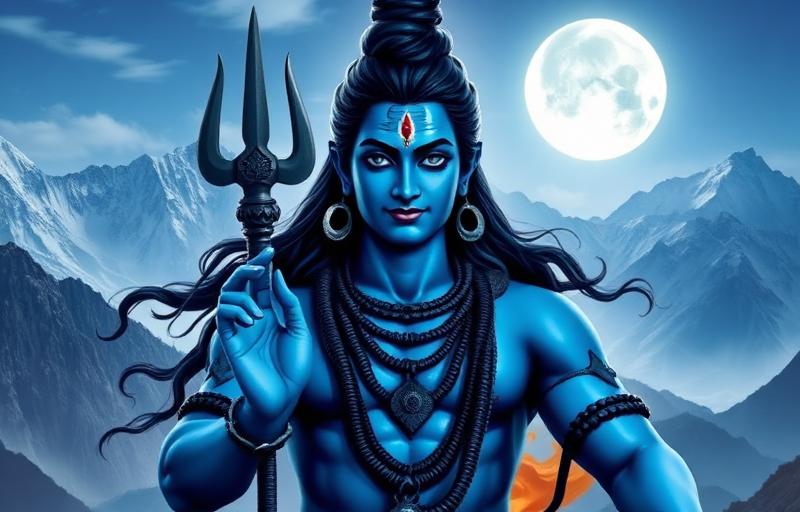
Sawan's entire identity as Shiva's month rests on one event: the Samudra Manthan, the churning of the cosmic ocean by devas and asuras in search of amrita, the nectar of immortality. Among the many things that surfaced from that churning was Halahala, a poison so lethal that it threatened to destroy every being in the three worlds before the nectar could even be reached. No god or demon was willing or able to absorb it, until Shiva stepped forward, drank it, and held it in his throat rather than letting it pass further into his body, turning his neck permanently blue and earning the name Neelkanth.
This is, structurally, a story about conquering death on behalf of all creation, and that is precisely what the Maha Mrityunjaya Mantra asks for on an individual scale. The mantra's plea, release from the bondage of death, mirrors Shiva's own act of absorbing a death-dealing substance and transforming it into something survivable rather than destructive. Devotees who chant this mantra during Sawan are, in effect, invoking the same power Shiva demonstrated during the very story the month commemorates.
This is why temple priests and household elders alike report a sharp seasonal rise in Maha Mrityunjaya chanting specifically during Sawan compared to the rest of the year. It is also why the mantra is chanted in far higher numbers on Sawan Shivratri (Tuesday, 11 August 2026), the single day most associated with Shiva's power over destruction and protection simultaneously. Health-related prayers, recovery from illness, and requests for a family member's protection all cluster heavily around this mantra during these thirty days, more than at any other point in the Hindu calendar outside Mahashivratri itself.
Pronunciation Notes: What Most Beginners Get Wrong
The Maha Mrityunjaya Mantra's Sanskrit is longer and less forgiving than Om Namah Shivaya, and a few specific words trip up most beginners.
- Tryambakam is often flattened into "tri-am-ba-kam" said quickly, losing the soft blend between "Try" and "ambakam." Slow it down: Try-am-ba-kam, with a gentle emphasis on the second syllable.
- Urvarukamiva is the word most people stumble over, sometimes splitting it incorrectly. It is actually two words joined, urvarukam (cucumber or a cucumber-like fruit) and iva (like, as), said smoothly as one flowing word: Ur-va-ru-ka-mi-va.
- Bandhanan Mrityor Mukshiya is frequently rushed. Each word deserves its own weight: Bandhanan (from bondage), Mrityor (of death), Mukshiya (may I be released), read as a clear, deliberate sequence rather than slurred together.
- Maamritat, the closing word, is sometimes mispronounced as two separate words. It is a sandhi (a Sanskrit sound-joining) of "maa" and "amritat," pronounced as one connected sound: Maa-mri-tat.
- Sugandhim Pushtivardhanam is often rushed together into a single blur; separating the two words slightly, with a brief natural pause between them, keeps both distinct without breaking the verse's rhythm.
The most important general rule for anyone new to this mantra: pronunciation accuracy improves naturally through repeated, unhurried practice, and slowing down to get the sandhi joins right matters far more than rushing to hit a high repetition count with garbled Sanskrit. Listening to a slow, clear recitation a few times before starting your own daily practice, rather than guessing from text alone, resolves most of these errors within the first week. Written transliteration is a useful crutch early on, but do not let it become a permanent substitute for actually memorising the sound.
How Many Times to Chant It This Sawan, and On Which Days
The right count depends heavily on why you are chanting and how much time you realistically have.
- Daily minimum: 11 repetitions, done at a slow, deliberate pace, is considered a meaningful daily practice, achievable in roughly five minutes even with careful pronunciation.
- Standard practice: 108 repetitions, one full mala, is the count most devotees aim for when chanting specifically for health, protection, or recovery from illness during Sawan.
- Sawan Shivratri (Tuesday, 11 August 2026): Considered the single most powerful day in the month for this mantra specifically, since it combines the general potency of Shivratri with Sawan's Neelkanth theme. Many devotees raise their count to several rounds of the mala on this day alone.
- Sawan Mondays (3, 10, 17 and 24 August 2026): A secondary set of high-focus days, often paired with jalabhishek at a temple, where 108 to 1008 repetitions are common depending on available time.
- Advanced sadhana (125,000 or sava lakh repetitions): A formal purashcharana undertaken over an extended period, typically with a priest's guidance and a specific sankalp, not something an ordinary household devotee is expected to attempt casually.
A note on when in the day: Brahma Muhurat (roughly 4 to 6 AM) is traditionally preferred for this mantra above all others in this list, since it is considered the mantra most closely tied to health and vitality, both of which are said to be best invoked when the body and mind are freshest.
🔱 The Vandnaa App marks Sawan Shivratri and all four Sawan Mondays on its 2026 calendar with a Maha Mrityunjaya reminder, so you never miss the days tradition considers most significant for this specific mantra.
When Households Turn to This Mantra Specifically
Unlike Om Namah Shivaya, which is chanted for general devotion at any time, Maha Mrityunjaya Mantra tends to be reached for at specific moments, and recognising these patterns helps explain its Sawan surge.
- During illness, whether minor or serious, in the chanter or in a family member, this is typically the first mantra households turn to, often alongside medical treatment rather than as a replacement for it
- Before surgery or a significant medical procedure, family members frequently chant this mantra in a nearby temple or at home while waiting
- On behalf of elderly parents or grandparents, as a prayer for a peaceful, comfortable stage of life rather than a plea against natural aging
- During Sawan specifically, even in the absence of any immediate illness, as a general protective and health-affirming practice tied to the month's Neelkanth theme
- At the start of a new venture or a period of uncertainty, since the mantra's core plea, release from bondage toward freedom, is understood by many as extending beyond literal death to any form of being "stuck"
An important clarification worth stating plainly: this mantra is understood in Hindu tradition as a spiritual and psychological support, offering comfort, courage and a sense of protection, not a substitute for medical care. Most households that chant it during a health crisis do so in addition to doctors and treatment, not instead of them, treating faith and medicine as complementary rather than competing responses to illness.
How to Start If You Have Never Chanted This Mantra Before
Starting a mantra this old and this long can feel intimidating, but the path in is simpler than it looks.
A realistic first-week plan: 1. Day 1 to 2: Read the mantra slowly, out loud, five times a day, without worrying about counting repetitions yet. The goal at this stage is comfort with the syllables, not speed or volume. 2. Day 3 to 4: Begin chanting it alongside a written or app-based transliteration, aiming for just 5 to 11 repetitions, ideally during Brahma Muhurat or before sleep. 3. Day 5 onward: Once the words feel natural rather than effortful, introduce a mala and work toward a full round of 108 repetitions, understanding this may take fifteen to twenty minutes at a careful, unrushed pace.
A few grounding reminders for beginners: there is no risk in mispronouncing a few syllables while learning; sincerity carries more weight than perfection in Hindu tradition. It is also entirely acceptable to chant only on the days you can manage, rather than committing to all thirty days of Sawan from the outset. Many devotees build a lasting Maha Mrityunjaya practice by starting with just Sawan Shivratri and the four Mondays in their first year, only expanding to a fuller daily practice in subsequent years once the mantra feels genuinely familiar.
What matters most in this first attempt is simply beginning, not arriving at a perfect, polished recitation on day one.
Frequently Asked Questions
Why is the Maha Mrityunjaya Mantra chanted more during Sawan than other months?+
Sawan commemorates Shiva drinking the Halahala poison during the Samudra Manthan to save creation, becoming Neelkanth. Since the Maha Mrityunjaya Mantra is itself a plea for release from death's bondage, chanting it during the month that celebrates Shiva's own victory over a death-dealing poison is considered especially meaningful by tradition.
Is Sawan Shivratri the best day to chant Maha Mrityunjaya Mantra in 2026?+
Yes, Sawan Shivratri, which falls on Tuesday, 11 August 2026, is widely considered the single most significant day in the month for this specific mantra, since it combines Shivratri's general potency with Sawan's Neelkanth theme. The four Sawan Mondays are the next most emphasised days.
Can I chant Maha Mrityunjaya Mantra for someone else's health without them knowing?+
Yes. Chanting this mantra on behalf of a family member's health or wellbeing, whether or not they are aware of it, is an extremely common practice and is considered a valid, meaningful act of devotion and care within Hindu tradition.
Should I chant Maha Mrityunjaya Mantra instead of taking medical treatment during illness?+
No. This mantra is understood in tradition as spiritual and emotional support that complements medical care, not a replacement for it. Most households chant it alongside doctor's treatment and medication, drawing on both faith and medicine together during a health concern.
What if I cannot pronounce the Sanskrit words correctly yet?+
Begin slowly by reading the mantra aloud a few times daily before attempting a full mala. Tradition holds that sincerity matters more than perfect pronunciation, and accuracy naturally improves with unhurried, repeated practice over the first week or two.
About the author
Acharya Vinaya Kapoor · M.A. Sanskrit, Mantra & Stotra Studies
Acharya Vinaya holds an M.A. in Sanskrit from Banaras Hindu University and writes the mantra and stotra commentary on Vandnaa. Her focus is on accurate pronunciation, traditional context, and helping modern readers connect with classical texts.
Meet the Vandnaa editorial team →