What Om Namah Shivaya Actually Means
Before counting repetitions, it helps to know what is actually being said. "Namah" is a form of surrender or bowing, and "Shivaya" addresses Shiva directly, so the phrase translates roughly to "I bow to Shiva" or, in a deeper reading, "I bow to my own true, auspicious nature", since the word Shiva itself means the auspicious one. Add the Om at the start, the primordial sound said to contain all of creation, and the mantra becomes a complete arc: from the sound of the universe itself, to a bow, to the specific form of Shiva.
Strip away the Om and this leaves exactly five syllables, Na, Ma, Shi, Va, Ya, which is why it is formally called the Panchakshari Mantra (five-syllable mantra). One long-standing esoteric interpretation ties each syllable to one of the five great elements that make up the physical world, earth, water, fire, air and ether, meaning the mantra is understood by many teachers as an offering of the entire material universe back to its source.
Why this particular mantra, and not a longer prayer, became the default chant of Sawan comes down to accessibility. It requires no complex Sanskrit grammar, no lengthy memorisation, and can be said in under two seconds, which makes it repeatable hundreds of times in a single short sitting. A four-year-old at a temple and a scholar of the Shiva Purana can chant the exact same five syllables with equal validity, which is part of why it has remained the single most recited mantra in Shaiva households for centuries, and why it takes centre stage every single day of Sawan specifically.
Why Tradition Holds That Sawan Amplifies This Mantra
Hindu tradition does not claim the mantra's Sanskrit sound changes in Sawan; what changes, according to this belief, is the receptivity of the moment. Sawan is considered the month Shiva is most present and most easily reached, tied directly to the Samudra Manthan story: when the Halahala poison threatened all of creation, Shiva alone stepped forward to drink it, holding it in his throat rather than letting it spread, becoming Neelkanth, the blue-throated one. The month is treated as a standing commemoration of that act of protection, and prayers offered during it are believed to land on a deity who is, in a manner of speaking, already turned toward his devotees.
There is also a simpler, more practical explanation that priests often give alongside the mythological one: collective intention. When millions of households across India are chanting the same five syllables during the same thirty-day window, from Kanwariyas walking barefoot on highways to grandmothers doing japa on a veranda, the shared atmosphere of devotion itself is considered to strengthen an individual's practice. This is not unlike how a group chant in a temple feels different from chanting alone at home; the surrounding energy carries the individual along.
What this means practically is not that skipping other months makes prayers pointless, but that Sawan is treated as the season to build or deepen a chanting habit precisely because the cultural and communal support for doing so is at its highest. A devotee who has never kept a consistent japa practice will find Sawan, with its temple bells, Kanwariya processions and family reminders, the easiest possible month to start one.
How Many Times Should You Chant It: 11, 108 or 1008?
There is a genuine hierarchy of counts in Hindu japa tradition, and knowing where you fit into it removes a lot of the guesswork.
- 11 or 21 repetitions: A realistic minimum for a busy weekday, achievable in under two minutes. Better done consistently every day than skipped entirely because 108 feels unreachable.
- 108 repetitions (one full mala): The standard, most widely recommended count for a proper daily japa session. The number 108 itself is considered sacred across multiple Hindu traditions, tied to astronomical and yogic calculations, and a single mala of prayer beads is built specifically around this number so that one full round equals exactly one complete practice.
- 1008 repetitions: Reserved for special days, most commonly the four Sawan Mondays and Sawan Shivratri (11 August 2026), and undertaken by devotees with more available time. This is typically done as ten rounds of the mala rather than counted individually, spread across a few hours or the whole day rather than in one unbroken sitting.
- 125,000 repetitions (sava lakh): An advanced, structured sadhana called a purashcharana, usually undertaken over many days with a specific resolve (sankalp) and often guided by a priest or teacher. Not expected of an ordinary devotee, mentioned here mainly so the scale of dedicated practice is understood.
For most people reading this, the honest, achievable target is one full mala (108) during evening puja on ordinary days, and an attempt at more only on the four Mondays and Shivratri, when time and motivation both tend to be higher.
The Best Times of Day to Chant During Sawan
Timing is not about magical windows opening and closing; it is about which hours naturally support a quiet, focused mind.
- Brahma Muhurat (roughly 4:00 to 6:00 AM): Widely considered the single best window for any japa, Shiva mantras included, because the mind is undisturbed by the day's noise and the body is rested. Many serious sadhakas reserve their longest chanting session for this hour throughout Sawan.
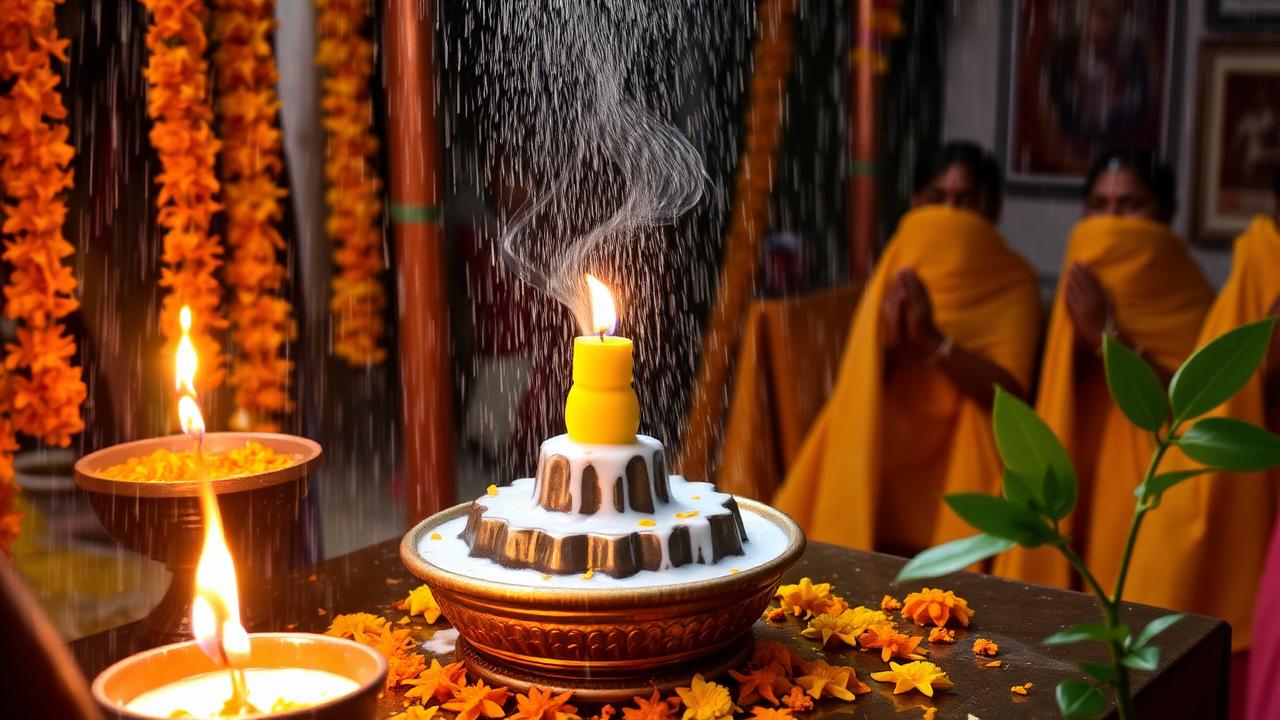
- During abhishek: Whether at a temple or at home, pouring water or milk over a Shivling while chanting Om Namah Shivaya, one pour per repetition, is one of the most common and satisfying ways to combine ritual action with sound.
- Pradosh Kaal (roughly ninety minutes before and after sunset): The traditional window for the main evening Shiv puja on Sawan Mondays, and by extension the natural time for the day's larger japa session, often the 108-count round.
- Just before sleep: A shorter, quieter round, even 11 repetitions, is considered a gentle way to close the day, particularly useful for anyone who could not manage a longer session earlier.
- While commuting or waiting: A silent, mental round during a train ride, a traffic jam, or a waiting room turns otherwise wasted minutes into devotional time, and many working professionals rely on exactly this slot to hit their daily count during a busy Sawan.
What matters more than the exact clock time is protecting whichever slot you choose from interruption. A ten-minute session done at the same time daily, phone silenced and attention undivided, consistently outperforms a longer session done distractedly while multitasking. If Brahma Muhurat genuinely does not fit your schedule, choosing any other slot and keeping it fixed, so the mind learns to expect japa at that hour, matters far more than chasing the theoretically ideal time and missing it most days.
How to Use a Mala Correctly for Panchakshari Japa
A mala is simply a counting tool, but using it correctly makes the practice smoother and, according to tradition, more respectful of the mantra itself.
- Bead count and material: A standard mala has 108 beads plus one slightly larger sumeru (or meru) bead. Rudraksha is the traditional choice for Shiva mantras specifically, though tulsi or crystal malas are also used.
- Never cross the sumeru bead. When you complete one full round and reach it, tradition says to reverse direction rather than continuing over it, symbolically treating it as a threshold rather than just another bead. This is why a devotee doing multiple rounds will appear to go back and forth rather than simply spinning the mala in one direction endlessly.
- Hand and fingers: The mala is typically held in the right hand, moved with the thumb, using the middle finger to draw each bead, while the index finger is traditionally kept from touching the beads directly.
- Three forms of japa: Vaikhari (spoken aloud, audible to others), Upanshu (a whisper, audible only to yourself), and Manasik (entirely mental, no sound at all). All three are valid; Upanshu is often recommended for daily practice since it is quiet enough for shared living spaces yet keeps the mind more anchored than silent japa alone.
- Keep the mala clean and personal. Traditionally, a mala used for japa is not lent out casually and is stored wrapped in a clean cloth rather than left lying around.
If you do not own a mala, counting on the segments of your fingers or simply setting a timer works just as well; the mala is a support for consistency, not a prerequisite for a valid mantra.
Common Mistakes and How to Stay Consistent All Month
Most devotees do not fail at Panchakshari japa because of pronunciation; they fail because of inconsistency. A few patterns are worth watching for.
- Chanting too fast to actually hear the mantra. Speed without attention turns japa into mechanical repetition. Slowing down, even if it means fewer repetitions, keeps the practice meaningful.
- Skipping a day and then abandoning the whole streak. One missed morning does not undo three weeks of practice. Simply resume the next day rather than treating the streak as broken beyond repair.
- Treating 1008 as the only "real" count. A rushed 1008 done while distracted is not superior to a calm, attentive 108. Match your count to the time and focus you genuinely have that day, not to what looks impressive.
- Forgetting the meaning behind the sound. Occasionally pausing to recall that "Namah Shivaya" means bowing to the auspicious keeps the practice from becoming pure repetition without feeling.
A simple way to sustain the habit across all thirty days of Sawan 2026 is to anchor the practice to something you already do daily, brushing your teeth, your morning tea, or your commute, rather than treating it as a separate task competing for a free slot in the day. Anchored habits survive busy weeks far better than habits that depend on remembering to "find time."
🙏 The Vandnaa App sends a daily Om Namah Shivaya reminder timed to Brahma Muhurat and evening puja, with a jaap counter that tracks whether you hit 108 or 1008 on each of the four Sawan Mondays.
What People Ask Most
Is 108 or 1008 the correct number of times to chant Om Namah Shivaya in Sawan?+
Both are correct for different situations. 108, one full mala, is the standard daily count suitable for any day. 1008 is reserved for special days like the four Sawan Mondays and Sawan Shivratri, done by devotees with more time. What matters most is consistency and attention, not reaching the higher number every single day.
Can I chant Om Namah Shivaya silently in my mind instead of out loud?+
Yes. Silent mental japa, called Manasik japa, is considered one of the three valid forms of chanting alongside spoken and whispered japa. It is often recommended for public places, workplaces, or late at night when speaking aloud is not practical.
Do I need to face a particular direction while chanting Om Namah Shivaya?+
Facing east or north during morning japa is a common recommendation since these directions are traditionally associated with positive energy at that hour, but it is not a strict requirement. Chanting with sincerity in any direction, at home, in a temple, or even while commuting, is considered valid.
What is the ideal number of repetitions for someone chanting Om Namah Shivaya for the very first time this Sawan?+
Start small and sustainable, 11 or 21 repetitions once a day, rather than attempting a full 108-bead mala immediately. It is far more valuable to chant a small number consistently across all four weeks of Sawan than to attempt a large count once and give up after a few days.
Does chanting Om Namah Shivaya during Sawan require any special diet or fasting?+
No, chanting this mantra does not require fasting. Fasting on Sawan Somwar is a separate, optional practice that many devotees choose to combine with japa, but the mantra itself can be chanted by anyone regardless of what they have eaten that day.
About the author
Acharya Vinaya Kapoor · M.A. Sanskrit, Mantra & Stotra Studies
Acharya Vinaya holds an M.A. in Sanskrit from Banaras Hindu University and writes the mantra and stotra commentary on Vandnaa. Her focus is on accurate pronunciation, traditional context, and helping modern readers connect with classical texts.
Meet the Vandnaa editorial team →