Who Is Matsya Avatar
Matsya is the first of the ten avatars (the Dashavatar) of Lord Vishnu, in which he descended to earth in the form of a giant fish. He appears at the dawn of a new cosmic age to protect creation when the world is threatened by a great flood (pralaya). As the fish, Vishnu becomes the saviour of King Manu, of all living seeds and of the sacred Vedas. Matsya marks the very beginning of Vishnu's journey of protecting dharma through the ages.
The Story of Matsya
One day, King Manu was offering water in a river when a tiny fish came into his hands and begged for protection. The fish grew larger each day, from a jar to a pond to a river and finally to the vast ocean, revealing itself as Lord Vishnu. The Lord warned Manu that a great flood would soon dissolve the world and asked him to build a large boat and gather the seven sages, seeds of all plants and the Vedas.
When the deluge came, the giant fish appeared with a single horn, and Manu tied the boat to it using the serpent Vasuki as a rope. Matsya towed the boat safely through the raging waters until the flood subsided, preserving the seeds of life for the new age.
Why Vishnu Took the Form of a Fish
In one telling, a demon named Hayagriva stole the Vedas and hid in the depths of the cosmic ocean, plunging the world toward ignorance and chaos. To recover the sacred knowledge and protect creation during the coming flood, Vishnu chose the form best suited to move through water - a fish.
The choice is deeply meaningful. When the whole world is submerged, only a being at home in water can act. By becoming Matsya, Vishnu shows that the divine takes exactly the form needed to rescue dharma in each crisis, beginning with the most basic act of saving life and truth from being lost.
Symbolism of Matsya Avatar

Matsya carries layers of meaning:
The flood stands for dissolution and the cycles of destruction and renewal that the universe passes through. The boat is the vessel of dharma and faith that carries the worthy safely across troubled times. The fish saving the Vedas shows that true knowledge is never truly lost; it is protected and reborn in every age. The first avatar as the simplest creature mirrors the idea that life itself began in water and evolved upward, a thought many see echoed in the order of the Dashavatar.
Lessons from Matsya Avatar
The story offers timeless guidance:
1. Protect the small and helpless - Manu was saved because he first showed compassion to a tiny fish. 2. Heed timely warnings - Manu acted on the Lord's caution and prepared, so he survived the flood. 3. Guard true knowledge - preserving the Vedas teaches us to protect wisdom, values and learning for the next generation. 4. Have faith in difficult times - even in a world-ending flood, surrender to the divine carries us through.
A Short Matsya Mantra
Devotees remember this first avatar with a simple prayer:
Om Matsyaya Namah
A fuller invocation is:
Om Namo Bhagavate Matsyaya, Vedoddharakaya Namah
(Salutations to Lord Matsya, the rescuer of the Vedas.) Chanting it with devotion is a way to honour Vishnu's first descent and to pray for protection, clear knowledge and safe passage through life's storms.
Common Questions From Devotees
What is the Matsya Avatar of Vishnu?+
Matsya is the first of Vishnu's ten avatars, in which he took the form of a giant fish. He saved King Manu, the seven sages, the seeds of life and the Vedas from a world-ending flood.
Why did Vishnu take the form of a fish?+
A flood was about to dissolve the world, and a fish was the form best suited to act in water. In one account, he also recovered the Vedas stolen by the demon Hayagriva.
Who was saved by Matsya in the flood?+
Matsya saved King Manu, the seven great sages (Saptarishi), the seeds of all plants and animals, and the sacred Vedas, preserving life and knowledge for the next age.
What does the Matsya Avatar symbolise?+
The flood represents dissolution, the boat represents dharma and faith, and the rescued Vedas show that true knowledge is never lost but protected and reborn in every cosmic age.
Where does Matsya come in the Dashavatar order?+
Matsya is the first of the ten Dashavatar incarnations, followed by Kurma, Varaha, Narasimha, Vamana and the later avatars. It marks the beginning of Vishnu's descents to protect dharma.
What is the Matsya mantra?+
A simple mantra is 'Om Matsyaya Namah'. A fuller form, 'Om Namo Bhagavate Matsyaya, Vedoddharakaya Namah', honours Matsya as the rescuer of the Vedas.
About the author
Anjali Mehta · Editor, M.A. Religious Studies
Anjali is the managing editor for Vandnaa and oversees the festival and vrat coverage. She holds an M.A. in Religious Studies and reviews every published article for accuracy, accessibility, and tradition-fidelity.
Meet the Vandnaa editorial team →Explore on Vandnaa
Related Articles
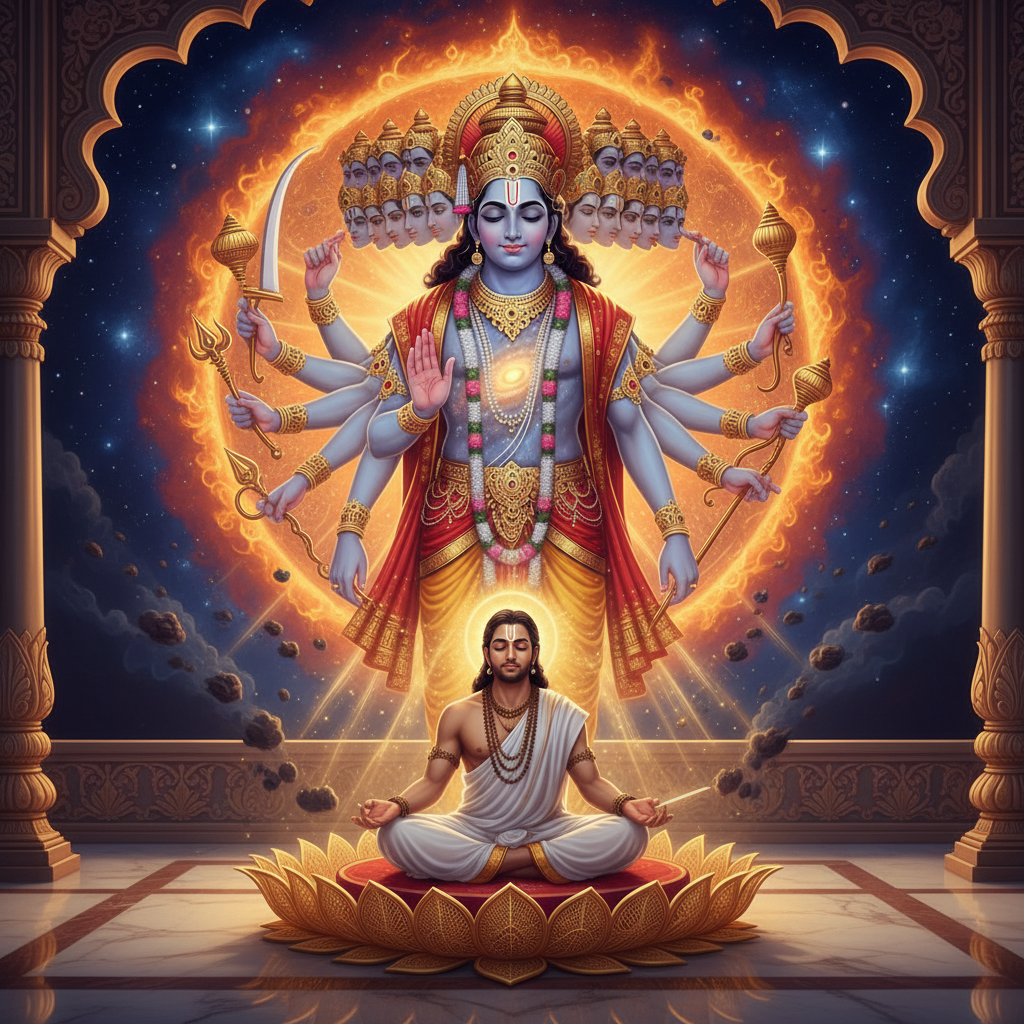
Dashavatar - 10 Avatars of Lord Vishnu: Names, Order, Meaning, Significance
11 min read

Kurma Avatar - Story, Significance & Lessons
9 min read
Varaha Avatar - Story, Significance & Lessons
9 min read
Vamana Avatar - Story, Significance & Lessons
9 min read
Vishnu Aarti Lyrics - Om Jai Jagdish Hare in Hindi & English
8 min read
Vishnu Sahasranama: The 1000 Names of Vishnu - Meaning, Benefits & Daily Recitation Vidhi
12 min read