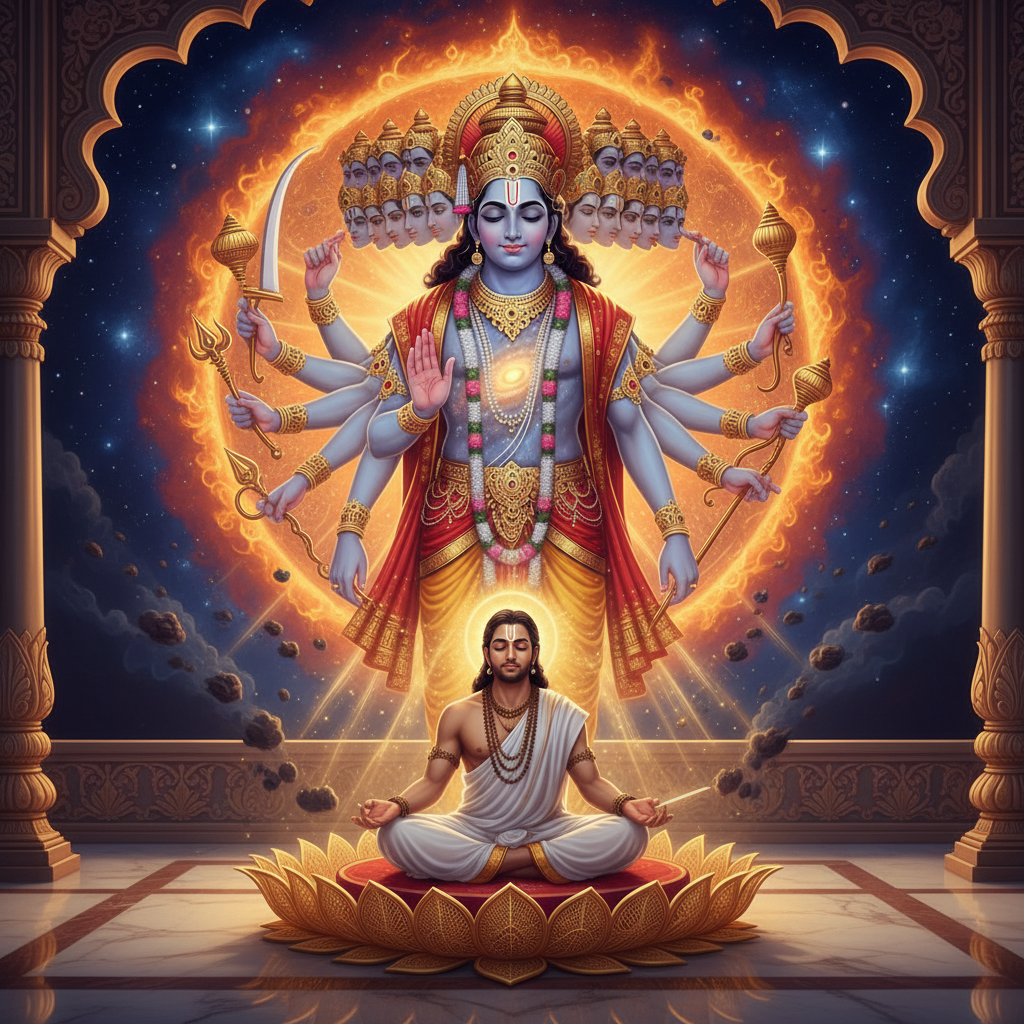
Why Om Jai Jagdish Hare is the Universal Hindu Aarti
Om Jai Jagdish Hare is composed for Lord Vishnu - but it has become the default closing aarti for every Hindu puja in India. Whether you're worshipping Ganesh, Lakshmi, Durga, or Hanuman - most people end with this aarti. Why?
The historical reason: Composed by Pandit Shraddha Ram Phillauri in 1870 in Punjab, this aarti was deliberately written to be universally Hindu - not sectarian, not regional, not language-specific. The composer wanted an aarti every Hindu could sing together regardless of which deity they personally favoured.
The mystical reason: In the Vaishnav tradition (which has deeply influenced all of Hindu practice), Vishnu is considered the cosmic preserver - the deity who maintains the universe. Singing his aarti at the close of any puja is symbolically asking him to preserve the merit just generated. Hence its closing-aarti role.
Why it works for any deity: The aarti uses the word 'Jagdish' (Lord of the Universe) - which technically applies to any chief deity. So when a Shiva devotee sings it, they hear it as Shiva-Jagdish; a Devi devotee hears it as Devi-Jagdish. The aarti is ecumenical by design.
The 5 verses cover: 1. Cosmic protection (general) 2. Removal of suffering of devotees 3. The eternal blissful nature 4. The universal mother-father (parental aspect) 5. The compassionate liberator
The most quoted line: 'Tum poorna parmatma, tum antaryami' - 'You are the complete supreme soul, you are the inner-dweller.' This single line captures Vishnu's omnipresence.
🪷 The Vandnaa App has Om Jai Jagdish Hare in 5 styles - classical, kirtan, modern bhajan, regional Punjabi, and Sanskrit-pure.
Complete Lyrics - Hindi & English
Hindi:
ॐ जय जगदीश हरे, स्वामी जय जगदीश हरे। भक्तजनों के संकट, क्षण में दूर करे॥ ॐ जय जगदीश हरे॥
जो ध्यावे फल पावे, दुख बिनसे मन का। स्वामी दुख बिनसे मन का। सुख सम्पत्ति घर आवे, कष्ट मिटे तन का॥ ॐ जय जगदीश हरे॥
मात-पिता तुम मेरे, शरण गहूँ मैं किसकी। स्वामी शरण गहूँ मैं किसकी। तुम बिन और न दूजा, आस करूँ मैं जिसकी॥ ॐ जय जगदीश हरे॥
तुम पूरण परमात्मा, तुम अंतर्यामी। स्वामी तुम अंतर्यामी। पारब्रह्म परमेश्वर, तुम सबके स्वामी॥ ॐ जय जगदीश हरे॥
तुम करुणा के सागर, तुम पालनकर्ता। स्वामी तुम पालनकर्ता। मैं मूरख खल कामी, कृपा करो भर्ता॥ ॐ जय जगदीश हरे॥
तुम हो एक अगोचर, सबके प्राणपति। स्वामी सबके प्राणपति। किस विधि मिलूँ दयामय, तुमको मैं कुमति॥ ॐ जय जगदीश हरे॥
दीनबन्धु दुखहर्ता, तुम ठाकुर मेरे। स्वामी तुम ठाकुर मेरे। अपने हाथ उठाओ, द्वार पड़ा तेरे॥ ॐ जय जगदीश हरे॥
विषय विकार मिटाओ, पाप हरो देवा। स्वामी पाप हरो देवा। श्रद्धा भक्ति बढ़ाओ, संतन की सेवा॥ ॐ जय जगदीश हरे॥
English meaning (verse-by-verse):
Verse 1: 'Om, victory to the Lord of the Universe, Master, victory to the Lord of the Universe. The troubles of devotees, you remove in a moment.'
Verse 2: 'Whoever meditates on you, attains fruit; the mind's sorrows dissolve. Happiness and prosperity come to the home; bodily afflictions disappear.'
Verse 3: 'You are my mother and father; in whose refuge can I take shelter? Without you, there is no other in whom I can hope.'
Verse 4: 'You are the complete supreme soul; you are the inner-dweller. Supreme Brahman, supreme Lord, you are everyone's master.'
Verse 5: 'You are the ocean of compassion; you are the sustainer. I am foolish, wicked, and lustful - show your grace, O Lord.'
Verse 6: 'You are the One imperceptible, the life-lord of all. By what method can I meet you, O merciful one - I, the foolish-minded?'
Verse 7: 'Friend of the lowly, remover of sorrow, you are my Master. Lift up your hands; I have come to your door.'
Verse 8: 'Destroy worldly attachments, remove sins, O Lord. Increase my faith and devotion; let me serve the saints.'
Vishnu Aarti Vidhi - Step by Step
Pre-requisites:
- Bath, clean clothes (yellow or white preferred)
- Tilak (chandan/sandalwood for Vishnu)
- Tulsi leaves - essential
Items needed:
- Vishnu/Krishna/Narayan photo or murti (any Vishnu form works)
- Brass/steel diya
- Pure ghee for the diya (NOT mustard)
- Tulsi leaves
- Yellow flowers (marigold, lotus if available)
- Camphor
- Bell
- Kheer, panjiri, or makhan-mishri as bhog
Step-by-step:
1. Setup (3 min) - Clean puja place, place Vishnu image facing east
2. Sankalpa (1 min) - Take water in palm, state purpose, sprinkle on ground
3. Apply tilak (2 min) - Sandalwood tilak on Vishnu's image AND yourself
4. Light ghee diya (1 min) - Single wick or 5-wick for special days
5. Offer Tulsi (2 min) - Place fresh Tulsi leaves at Vishnu's feet (mandatory)
6. Offer flowers - Yellow marigold or any seasonal flower (avoid red flowers - those are for Shakti/Hanuman)
7. Offer bhog - Kheer is most loved by Vishnu
8. Sing Om Jai Jagdish Hare - Standing, with aarti thaali, clockwise motion. Full 8 verses + chorus.
9. Camphor aarti - At the end, light camphor and circle it
10. Distribute prasad - Always share Tulsi-prasadam with all
Best time:
- Morning (after sunrise) - daily standard
- Sunset (sandhya) - preferred evening time
- Ekadashi - 11th day of moon (twice monthly) - most powerful
- Thursday - Vishnu's day
Special days for full aarti:
- Vaikuntha Ekadashi, Janmashtami, Ram Navami, Tulsi Vivah
- On these days do extended aarti with extra Tulsi and full bhog
Closing rule: After aarti, take Tulsi-charanamrit (water that touched Tulsi/Vishnu's feet) and sip a few drops. This is considered the holiest prasad in all Hindu worship.
Benefits of Singing Om Jai Jagdish Hare Daily
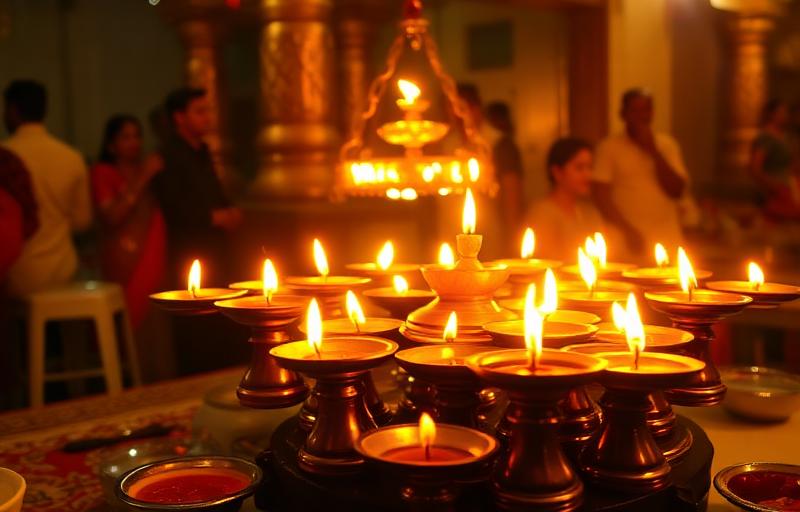
1. Universal Protection - Vishnu's role as cosmic preserver means his aarti creates a protective field around the home and family.
2. Family Harmony - The lines about 'mother-father, refuge' awaken the felt sense of cosmic family - softens earthly family tensions.
3. Ego Reduction - The line 'main moorakh khal kami' (I am foolish, wicked, lustful) is a daily humility practice. Reduces arrogance over time.
4. Material Prosperity - Vishnu is Lakshmi's consort. Vishnu aarti naturally invokes Lakshmi's grace. Sustained practice often correlates with financial stability.
5. Removal of Suffering - The opening 'bhakta-jano ke sankat, kshana mein door kare' (devotees' troubles removed in moments) is a direct invocation.
6. Increase in Faith & Devotion - The closing line specifically asks for 'shraddha bhakti' - over time, devotee's bhakti deepens almost effortlessly.
7. Path to Moksha - Vishnu offers Vaikuntha (his eternal abode) to those who meditate on him at death. Daily aarti is daily memorization - building the habit of remembering Vishnu, which serves at the final moment.
The 11-day promise: Sing this aarti for 11 consecutive days at sunset (Sandhya time). Many devotees report a noticeable shift in family atmosphere and personal mood within those 11 days.
The Ekadashi-special practice: On every Ekadashi day, sing this aarti at all three sandhi times (morning, noon, sunset). The combined effect of Ekadashi + triple aarti is considered equivalent to a 21-day continuous sadhana.
Common Mistakes to Avoid
1. Skipping Tulsi. Same rule as Krishna - Tulsi is mandatory for any Vishnu form. Without Tulsi, the offering is incomplete.
2. Using mustard oil. Vishnu requires ghee or pure cotton-wick. Mustard is reserved for Hanuman.
3. Singing only the chorus. Many people sing only 'Om Jai Jagdish Hare' once and stop. This is incomplete - the 8 verses convey the actual content.
4. Wearing dark colors. Yellow is Vishnu's color. White or sattvic light colors acceptable. Avoid black/dark blue for Vishnu worship.
5. Singing in haste. 4-5 minutes is the proper duration. Rushing through misses the bhakti.
6. Offering meat or onion-garlic-laced bhog. Vishnu is strictly sattvic. Even the bhog must be onion-garlic-free.
7. Plucking Tulsi at wrong times. Never on Sundays, Ekadashis, after sunset, or during eclipses. Pluck only in the morning with prayer. Better to plant a Tulsi pot at home for daily fresh leaves.
8. Not closing with charanamrit. The few drops of Tulsi-water at the end is the deepest prasad - don't skip.
9. Doing Vishnu aarti and then immediately fighting/arguing. The grace of the aarti needs at least 30 minutes of peaceful aftermath. Schedule disputes for later.
10. Treating it as just 'closing aarti' without devotion. Many people sing it mechanically at the end of any puja. Even as a closing aarti, give it full attention. It is Vishnu's specific aarti, not a generic ritual filler.
Singing Vishnu Aarti for Different Vishnu Forms
Vishnu manifests in 10 main avatars (Dashavatara) plus several non-avatar forms. The same Om Jai Jagdish Hare aarti can be sung for any of them - Vishnu's essence is shared:
1. Narayana (the primal Vishnu form) - The default. Aarti at home in front of Narayana picture.
2. Vishnu with Lakshmi (Vishnu-Lakshmi together) - Most common home form. Sing Om Jai Jagdish Hare on Thursdays especially.
3. Krishna (8th avatar) - On Janmashtami, sing Krishna aarti FIRST, then Om Jai Jagdish Hare as closing.
4. Ram (7th avatar) - On Ram Navami, sing Ram aarti FIRST, then Om Jai Jagdish Hare as closing.
5. Narasimha (4th avatar) - On Narasimha Jayanti. Sing the aarti with extra fervor for protection.
6. Vamana (5th avatar) - On Vamana Dwadashi.
7. Hayagriva - For students seeking knowledge. Sing as standard.
8. Venkateswara/Balaji - At Tirupati and home. Pair with Venkateswara Suprabhatam if known.
9. Jagannath - On Rath Yatra (July). Sing Jagannath aarti first, then Om Jai Jagdish Hare.
10. Vithoba (Marathi tradition) - In Maharashtra, often paired with Vithoba bhajans.
The universal applicability: This is the genius of Om Jai Jagdish Hare - its words technically apply to ALL these forms. 'Jagdish' (Lord of universe), 'Antaryami' (inner dweller), 'Parmatma' (supreme soul), 'Parabrahma' (transcendent absolute) - none of these are specific to one Vishnu form. They apply equally.
This is why the aarti has spread so universally - even non-Vaishnav homes can sing it without theological issue.
Make Vishnu Aarti Your Daily Anchor of Faith
Of all Hindu aartis, Om Jai Jagdish Hare is the most universally recognized - the one every Hindu can sing along to, regardless of regional or sectarian background. Making it your daily evening anchor connects you to a vibrational field built by every Hindu home for the past 150+ years.
Three commitment levels:
Level 1 - The Closer:
- Sing it as the closing aarti of any other puja you do
- No standalone session needed
- Builds passive familiarity
Level 2 - Daily Sandhya:
- Standalone evening singing
- 5 minutes
- Family together is best
Level 3 - Three Sandhi Times:
- Morning, noon, sunset on Ekadashi
- Daily morning + evening on regular days
- For dedicated Vaishnav devotees
A final reflection:
Some aartis are technical - for specific deities, specific intentions, specific traditions. Om Jai Jagdish Hare is democratic. Every Hindu, every age, every region - this is the common voice. When you sing it, you are not alone. You are joining a chorus 150 years old that includes great-grandparents, distant cousins, strangers in temples 2000 km away, and Hindus in diaspora across the world.
This collective bhakti - one melody, one set of words, one Vishnu - is itself a form of worship. The aarti is a thread that ties Hindu civilization together across geography, language, and time.
Sing it tonight. Tomorrow night. Every night. After many years, you'll realize: this small daily practice is one of the most stabilizing forces in your life.
Jai Shri Hari. Om Namo Narayanaya.
🪷 The Vandnaa App has Om Jai Jagdish Hare in 5 vocal styles (classical, kirtan, modern, regional Punjabi, Sanskrit-pure) with Ekadashi triple-time reminders and Tulsi-charanamrit checklist.
Quick Answers
Can I sing Om Jai Jagdish Hare for any deity, not just Vishnu?+
Yes - that's exactly why it became the universal closing aarti. The words 'Jagdish' (Lord of universe), 'Antaryami' (inner-dweller), 'Parmatma' apply to any chief deity. It's traditionally sung at the end of Ganesh, Lakshmi, Durga, Hanuman pujas as a unifying close.
Who composed Om Jai Jagdish Hare?+
Composed by Pandit Shraddha Ram Phillauri in 1870 in Phillaur, Punjab. He deliberately wrote it as a non-sectarian, universal Hindu aarti that could unify diverse Hindu households under one common worship-song.
What is the difference between Vishnu aarti and Krishna aarti?+
Vishnu aarti (Om Jai Jagdish Hare) is universal - for any Vishnu form including Krishna. Krishna aarti (Aarti Kunj Bihari Ki) is specific to Krishna's Vrindavan-Bihari form. On Janmashtami, you sing Krishna aarti FIRST, then Om Jai Jagdish Hare as universal closing.
Is Tulsi mandatory for Vishnu aarti?+
Yes - Tulsi is essential for any Vishnu/Narayan/Krishna worship. Without Tulsi, the offering is technically incomplete. Plant a Tulsi at home if possible for daily fresh leaves. If unavailable, even a dried Tulsi leaf works in emergency.
Best day for Vishnu aarti?+
Thursday (Guruvar) is Vishnu's primary day. Ekadashi (11th day of moon, twice monthly) is most powerful. Vaikuntha Ekadashi (December-January), Janmashtami (August), Ram Navami (April) are extraordinary occasions for full elaborate aarti.
Can I sing Vishnu aarti without a murti or photo?+
Yes - even mental visualization of Narayan or any Vishnu form works. The aarti's words themselves create the energetic field. Ideal: have a small picture or murti, but not strictly mandatory.
About the author
Acharya Vinaya Kapoor · M.A. Sanskrit, Mantra & Stotra Studies
Acharya Vinaya holds an M.A. in Sanskrit from Banaras Hindu University and writes the mantra and stotra commentary on Vandnaa. Her focus is on accurate pronunciation, traditional context, and helping modern readers connect with classical texts.
Meet the Vandnaa editorial team →Explore on Vandnaa
Related Articles
Krishna Aarti Lyrics in Hindi & English - Aarti Kunj Bihari Ki
9 min read
Vishnu Sahasranama: The 1000 Names of Vishnu - Meaning, Benefits & Daily Recitation Vidhi
12 min read
108 Names of Lord Krishna: Complete List with Meaning, Benefits & How to Chant Daily
12 min read
Tulsi Vivah 2026: Date, Katha, Puja Vidhi & Why This Marriage Begins Wedding Season
9 min read
Tulsi Plant at Home: Right Direction, Vastu Rules & 9 Sacred Benefits Every Hindu Should Know
8 min read
Nirjala Ekadashi 2026: Date, Vrat Vidhi & Why It Equals All 24 Ekadashis Combined
9 min read