Who Is Vamana Avatar
Vamana is the fifth of the ten avatars (the Dashavatar) of Lord Vishnu and the first to appear in fully human form, as a small dwarf brahmin boy. Unlike the fierce earlier avatars, Vamana acts not with weapons but with humility, wit and a simple request. He appears to gently humble the great king Bali, whose generosity was matched by a growing pride, and to restore balance between the devas and the asuras.
The Story of Vamana and King Bali
King Bali, a noble and generous asura, had conquered the three worlds and grown so mighty that even the gods feared him. To restore balance, Vishnu was born as Vamana, a small dwarf brahmin, and approached Bali during a grand sacrifice.
Known for never refusing a request, Bali offered Vamana anything he wished. The dwarf humbly asked only for three steps of land, measured by his own small feet. Bali laughed and agreed. Then Vamana grew into a cosmic giant: with his first step he covered the entire earth, with his second the heavens, and finding no place for the third, Bali offered his own head. Vamana placed his foot there, pushing Bali to the netherworld - but, pleased by his devotion and honesty, blessed him to rule there and to return each year.
Why Vishnu Took the Form of a Dwarf
King Bali was not an evil tyrant but a virtuous, charitable ruler whose only flaw was a swelling sense of his own greatness. Such a king could not be humbled by force; that would be unjust. Instead, the Lord chose the form of a tiny, humble brahmin to teach through wisdom rather than war.
By becoming Vamana, Vishnu shows that the divine corrects even good people gently, and that the smallest, most modest form can contain infinite greatness. The contrast between the little dwarf and the universe-spanning giant is the heart of the lesson.
Symbolism of Vamana Avatar

Vamana is full of deep meaning:
The dwarf form symbolises humility and the truth that greatness is not measured by size. The three steps are often read as the earth, the sky and the heavens, or as thought, word and deed that the divine pervades. Bali offering his own head shows complete surrender, which turns defeat into a blessing. The growing giant reminds us that the infinite can hide within the small, and that pride is humbled when the divine reveals its true vastness.
Lessons from Vamana Avatar
The story teaches enduring values:
1. Stay humble in success - even the noble King Bali had to learn that pride must bow before the divine. 2. Keep your word - Bali honoured his promise even when it cost him everything, earning lasting grace. 3. Greatness is not about size - a small, modest form held the whole universe; true power is inner, not outer. 4. Surrender brings blessing - Bali's complete surrender turned his loss into an eternal boon.
A Short Vamana Mantra
Devotees honour this avatar with a simple prayer:
Om Vamanaya Namah
A fuller invocation is:
Om Namo Bhagavate Vamanaya, Trivikramaya Namah
(Salutations to Lord Vamana, who as Trivikrama measured the worlds in three steps.) Chanting it with devotion is a way to pray for humility, the strength to keep one's word, and freedom from the pride that hides our true self.
Reader Questions Answered
What is the Vamana Avatar of Vishnu?+
Vamana is the fifth of Vishnu's ten avatars, in which he took the form of a small dwarf brahmin. He asked King Bali for three steps of land and then grew to cover the whole universe.
Why did Vishnu take the form of a dwarf?+
King Bali was virtuous but growing proud, so he could not be humbled by force. Vishnu chose a small, humble brahmin form to teach him through wisdom and humility rather than war.
Who was King Bali?+
Bali was a noble, generous asura king who conquered the three worlds. Famous for never refusing a request, he kept his word to Vamana even at great cost and was blessed for his devotion.
What do the three steps of Vamana mean?+
The three steps are often read as the earth, the sky and the heavens, or as thought, word and deed. They show that the divine pervades all realms and humbles even the mightiest pride.
Where does Vamana come in the Dashavatar order?+
Vamana is the fifth of the ten Dashavatar incarnations, coming after Matsya, Kurma, Varaha and Narasimha. He is the first to appear in fully human form.
What is the Vamana mantra?+
A simple mantra is 'Om Vamanaya Namah'. A fuller form, 'Om Namo Bhagavate Vamanaya, Trivikramaya Namah', honours Vamana as Trivikrama, who measured the worlds in three steps.
About the author
Anjali Mehta · Editor, M.A. Religious Studies
Anjali is the managing editor for Vandnaa and oversees the festival and vrat coverage. She holds an M.A. in Religious Studies and reviews every published article for accuracy, accessibility, and tradition-fidelity.
Meet the Vandnaa editorial team →Explore on Vandnaa
Related Articles
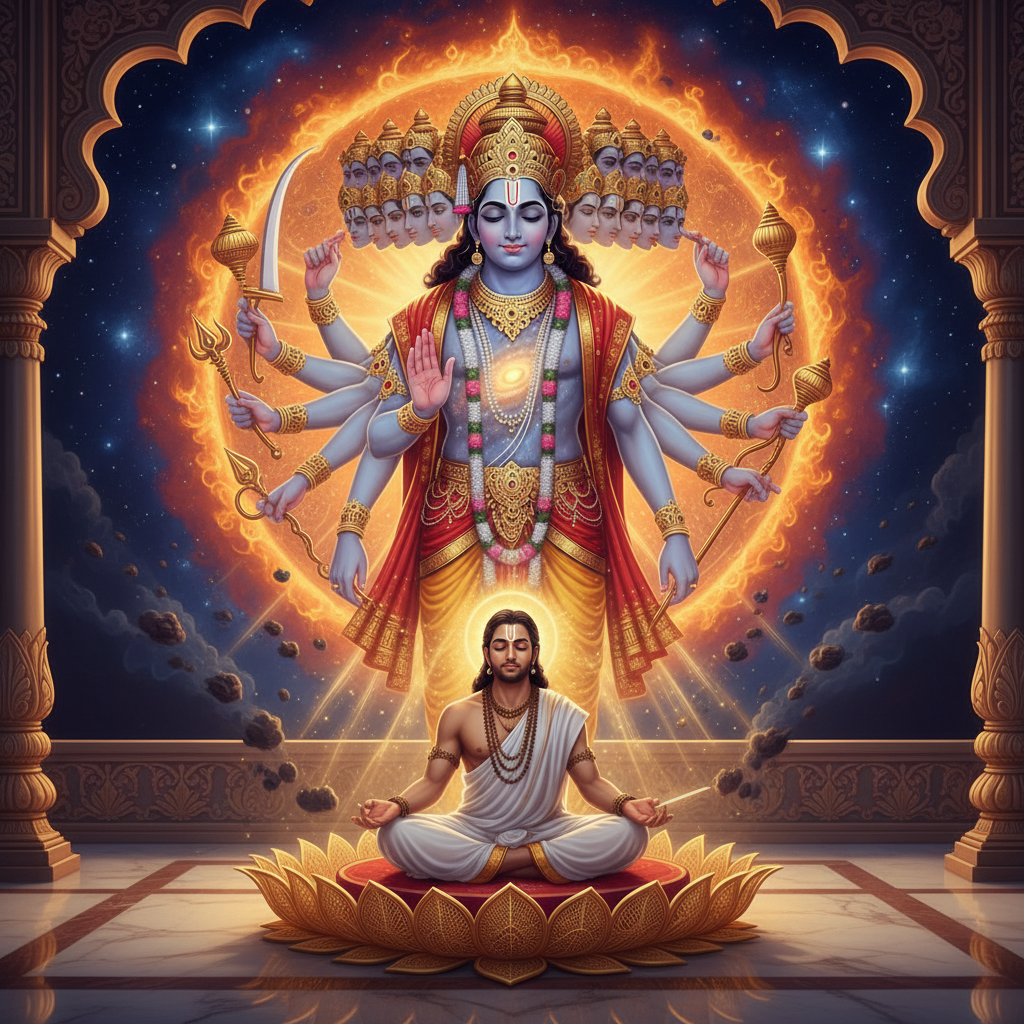
Dashavatar - 10 Avatars of Lord Vishnu: Names, Order, Meaning, Significance
11 min read

Matsya Avatar - Story, Significance & Lessons
9 min read
Kurma Avatar - Story, Significance & Lessons
9 min read
Varaha Avatar - Story, Significance & Lessons
9 min read
Vishnu Aarti Lyrics - Om Jai Jagdish Hare in Hindi & English
8 min read
Vishnu Sahasranama: The 1000 Names of Vishnu - Meaning, Benefits & Daily Recitation Vidhi
12 min read