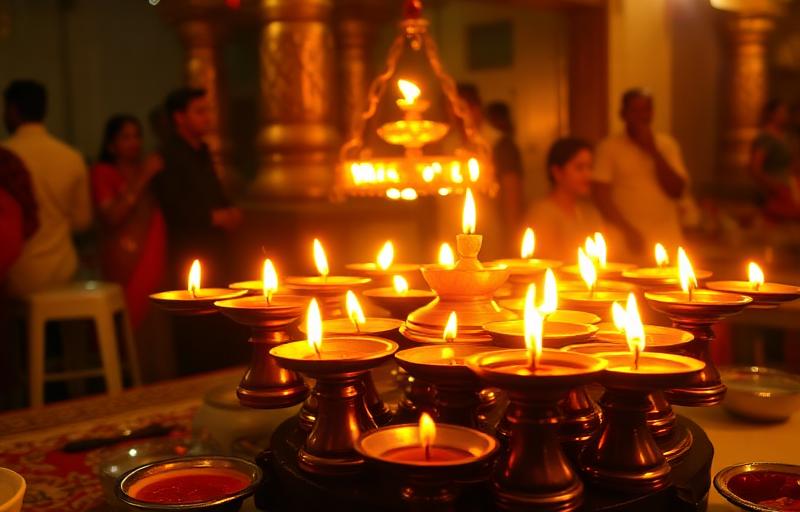
The Temple on the Lake
The Naina Devi temple stands at the northern end of Naini lake at Nainital, Uttarakhand, at about 1,940 metres.
What is there:
- The goddess Naina Devi, represented as two eyes, netras, rather than as an anthropomorphic image
- Shrines to Kali and Ganesha alongside
- A large peepal tree in the compound
- The lake immediately below, and the Mall Road along its side
- Very heavy visitor traffic, since it is in the middle of a major hill station
The Peetha claim:
- The eyes of Sati are said to have fallen here
- Naina means eyes, and the town and lake take their names from the goddess
- The lake is understood to be the shape the eyes left, and it is roughly eye shaped
The complication. There is another Naina Devi, in Bilaspur district, Himachal Pradesh, also a Shakti Peetha, also claiming the eyes, mentioned in the Jwalamukhi entry as part of the Himachal Devi circuit.
- Both are called Naina Devi
- Both are Shakti Peethas
- Both are associated with the eyes
- Both receive very large numbers
- They are about 250 km apart
How the tradition handles that. It does not. Nobody has adjudicated between them and nobody has needed to.
As discussed in the Manimahesh entry regarding the five Kailashes, the tradition does not treat a sacred location as unique in the way a modern reader might expect. A place where a reality is manifest can be more than one place.
The Shakti Peetha lists themselves vary between 51, 52, 64 and 108, different lists assign different body parts to different sites, and several sites appear on some lists and not others.
That is not a defect. It is what happens when a sacred geography develops over a very long period across an enormous area, through many local traditions, without any central authority to reconcile it.
And a practical consequence. If you are looking up Naina Devi, check which one. Directions, timings, festivals and the surrounding country are entirely different.
This entry is about the Nainital one.
A Deity With No Body
The image at Naina Devi is two eyes, and that is unusual enough to be worth a section.
What is in the sanctum:
- Two eyes, netras, mounted and worshipped
- Not a face, not a figure, not a linga
- Accompanied by shrines to Kali and Ganesha, which are conventional
Part representing whole. This is the operative principle and it recurs across the Shakti Peethas.
The Peetha network is founded on the idea that a part of the goddess is present at each site, and at many of them the part is what is worshipped.
- Kamakhya in Assam, the yoni, where the image is a cleft in rock with a spring
- Jwalamukhi, the tongue, worshipped as flame
- Naina Devi, the eyes
- Hinglaj in Balochistan, the head
- Numerous others where the associated part shapes what is present
Why this matters theologically. It is a specific and unusual arrangement.
- Most Indian deities are worshipped in a complete form, or in an aniconic form like a linga that stands for the whole
- The Peethas worship a fragment, explicitly
- And the fragments are distributed across a subcontinent, so that the complete goddess exists only as the sum of the sites
- A devotee visiting one Peetha is visiting a part
That produces the circuit logic. To approach the whole, you go to all of them, which is what the Peetha yatra attempts and which almost nobody completes.
Eyes in Indian devotional practice. Since this shrine is eyes, the associations are worth setting out.
- Darshan, the central act of Indian worship, means seeing, and the reciprocal seeing by the deity is the point
- The deity's eyes are the last thing completed when an image is made, and the ceremony of opening them, netra unmilana or nayanonmilana, is what brings the image alive
- Before that ceremony an image is not a deity
- The eyes are painted or carved last, frequently at the moment of consecration, and in some traditions the sculptor does not look at them directly as he does it
- At Puri, the deities' large round eyes are the defining feature of the form
- Silver eyes are offered at healing shrines by people with eye conditions, as noted at Arasavalli
Why the eyes matter more than any other feature. Because darshan is mutual.
The devotee comes to see the deity. The tradition holds that the deity sees them back, and that is the transaction. An image without eyes cannot perform it.
A shrine where the deity is only eyes has stripped that down to its essential element, and there is a certain logic to it.
The lake as the shape. Local tradition holds that the lake is the shape the falling eyes left.
That is a claim about landscape of the kind described at Prashar, where Bhima's elbow made the lake. India's landscape is read as narrative, and a body of water shaped roughly like an eye, at a place where the eyes are said to have fallen, is exactly the kind of correspondence that produces a shrine.
Geologically, Naini lake is a tectonic lake, formed in a depression associated with faulting, of which the Nainital fault is the principal feature. That fault is also, as the next section describes, the reason the town is dangerous.
The 1880 Landslide
The present temple is a rebuilding, and the reason is one of the worst disasters in the town's history.
What happened:
- On 18 September 1880, after days of exceptionally heavy rain, a landslide came down from the Sher ka Danda hillside above the town
- It buried the Victoria Hotel, the Naina Devi temple and a substantial area at the north end of the lake
- 151 people died, of whom over 100 were Indian and the rest European
- The area buried by the slide was subsequently levelled and became the Flats, the open ground at the north end of the lake that the town still uses
What was done afterwards:
- An extensive system of storm water drains was constructed across the hillsides, which is still in use and is still the town's principal protection
- Construction on the most unstable slopes was restricted
- The temple was rebuilt
The drainage system. It deserves a note because it is genuinely impressive and is largely invisible.
Nainital's hillsides are cut with a network of stone lined channels, built after 1880, designed to carry rainwater off the slopes before it can saturate and destabilise them.
That system has kept the town standing for well over a century. Its maintenance is critical and its blocking, by construction, by waste and by neglect, is the principal thing that would allow 1880 to happen again.
Nainital's ongoing risk. This should be said plainly because the town is very heavily visited.
- Nainital sits in a tectonically active basin on a fault
- The slopes are steep and are composed of fractured rock and old landslide material
- The town has grown enormously beyond what the 1880 restrictions envisaged
- Construction on slopes, some of it unauthorised, continues
- Slope failures occur regularly, including significant ones in recent years affecting the Balia Nala area at the lake's outflow
- The lake itself is under pressure, described below
That is not a reason not to go. It is a reason to understand that a hill station is a settlement on a slope, that slopes fail, and that the drains you walk past matter more than anything else in the town.
The lake's condition. Naini lake is the reason the town exists and it is not in good health.
- Sewage inflow, historically substantial and reduced but not eliminated
- Sedimentation from construction and slope erosion
- Falling water levels in some years, related to reduced recharge and to catchment changes
- Encroachment on the catchment and on the recharge zones, particularly the Sukhatal lake area, which is the principal recharge for Naini lake and has been the subject of considerable controversy over development proposals
- Waste from boats, from visitors and from the surrounding town
Sukhatal. Worth understanding because it is the current live issue.
Sukhatal is a seasonal lake above Nainital that fills in the monsoon and drains through the ground, recharging the aquifer that feeds Naini lake. Development proposals for the site have been repeatedly contested by residents, scientists and courts on the grounds that concreting a recharge zone would damage the lake it feeds.
That is the kind of dispute that determines whether a hill station has water in twenty years, and it is being fought while several million visitors a year come to look at the lake.
What a visitor can do:
- Do not put anything in the lake
- Use accommodation with proper sewage connection where you can establish it
- Do not litter on the slopes, since it blocks drains
- Use the lake responsibly, and note that boating is regulated
- Understand that the town's water comes from the lake, and use it as though it does
How Nainital Happened

The town around this temple is a nineteenth century creation and the process by which it happened is worth setting out, because it applies to every hill station in India.
Before:
- The lake and the temple existed and were known locally
- The area was Kumaoni village country, sparsely settled at that altitude
- The lake was regarded as sacred and there were prohibitions on its use
The founding:
- 1841, when P Barron, a British sugar merchant from Shahjahanpur, reached the lake and subsequently promoted it
- A settlement was established rapidly
- By the 1840s and 1850s it had become a substantial station
- It became the summer capital of the United Provinces
Why the British built hill stations:
- Heat. The Indian plains in summer were, for Europeans without air conditioning, genuinely debilitating
- Disease. Before the causes of malaria and cholera were understood, altitude was correctly associated with lower disease burden, for reasons nobody could explain but which were real
- Climate resembling home, which mattered a great deal psychologically
- Administration, since the government moved to the hills for the summer and needed somewhere to work
- Military convalescence and cantonments
The pattern:
- Shimla, summer capital of British India
- Nainital, summer capital of the United Provinces
- Darjeeling, for Bengal
- Ooty, for Madras
- Mahabaleshwar, for Bombay
- Mussoorie, Ranikhet, Dalhousie, Kodaikanal, Shillong and dozens more
What they have in common architecturally:
- A Mall, a level road for walking, with a bandstand and a view
- A church, generally in Gothic revival
- A club
- Bungalows on the slopes with gardens
- A bazaar in the lower town, where the Indian population lived and worked
- A cantonment in many cases
The social geography. It should be said, because it is legible in the layout of every one of these towns.
The European population lived on the upper slopes with the views. The Indian population lived in the lower bazaar. The Mall was for walking on and access to it was, in several stations, restricted by rules that were about race.
That is the physical form of the arrangement, and it is still visible in the layout, because the streets have not moved.
What happened afterwards:
- After 1947, the hill stations were taken over by Indian tourism and by Indian institutions
- The schools, several of which are among the country's best known, continued
- The bungalows became hotels
- Visitor numbers increased by orders of magnitude
- The infrastructure, built for a few thousand summer residents, now serves millions of annual visitors
And the consequence. The current condition of Nainital, Shimla, Mussoorie and the others is the result of a nineteenth century settlement plan carrying a twenty first century load.
The drains, the water supply, the sewerage and the slope stabilisation were designed for a summer station. They are now carrying a year round city.
Where the temple sits in this. Naina Devi predates the town, gave it its name, was destroyed by the landslide the town's construction contributed to, was rebuilt, and now sits in the middle of the Mall with several thousand people walking past it on a summer evening.
That is a fair summary of what happened to a great many Indian sacred sites in the last two centuries.
Nanda Ashtami and the Kumaoni Goddess
The temple's principal season is Navratri, but the more distinctive Kumaoni occasion is Nanda Ashtami, and it is worth explaining.
Nanda Devi:
- The presiding goddess of Kumaon and Garhwal
- Identified with the mountain Nanda Devi, at 7,816 metres the highest peak entirely within India
- Understood as a daughter of the region, as set out at Patal Bhuvaneshwar
- Married to Shiva and living at Kailash, so that her visits to her natal home are the framework for her festivals
Nanda Ashtami:
- Held in Bhadrapada, generally September
- Observed at Almora, Nainital, Ranikhet and across the region
- Images of Nanda and Sunanda are made from banana stems and decorated
- They are worshipped for several days
- They are then taken in procession and immersed
- The festival is understood as the daughter's visit home and her departure at the end
Why the banana stem. The images are made fresh each year from plant material and are immersed at the end, following the same logic as Ganesh visarjan, the Bathukamma stacks and the kalamezhuthu erasure described elsewhere in this series.
What is made for the occasion is given up at the end of it.
The emotional register. This is what makes the Kumaoni Devi festivals different from most.
The songs are about a daughter who has married away and comes home briefly.
- The mother prepares for her arrival
- The daughter comes
- They have a short time together
- She must go back to her husband's house
- The songs at the departure are songs of a family sending a daughter away
That is exactly the emotional structure of the Bengali Durga Puja, where the same framework applies and where the Vijayadashami songs are about Uma going back to Shiva.
It is also, and this is the point, the emotional structure of an actual Indian daughter's marriage in a patrilocal society, where a woman leaves her natal home permanently and returns as a visitor.
Why that framing is significant. The festivals give an entire region a structured occasion to feel, publicly and together, something that is otherwise felt privately by a very large number of families.
A mother whose daughter has married into another village sings, at Nanda Ashtami, songs about a mother whose daughter has married away, in the company of every other woman in the same position.
That is a considerably more sophisticated piece of social technology than it looks.
The Nanda Devi Raj Jat, described at Patal Bhuvaneshwar, is the twelve yearly extension of the same idea: the region walks the daughter to the edge of its territory and lets her go on.
At Nainital specifically. The Nanda Devi temple in Nainital, near Naina Devi, holds the observance, and the Almora fair is the largest in the region.
If you are in Kumaon in September, this is what to see, and it is much more characteristic of the region than anything at the Mall.
Visiting Naina Devi
Getting there
- Naina Devi, at the north end of Naini lake, Nainital, Uttarakhand, at about 1,940 metres
- The temple is on the Mall Road, next to the Flats
- Kathgodam is the nearest railhead, about 35 km, and is well connected to Delhi
- Pantnagar is the nearest airport, about 70 km
- Buses and taxis run from Kathgodam, Haldwani and Delhi
Timings
- The temple opens early and runs through the day. Check current timings
- Aratis morning and evening
When to go
- Navratri, in Chaitra and Ashwin, which is the principal season
- Nanda Ashtami, in Bhadrapada, generally September
- March to June is the peak tourist season, when the town is extremely crowded
- September to November for better weather and fewer people
- Winter is cold, quiet and occasionally snowy, and the town is at its best
- Avoid weekends and public holidays in season unless you enjoy crowds
At the temple
- The image is two eyes, so do not go expecting a figure
- Traditional dress is appropriate; head covering is customary
- The temple is small and in the middle of a very busy street, so it can be crowded
- Photography may be restricted in the sanctum
Practicalities
- Nainital is a full hill station with accommodation at every level, and it books out in season
- The Mall is partially pedestrianised at certain hours
- Parking is very difficult in season
- Boating on the lake is regulated and rates are posted
Combining the visit
- Naini lake, the boats and the Mall
- Naina Peak or China Peak, the highest point above the town, reachable on foot or by pony
- Snow View and Tiffin Top
- Nanda Devi temple, Nainital
- Bhimtal, Sattal, Naukuchiatal and the other lakes below, which are quieter than Nainital and better for birds
- Ghorakhal, with its Golu Devta temple hung with bells, described at Patal Bhuvaneshwar
- Mukteshwar, about 50 km, with a Shiva temple on a cliff and one of the best views in Kumaon
- Almora, Jageshwar and Katarmal, further into Kumaon
- Corbett national park, to the south
Sattal deserves a note. The group of interconnected lakes below Nainital, in oak forest, is among the best birdwatching sites in the Kumaon foothills, with a very long species list and considerably fewer people than Nainital.
If you want the Kumaon hills without the hill station, go there.
Ghorakhal. The Golu Devta temple near Bhimtal is hung with tens of thousands of bells and with written petitions, as at Chitai, and is closer to Nainital than Chitai is. It is worth an hour and it is a different kind of place entirely from anything on the Mall.
Mukteshwar. About 50 km, with an old Shiva temple on a cliff top, a colonial era veterinary research institute, and a view across the whole Himalayan wall from Bandarpunch to Nanda Devi.
It is quieter than Nainital and the view is better.
A closing thought. The eyes fell here and the lake is what they left.
That is the story, and the lake is genuinely eye shaped, and the town that grew around it is named after the goddess, and the temple has been buried by a landslide once already and rebuilt.
What the lake needs now is for somebody to look after the water going into it, which is a less romantic requirement than the story and considerably more urgent.
Frequently Asked Questions
Where is the Naina Devi temple in Nainital?+
At the northern end of Naini lake at Nainital, Uttarakhand, at about 1,940 metres, on the Mall Road next to the Flats. Kathgodam is the nearest railhead about 35 km away and is well connected to Delhi, and Pantnagar is the nearest airport about 70 km away.
Is this the same Naina Devi as the one in Himachal?+
No. There is another Naina Devi in Bilaspur district, Himachal Pradesh, also a Shakti Peetha and also associated with the eyes, about 250 km away. Both are called Naina Devi and both receive very large numbers. Nobody has adjudicated between them and nobody has needed to, since the tradition does not treat a sacred location as unique in the way a modern reader might expect.
What is the image at the temple?+
Two eyes, netras, mounted and worshipped, rather than a face, a figure or a linga, with shrines to Kali and Ganesha alongside. The Shakti Peethas worship a fragment of the goddess explicitly, and at many of them the associated part is what is present, as with the tongue as flame at Jwalamukhi and the yoni at Kamakhya.
What happened in the 1880 landslide?+
On 18 September 1880, after days of exceptionally heavy rain, a landslide came down from the Sher ka Danda hillside and buried the Victoria Hotel, the Naina Devi temple and a substantial area at the north end of the lake, killing 151 people. The buried area was levelled and became the Flats, an extensive storm water drainage system was built across the hillsides, and the temple was rebuilt.
What is the condition of Naini lake?+
Not good. It faces sewage inflow, reduced but not eliminated, sedimentation from construction and slope erosion, falling water levels in some years, and encroachment on the catchment and recharge zones, particularly Sukhatal, the seasonal lake that recharges the aquifer feeding Naini lake and whose development has been repeatedly contested by residents, scientists and courts.
What is Nanda Ashtami?+
A Kumaoni festival in Bhadrapada, generally September, observed at Almora, Nainital, Ranikhet and across the region, in which images of Nanda and Sunanda are made from banana stems, decorated, worshipped for several days and then taken in procession and immersed. It is understood as the daughter's visit to her natal home and her departure, and the songs are those of a family sending a daughter away.
About the author
Anjali Mehta · Editor, M.A. Religious Studies
Anjali is the managing editor for Vandnaa and oversees the festival and vrat coverage. She holds an M.A. in Religious Studies and reviews every published article for accuracy, accessibility, and tradition-fidelity.
Meet the Vandnaa editorial team →