What to play at home puja: the short answer
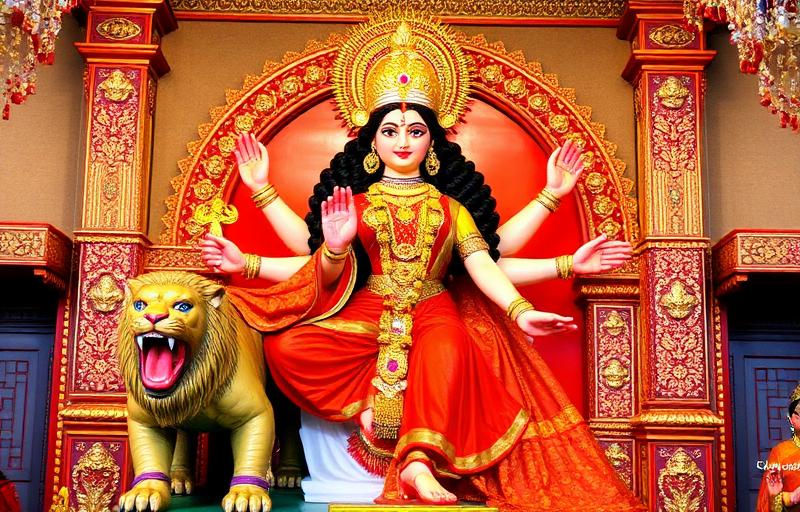
Keep it simple: in the morning play one short chant to invoke the Goddess, then the Durga Chalisa, and close with the Argala Stotram; in the evening light the lamp and sing one aarti, Jai Ambe Gauri in most Hindi-speaking homes or Jay Adhya Shakti in Gujarati homes. That is a complete Navratri sound routine, and it takes about fifteen minutes in the morning and ten in the evening.
Everything else in this post is optional layering. Sharad Navratri 2026 runs from Sunday 11 October (Ghatasthapana) to Monday 19 October, with Dussehra on Tuesday 20 October, so you have nine mornings and nine evenings to fill. A fixed order helps because you stop deciding what to play and simply begin.
A suggested daily skeleton:
- Morning (after bath, before the kalash): Ya Devi Sarvabhuteshu, Durga Chalisa, Argala Stotram
- Evening (at lamp-lighting): Jai Ambe Gauri or Jay Adhya Shakti, followed by one bhajan the family enjoys
- Weekend or Ashtami extras: Aigiri Nandini and a non-stop Mata bhajan set while you cook or decorate
If you only have five minutes, play the aarti alone. The Goddess is honoured by attention, not by length.
Morning: Ya Devi Sarvabhuteshu, Durga Chalisa, Argala Stotram
Morning is for stotra and chant, not for loud bhajans. The mind is quiet, the house is still, and Sanskrit verses set a steady rhythm for the day.
Start with Ya Devi Sarvabhuteshu. These verses come from the Devi Mahatmya (Durga Saptashati) and salute the Goddess who lives in all beings as consciousness, intellect, sleep, hunger, memory and compassion. Each verse ends with the same refrain of bowing again and again, so even a child can join by the third repetition. Play it as you light the morning lamp and place fresh flowers at the kalash.
Next, the Durga Chalisa in Anuradha Paudwal's voice, with lyrics on screen. Forty verses in simple Hindi that tell the Goddess's story, her forms and her promise to those who remember her. It takes seven to eight minutes and is the heart of a Hindi household's Navratri morning. To read along, open our Durga Chalisa lyrics and meaning page.
Close with the Argala Stotram, traditionally recited before the Saptashati. Its refrain asks the Goddess for form, victory, fame and the defeat of enemies, understood by most devotees as inner enemies: anger, fear and laziness. Chant-along versions pause after each line so you can repeat it.
Order matters less than regularity. Pick the same time each morning for all nine days.
Evening aarti: Jai Ambe Gauri, Ambe Tu Hai Jagdambe Kali, Jay Adhya Shakti
Evening aarti is the one thing almost every household does during Navratri, so choose yours and sing it, do not just play it.
Jai Ambe Gauri is the standard Hindi Durga aarti, sung at lamp-lighting in homes across North India and at most temple aartis. Anuradha Paudwal's T-Series recording has Hindi and English lyrics on screen, which helps children and family members who did not grow up with it. Read our Jai Ambe Gauri meaning once and the words will stay with you.
Ambe Tu Hai Jagdambe Kali is the other great Hindi aarti, addressed to the Goddess as Kali and as Jagdamba, mother of the world. Many families sing it on Saptami and Ashtami, the nights of Kalratri and Mahagauri, or alternate it with Jai Ambe Gauri on different evenings.
In Gujarati homes the evening belongs to Jay Adhya Shakti. Sadhana Sargam's version is the one most people know; if you want the Gujarati words on screen, use Studio Sangeeta's lyric video. This aarti is also what is sung at garba venues before the dancing begins, usually around nine or ten at night, so singing it at home links your puja to the wider celebration.
A mixed household can sing both: the Hindi aarti at the lamp, the Gujarati aarti before leaving for garba.
Day by day: one piece for each Navadurga form (11 to 19 October 2026)
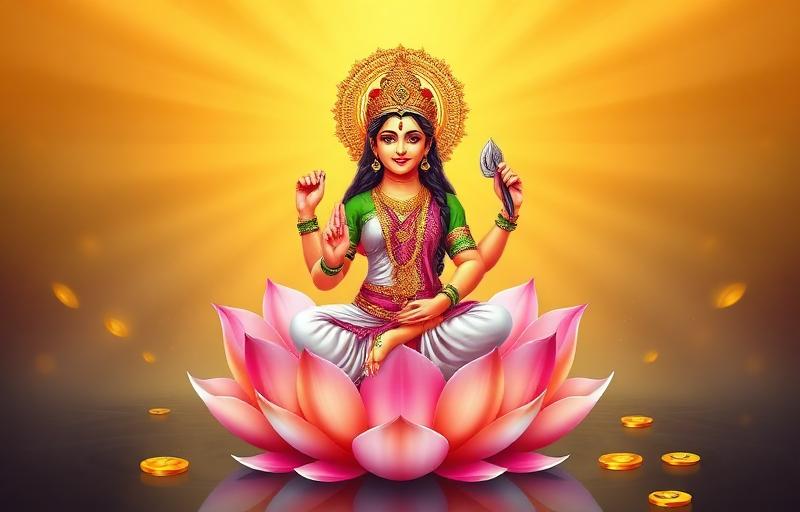
Each Navratri day honours one of the nine Navadurga forms, and pairing one piece with each form gives the morning a focus. Our Navadurga day-by-day guide has the puja vidhi, bhog and mantra for each day; here is the music to go with it.
- Day 1, Sun 11 Oct, Shailputri: Ya Devi Sarvabhuteshu, the invocation for Ghatasthapana morning
- Day 2, Mon 12 Oct, Brahmacharini: Durga Chalisa, the form of tapasya, so begin the daily chalisa discipline
- Day 3, Tue 13 Oct, Chandraghanta: Jai Ambe Gauri, her bell is said to drive away fear; ring a ghanti with the aarti
- Day 4, Wed 14 Oct, Kushmanda: Argala Stotram, the creator of abundance, so the stotra of asking fits
- Day 5, Thu 15 Oct, Skandamata: Chalo Bulawa Aaya Hai, the mother's call, a gentle bhajan about going to her
- Day 6, Fri 16 Oct, Katyayani: Aigiri Nandini, she is widely linked to the slaying of Mahishasura
- Day 7, Sat 17 Oct, Kalratri: Ambe Tu Hai Jagdambe Kali, the Kali aarti for the darkest, most protective night
- Day 8, Sun 18 Oct, Mahagauri: Jay Adhya Shakti, Ashtami is the big aarti night in Gujarat
- Day 9, Mon 19 Oct, Siddhidatri: Jai Mata Di dhuni, gratitude and celebration before Dussehra on 20 October
Treat this as a starting point; if your family has a favourite for a particular day, keep it.
Aigiri Nandini and the Mahishasura Mardini story
Aigiri Nandini is the popular name of the Mahishasura Mardini Stotram, a Sanskrit hymn attributed by tradition to Adi Shankaracharya. Rajalakshmee Sanjay's recording is fast, clear and rhythmic, which is why it has become a Navratri favourite far beyond South India, where it was long a morning staple.
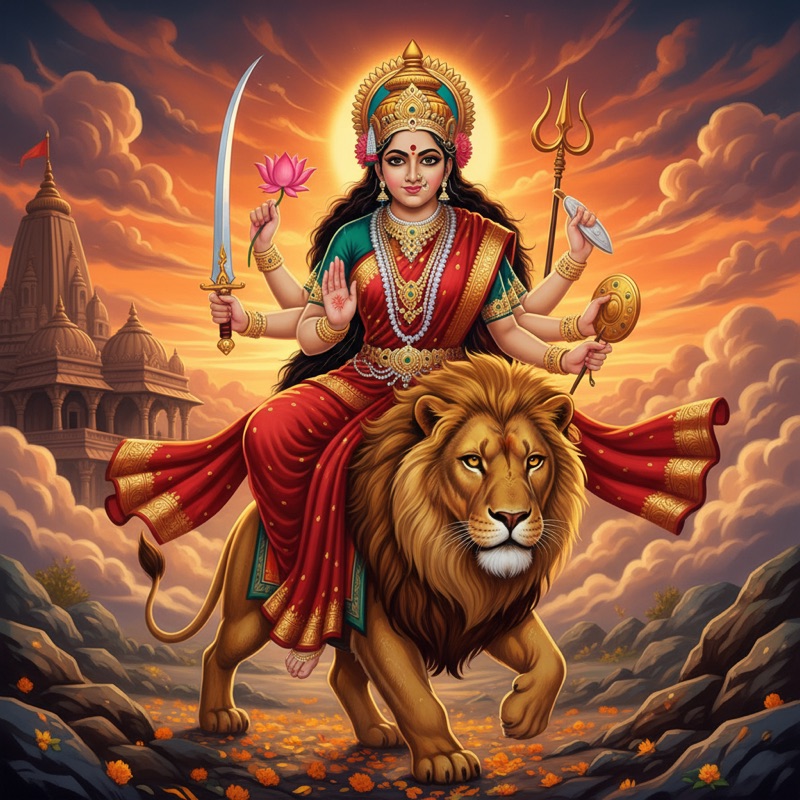
The story it celebrates is told in the Devi Mahatmya. Mahishasura, the buffalo demon, had won a boon that no man or god could kill him, and he drove the devas from heaven. From their combined anger a brilliant light arose and took the form of Durga, armed with weapons gifted by every god and seated on a lion. The battle is said to have lasted nine nights; on the tenth day she slew Mahishasura, which is why Vijayadashami follows Navratri. The stotra addresses her as the daughter of the mountain, the one who delights in the dance of battle, and the mother who protects.
It is a demanding piece, with twenty-one long verses, so most families play it rather than sing it, often on Ashtami or Navami morning, or on Day 6 for Katyayani. For a verse-by-verse meaning, read our Mahishasura Mardini Stotram guide. Playing it once with the meaning open changes how it sounds every time after.
Bhajans for the family and kids
Stotras are for the quiet morning; bhajans are for the family evening, after the aarti, when everyone is in the puja room and the children want something to clap to.
Jai Mata Di (Dhuni Maa Ke Naam Ki) by Lakhbir Singh Lakkha is the easiest entry point. The chorus is simply the Goddess's jai, so a three-year-old can join, and the beat rises steadily like a jagran. For a longer stretch, his non-stop Mata bhajans set runs through the well-known Sherawali bhajans and works as background while you prepare the bhog or set up for kanya pujan.
Two film bhajans have become folk property. Chalo Bulawa Aaya Hai from Avtaar (1983), sung by Narendra Chanchal, Mahendra Kapoor and Asha Bhosle, is the pilgrimage song for Vaishno Devi and for anyone who feels the Mother calling; grandparents will know every word. Maa Sherawaliye Tera Sher Aa Gaya from Khiladiyon Ka Khiladi (1996), by Sonu Nigam and Alka Yagnik, is louder and more playful, perfect for a Saturday evening when the kids are restless.
Let the children pick one bhajan a night. Ownership makes them show up for the aarti the next day, and by Navami they will know the words better than you do.
Practical tips for nine days of puja music

A few habits make the difference between a playlist that runs in the background and one that actually becomes puja.
- Volume: keep it at speaking level. Aarti is meant to be sung over, not shouted over, and neighbours in a flat will thank you across nine straight days.
- Phone on do-not-disturb: notifications over the Durga Chalisa break the mood instantly. Download or cast to a speaker, then put the phone face down.
- Sing, do not only play: for the aarti, use the recording as support for the first two or three days, then lower it and let the family carry the tune. Stotras can stay as play-along.
- Short on work days: on office mornings do Ya Devi plus the aarti; save the Chalisa, Argala and Aigiri Nandini for the weekend and for Ashtami and Navami. Our working family Navratri routine has a full timetable.
- Fixed slot: same time, same place, same order. Children remember rituals by sequence.
- One new piece only: if you are adding Argala Stotram or Aigiri Nandini this year, add one, not both. Learn it well; add the other next Navratri.
The aim is not a perfect playlist but nine days in which the house sounds like Navratri.
Frequently Asked Questions
Which aarti should I sing at home during Navratri?+
Jai Ambe Gauri is the standard Hindi Durga aarti and Jay Adhya Shakti is the Gujarati one. Either is complete on its own; sing whichever your family knows, and add Ambe Tu Hai Jagdambe Kali on Saptami or Ashtami if you like.
Is it fine to play recordings instead of singing?+
Yes. Stotras like Ya Devi, Argala and Aigiri Nandini are usually played along with. For the aarti, try to sing even if the recording is on; the intention and attention matter more than a perfect tune.
What should I play in the morning during Navratri?+
A short Ya Devi Sarvabhuteshu chant, then the Durga Chalisa, then the Argala Stotram. The three together take about fifteen minutes. On busy weekdays, Ya Devi alone with a lamp is enough.
Do I have to play Aigiri Nandini every day?+
No. In South India it is a morning staple, but most other households play it once or twice, typically on Ashtami or Navami morning or on Day 6 for Katyayani. Read the meaning once and it becomes far more rewarding.
About the author
Dr. Suresh Iyer · Vastu Shastra & Jyotish, 18+ years
Dr. Suresh has practiced traditional Vastu and basic Vedic Jyotish for over 18 years across South India. He contributes the Vastu, direction, and home-puja layout guides on Vandnaa.
Meet the Vandnaa editorial team →