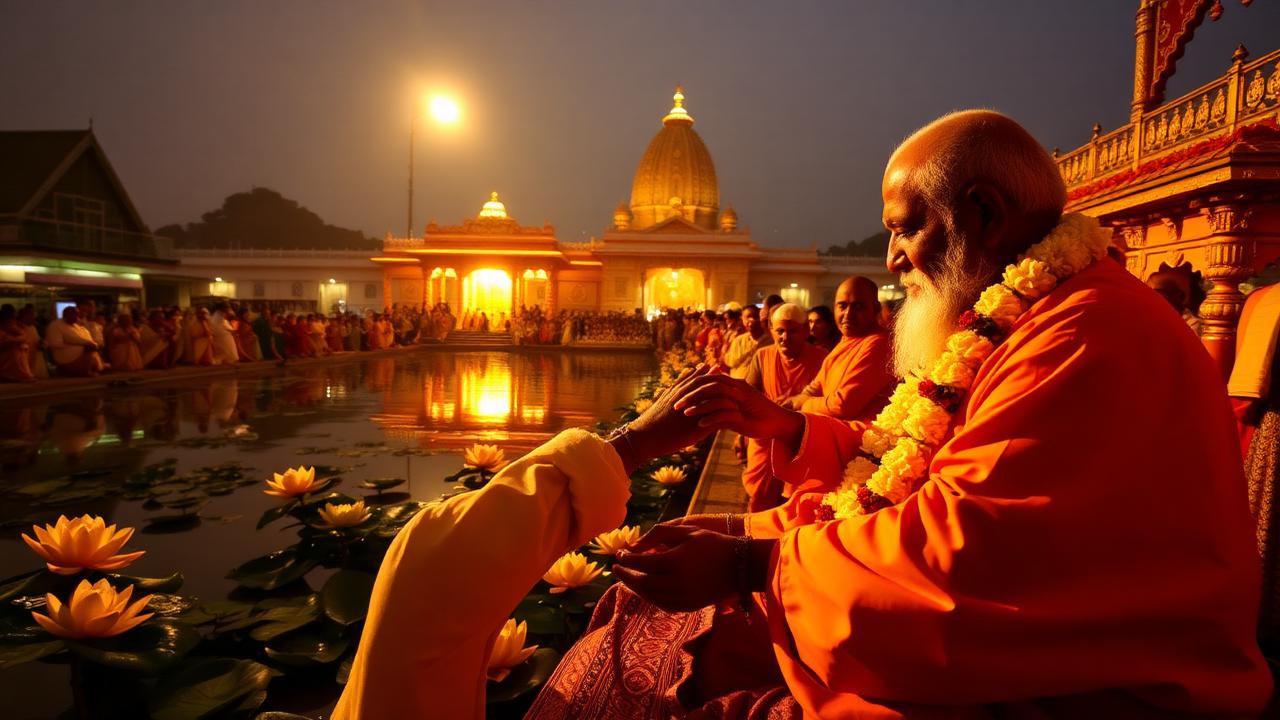
What Is the Om Sahana Vavatu Mantra?
Om Sahana Vavatu is the great shanti mantra of learning, chanted together by teacher and student before study begins. The Sanskrit word that defines it is saha - together. May we be protected together, may we be nourished together, may we work with vigour together, may our study be luminous, and may we never resent each other. In the ancient gurukula, where a student lived in the teacher's home for years, this prayer was the daily contract of the classroom: knowledge can only flow where there is mutual goodwill. Thousands of years later, the mantra still opens Vedanta discourses, school assemblies, yoga teacher trainings and music lessons across India and beyond. It asks for nothing material - only protection, nourishment, energy, bright understanding and freedom from mutual hostility, the five conditions without which no real learning happens.
Full Mantra in Devanagari with Transliteration
The complete shanti mantra:
ॐ सह नाववतु। सह नौ भुनक्तु। सह वीर्यं करवावहै। तेजस्वि नावधीतमस्तु मा विद्विषावहै। ॐ शान्तिः शान्तिः शान्तिः॥
oṁ saha nāvavatu, saha nau bhunaktu, saha vīryaṁ karavāvahai, tejasvi nāvadhītam astu mā vidviṣāvahai, oṁ śāntiḥ śāntiḥ śāntiḥ
Line by line: May That (the Divine) protect us both together. May That nourish us both together. May we work together with great energy. May our study be brilliant and effective; may we never hate or quarrel with each other. Om, peace, peace, peace.
Note the grammar: the mantra is entirely in the dual number, a special Sanskrit form for exactly two people - here, the teacher and the student - which gives the prayer its intimate, two-way character.
Word-by-Word Meaning
Each phrase unpacks beautifully: 1. saha - together, jointly 2. nau - us both (the dual form: teacher and student) 3. avatu - may (That, the Divine) protect 4. bhunaktu - may (That) nourish, sustain, cause to enjoy 5. vīryam - vigour, energy, capability 6. karavāvahai - may we both perform, may we both exert (dual form of 'let us do') 7. tejasvi - brilliant, radiant, full of tejas (inner fire) 8. nau adhītam - what is studied by us both 9. astu - may it be 10. mā vidviṣāvahai - may we two not hate or quarrel with each other (mā is the prohibitive 'not', vidviṣ means mutual hatred) 11. oṁ śāntiḥ śāntiḥ śāntiḥ - Om, peace, peace, peace
Overall meaning: 'May the Divine protect and nourish us both together; may we work together with energy; may our study be radiant; may there never be hostility between us. Om, peace, peace, peace.'
Deeper Meaning - The Sacred Teacher-Student Bond

Why would a teacher and student need to pray against hating each other? Because the ancients understood teaching honestly. Real learning involves correction, challenge and the bruising of egos. A student may resent a strict teacher; a teacher may grow impatient with a slow or argumentative student. The line mā vidviṣāvahai names this danger openly and asks for grace to overcome it. Deeper still, the mantra treats knowledge as a joint achievement, not a transfer. Saha vīryaṁ karavāvahai - may we work with vigour together - makes the student an active partner, not a vessel. And tejasvi nāvadhītam astu asks that the study become tejasvi, luminous: not merely memorised but alive, transforming both parties. In Vedanta, where the subject matter is the very nature of the self, this harmony between guru and shishya is held to be the single most important condition for understanding to dawn.
Source - The Upanishads of the Krishna Yajurveda
Om Sahana Vavatu is the shanti path (peace invocation) of the Upanishads belonging to the Krishna Yajurveda. It appears at the opening of the Taittiriya Upanishad (in its second and third chapters, the Brahmananda Valli and Bhrigu Valli) and traditionally precedes the Katha Upanishad - the famous dialogue in which the young seeker Nachiketa questions Yama, the lord of death, about what lies beyond dying. It also opens the Shvetashvatara and other Upanishads of the same Veda. Each Veda has its own signature shanti mantra: oṁ bhadraṁ karṇebhiḥ for the Atharvaveda's Upanishads, oṁ pūrṇamadaḥ for the Shukla Yajurveda's, and saha nāvavatu for the Krishna Yajurveda's. Reciting it before these texts was never optional decoration - it consecrated the session, aligning teacher, student and subject before a single verse of the actual teaching was uttered.
Why It Opens Study Sessions - When and How to Recite
The mantra is recited at the beginning of any session of learning - a scripture class, a school day, tuition at home, music or dance lessons, even a personal hour of study. The method is simple: 1. Teacher and students sit facing each other, spines comfortable, eyes closed or softly lowered. 2. Chant oṁ once, then the mantra slowly, ideally in unison; in classes, the teacher often leads line by line and students repeat. 3. Pause after mā vidviṣāvahai, then chant oṁ śāntiḥ śāntiḥ śāntiḥ, letting the third śāntiḥ fade into silence. 4. Begin the lesson directly from that silence. Why before study and not after? Because the mantra's purpose is to set the inner conditions for learning: it gathers scattered attention, dissolves leftover friction between teacher and taught, and frames the coming hour as a shared, sacred effort. Students studying alone can chant it too - the 'two' then becomes the learner and the knowledge itself, or the learner and the inner teacher.
Benefits of Chanting and the Three Shantis
Regular chanting of this mantra brings benefits that students and teachers notice quickly: 1. Focused beginnings - the minute of unison chanting collects the wandering mind better than any instruction to 'pay attention'. 2. A respectful classroom - daily praying against mutual resentment genuinely softens teacher-student friction. 3. Stamina for study - invoking vīrya (vigour) frames learning as energetic work, countering dullness. 4. Retention with insight - tejasvi adhītam is a prayer that study become luminous, understood and usable, not just memorised. 5. Calm under pressure - students chant it before exams to steady nerves. The closing śāntiḥ śāntiḥ śāntiḥ is chanted thrice to pacify the three classical sources of disturbance: ādhyātmika (from one's own body and mind), ādhibhautika (from other beings around us) and ādhidaivika (from forces beyond control, like weather and fate). With all three quieted, teacher and student begin their work inside a complete circle of peace.
Common Questions From Devotees
What does Om Sahana Vavatu mean in simple words?+
It is a joint prayer of teacher and student: 'May the Divine protect us both together, nourish us both together; may we work together with energy; may our study be brilliant; may we never hate each other. Om, peace, peace, peace.'
Which Upanishad is Om Sahana Vavatu from?+
It is the shanti mantra of the Krishna Yajurveda Upanishads. It opens sections of the Taittiriya Upanishad and traditionally precedes the Katha Upanishad and Shvetashvatara Upanishad, consecrating the study session before the teaching begins.
Why is the mantra in the dual form - who are the 'two'?+
Sanskrit has a special dual number for exactly two people, and this mantra uses it throughout: nau means 'us both'. The two are the teacher and the student. When chanted alone, the two can be understood as the learner and the knowledge, or the learner and the inner guru.
When should students chant Om Sahana Vavatu?+
At the start of any learning session - the school day, a class, tuition, music practice or personal study, and many chant it before exams to calm nerves. It is chanted at the beginning, not the end, because its purpose is to prepare the mind and the teacher-student relationship for learning.
What does ma vidvishavahai mean?+
It means 'may we two not hate or quarrel with each other'. The line honestly acknowledges that learning involves correction and friction, and asks for grace so that resentment never grows between teacher and student - the condition the Upanishads consider essential for knowledge to flow.
Why is shanti repeated three times at the end?+
The three repetitions pacify the three classical sources of disturbance: adhyatmika (from one's own body and mind), adhibhautika (from other beings) and adhidaivika (from natural and cosmic forces beyond our control). With all three calmed, study can proceed undisturbed.
About the author
Acharya Vinaya Kapoor · M.A. Sanskrit, Mantra & Stotra Studies
Acharya Vinaya holds an M.A. in Sanskrit from Banaras Hindu University and writes the mantra and stotra commentary on Vandnaa. Her focus is on accurate pronunciation, traditional context, and helping modern readers connect with classical texts.
Meet the Vandnaa editorial team →