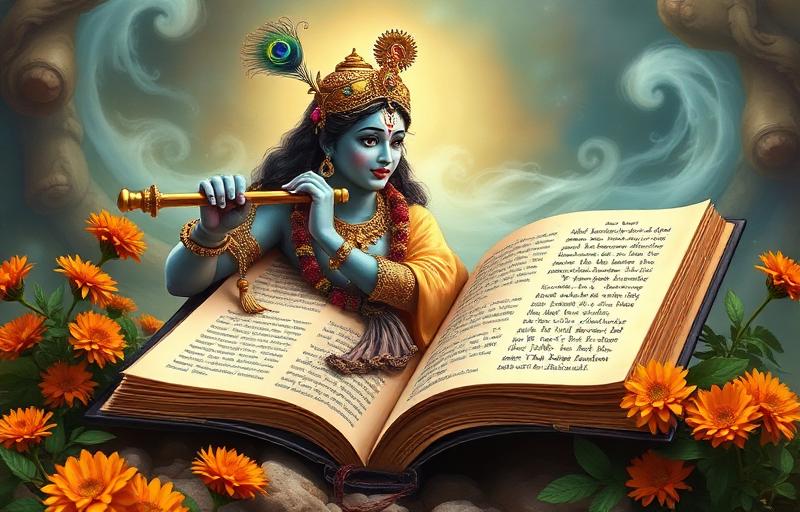
The Demon Who Joined a Game
Pralamba disguised himself not as an animal or a landscape feature, the way most of Kamsa's earlier demons did, but as one more cowherd boy, and joined Krishna, Balarama and the others in an ordinary game they were playing in the forest - teams racing each other, the losing side required to carry the winners home on their backs.
The Bhagavata Purana describes the teams being split, and by the arrangement of the game, Pralamba, still in disguise, ends up assigned to carry Balarama on his back. This is, structurally, the same trick every one of these demons tries: get close enough to the target through an activity that looks completely harmless, then act once nobody expects it.
Once he had Balarama on his back, Pralamba began running, growing larger and faster with every step, revealing his true enormous demon form as he carried Balarama away from the others toward the forest's depths, intending to either crush him or abandon him somewhere dangerous.
Balarama did not panic or call for help. He grew heavier and larger in turn, matching the demon's own transformation, and then struck him on the head with his fist - a single blow, delivered with enough force that Pralamba's skull split and he fell dead on the spot. Krishna and the other boys, who had been playing along oblivious to what was actually happening, arrived to find the game had quietly become something else entirely, and Balarama had already finished it before any of them understood there had been a threat.
The Orchard Guarded by a Donkey
Dhenuka is a separate demon entirely, and his episode has nothing to do with disguise or infiltration - he simply took the form of a wild donkey and, along with a herd of other donkey-demons under his command, guarded a forest thick with tala (palm or toddy palm) trees whose fruit the local cowherds wanted but were too frightened to go near.
Balarama and Krishna, hearing the boys of the village complain that the fruit was there for the taking but nobody dared enter Dhenuka's forest, went themselves. Balarama shook the palm trees to bring the fruit down, and when Dhenuka charged at the intrusion, Balarama caught him by the hind legs, swung him in a circle in the air, and flung him into the top of one of the very palm trees he had been guarding, killing him on impact and breaking the tree in the process.
Dhenuka's herd of fellow donkey-demons then attacked in force, and this is one of the few episodes in the early Vraja cycle where Krishna and Balarama fight together against multiple opponents rather than one demon apiece - each of them dealing with donkey-demons the same way, catching them by the legs and throwing them into the trees, until the entire forest was cleared and, the text specifies, safe enough afterward that the local people could finally gather the fruit that had been sitting untouched for who knows how long.
Why These Two Belong to Balarama
Across the whole Vraja demon cycle, most of the killings are Krishna's - Putana, Shakatasura, Trinavarta, Aghasura, Kesi. Pralamba and Dhenuka stand out precisely because they're Balarama's alone, and traditional commentary treats this as deliberate rather than incidental: the Bhagavata's larger project in this section is establishing that Balarama is not a secondary figure trailing behind his younger brother but carries independent, equal strength, expressed through his own weapon (a plough) and, here, through demons the text hands to him specifically.
Both episodes also share a structural note worth pointing out: each defeats the demon using the demon's own preferred territory or method against him. Pralamba wanted proximity through disguise, and is defeated the moment he reveals his true size, matched pound for pound. Dhenuka guarded a forest by intimidation, and is defeated by being thrown into the very trees he'd made frightening. The stories are constructed so the demon's own strategy becomes the mechanism of his death.
The forest associated with Dhenuka in local Braj tradition, sometimes called Talavana, is one of the twelve traditional forests (vanas) of the Braj pilgrimage circuit still visited today, and its association with the palm fruit and Dhenuka's name is part of the living geography devotees walk through during Braj parikrama, rather than a purely textual detail confined to the Purana.
Common Questions From Devotees
How did Balarama kill Pralamba?+
Pralamba disguised himself as a cowherd boy and, during a game, ended up carrying Balarama on his back, then revealed his true demon form and tried to carry him away. Balarama matched his growing size and struck him dead with a single blow to the head.
Why did Dhenuka guard a forest of palm trees?+
The Bhagavata doesn't give Dhenuka a stated motive beyond territorial hostility - he and his fellow donkey-demons occupied the forest and attacked anyone who approached, which is why the local cowherds had left the fruit untouched despite wanting it.
Did Krishna fight Dhenuka too, or only Balarama?+
Balarama kills Dhenuka himself, but when the rest of Dhenuka's herd of donkey-demons attacks afterward, both Krishna and Balarama fight them together, each throwing demons into the palm trees until the forest is cleared.
About the author
Anjali Mehta · Editor, M.A. Religious Studies
Anjali is the managing editor for Vandnaa and oversees the festival and vrat coverage. She holds an M.A. in Religious Studies and reviews every published article for accuracy, accessibility, and tradition-fidelity.
Meet the Vandnaa editorial team →