When Bhog Becomes Prasad - The Grace Returned
Two words mark the most beautiful exchange in Hindu worship. Bhog (or naivedya) is the food a devotee places before the deity - our offering, travelling upward. Prasad is the same food after the deity has ceremonially accepted it - grace, travelling back down. The word prasad itself means divine favour or kindness. Nothing changes chemically in those few minutes, and everything changes spiritually: the laddoo you offered as yours returns as His. The Bhagavad Gita holds the key verse - patram pushpam phalam toyam - Krishna accepts a leaf, a flower, a fruit or water from anyone who offers with love. The deity does not consume the food; tradition says the Lord accepts its bhava, the love within it, and infuses the offering with blessing. That is why a spoon of temple prasad outranks any feast: you are not eating food, you are eating acceptance.
How to Offer Bhog Correctly - The Step-by-Step Vidhi
Offering bhog is simple, but a few rules carry the tradition's whole etiquette: 1. Fresh and sattvik only - cook the bhog fresh, without onion, garlic or tasting during cooking; the first portion belongs to the Lord, untouched by anyone's tongue. 2. Clean vessel, never your everyday plate - use a dedicated bhog thali or katori, ideally of pital, silver or fresh leaf. 3. Cover the bhog while carrying it and while it sits before the deity - covering protects purity and expresses reverence, the way one covers a gift. 4. Offer with the right hand, placing the thali before the murti, then sprinkle a little water around it as shuddhi. 5. Invite the Lord to eat - fold hands and recite the naivedya mantra or simply say with love, "Prabhu, bhog lagaiye." 6. Allow a few quiet minutes, screen or curtain drawn in many traditions, before taking the thali back as prasad.
The Offering Mantras - Words That Carry the Thali
The classical naivedya offering uses the Pranahuti mantras, offering the food to the five pranas of the Lord: Om Pranaya Svaha, Om Apanaya Svaha, Om Vyanaya Svaha, Om Udanaya Svaha, Om Samanaya Svaha - concluding with Om Brahmane Svaha. Many households use the shorter, equally honoured line: "Naivedyam samarpayami" - I offer this naivedya - spoken with the deity's name, for example Shri Krishnaya naivedyam samarpayami. The Gita verse Brahmarpanam Brahma Havir... (4.24) is also widely recited, framing the food, the offering and the eater all as Brahman. And if Sanskrit feels distant, tradition keeps the door wide open: the bhakti of "Thakurji, bhog lagao" said by a grandmother is counted complete. The mantra is a vehicle; the bhava - the genuine feeling that this food is His before it is ours - is the actual offering. Speak whichever words let that feeling stand upright.
Which Foods Please Which Deity - A Quick Map
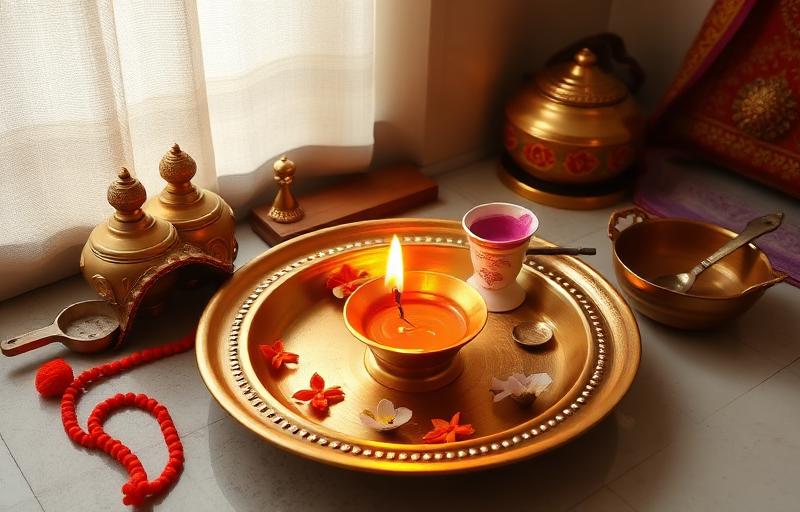
Every deity accepts any sattvik offering made with love, but tradition records favourites that devotees delight in honouring: 1. Ganesh ji - modak and motichoor laddoo. 2. Krishna / Vishnu / Thakurji - makhan-mishri, panchamrit, kheer and tulsi-touched preparations. 3. Shiv ji - simple offerings: milk, bel patra, dhatura, bhang-free sattvik sweets; Shiv asks for almost nothing. 4. Maa Durga / Devi - halwa-puri-chana, especially during Navratri; kheer for Lakshmi ji. 5. Hanuman ji - boondi laddoo, gur-chana and churma. 6. Surya Dev - gur (jaggery) and wheat preparations. These are preferences of love recorded by generations, not entry requirements - a fruit offered sincerely is never inferior to a 56-bhog spread. For the complete subject, including regional naivedya rules, see our detailed guide on naivedya and bhog offerings for each deity.
The Tulsi Leaf - Why Vishnu Bhog Is Incomplete Without It
In Vaishnav tradition, no bhog reaches Lord Vishnu or Krishna without a tulsi leaf placed upon it. The Padma Purana and Vaishnav lore hold that the Lord values one tulsi dal above the rarest delicacies - the famous tale of Tulabhara, where mountains of jewels could not balance the scale against Krishna, but a single tulsi leaf placed with devotion by Rukmini did. Tulsi is Vishnupriya - beloved of Vishnu - and her leaf on the thali is the signature of love that authenticates the entire offering. The rules of respect: pluck tulsi gently with the right hand after a small pranam, avoid plucking on Ekadashi and Sundays (offer previously plucked or fallen leaves instead - tulsi does not become stale for the Lord), and never offer tulsi to Shiv ji or Ganesh ji, whose traditions differ. One leaf is enough. Grace has never been measured by volume.
How to Receive Prasad - Right Hand, Full Heart, Zero Waste
Receiving prasad has its own graceful protocol, learnt at every temple doorway: 1. Right hand over left - extend the right palm, supported underneath by the left, forming a small cradle of respect. Never receive prasad with the left hand alone. 2. Touch it to the forehead or eyes before eating - acknowledging it as grace, not snack. 3. Never refuse prasad - tradition treats refusal as turning away the deity's own kindness; if you cannot eat it (fasting, diabetes, allergy), accept it respectfully and share it with someone who can. 4. No wastage, ever - take only what you can finish; dropped or leftover prasad should go to a cow, birds, a tulsi bed or flowing water, never the dustbin. 5. Eat it seated and unhurried, ideally saying the Lord's name first. The rules all point one way: what came back from the altar carries the altar with it, and is handled accordingly.
Sharing Prasad and the Mistakes to Avoid

Prasad multiplies by division - it is meant to be shared, never hoarded. Distribute it to everyone present without picking favourites, send a portion to neighbours and elders, and remember the order many households keep: deity first, then guests and children, the family after, the offerer last. Common mistakes worth gently correcting: 1. Tasting bhog while cooking - the offering must reach the Lord untouched. 2. Offering stale, leftover or refrigerated-overnight food as fresh bhog. 3. Leaving bhog before the deity for hours - offer, wait briefly, then distribute; food left too long is no longer treated as prasad. 4. Receiving with the left hand or grabbing casually mid-conversation. 5. Refusing or binning prasad - the two heaviest discourtesies. 6. Buying prasad as a formality while the heart stays uninvolved - the one mistake no rule can fix, and the one bhakti fixes instantly.
Common Questions From Devotees
What is the difference between bhog and prasad?+
Bhog (naivedya) is the food while it travels from devotee to deity - the offering. Prasad is the same food after the deity has ceremonially accepted it - grace returning to the devotee. Nothing changes physically; everything changes in meaning. What went up as ours comes back as His, which is why prasad is received with reverence.
Why do we receive prasad with the right hand over the left?+
The right hand is traditionally the hand of giving and receiving sacred things, while the left supports it from below, forming a respectful cradle. Receiving with the left hand alone is considered discourteous to the giver and to the grace itself. Touching the prasad to the forehead before eating completes the gesture of acceptance.
Can we refuse prasad if we are fasting or diabetic?+
Do not refuse it - accept it respectfully, touch it to your forehead, and share it with a family member or someone nearby who can eat it. Tradition treats outright refusal as turning away the deity's kindness, but it never demands that you harm your health or break a vrat. Accepting with love and passing it on honours both the prasad and your body.
Why is a tulsi leaf placed on Vishnu and Krishna bhog?+
Tulsi is Vishnupriya - most beloved of Lord Vishnu - and Vaishnav tradition holds that bhog reaches him only when a tulsi leaf rests upon it. The Tulabhara katha shows a single tulsi leaf outweighing mountains of jewels on Krishna's scale. One leaf, plucked gently with a pranam (not on Ekadashi or Sundays), completes the offering. Tulsi is not offered to Shiv ji or Ganesh ji.
What should be done with leftover or fallen prasad?+
Never put prasad in a dustbin. Take only what you can finish; anything remaining should be given to a cow, offered to birds, placed at the base of a tulsi or peepal plant, or immersed in flowing water. The principle is simple: food that has touched the altar is treated as sacred to its last crumb, and feeding another creature with it is itself seva.
Can food cooked with onion and garlic be offered as bhog?+
No - bhog is always sattvik. Onion, garlic, meat, eggs and alcohol are excluded from offerings across traditions, and the bhog should be cooked fresh without being tasted during preparation. Simple sattvik food offered with love - even fruit, milk or batasha - is always superior to an elaborate dish that breaks these principles.
About the author
Pandit Mahesh Trivedi · Festival Traditions & Panchang
Pandit Mahesh leads the festival-date and Panchang content on Vandnaa. He cross-references multiple regional panchangs (Drik, Vaishnava, Bengali, Marathi) for every festival date published on the site.
Meet the Vandnaa editorial team →