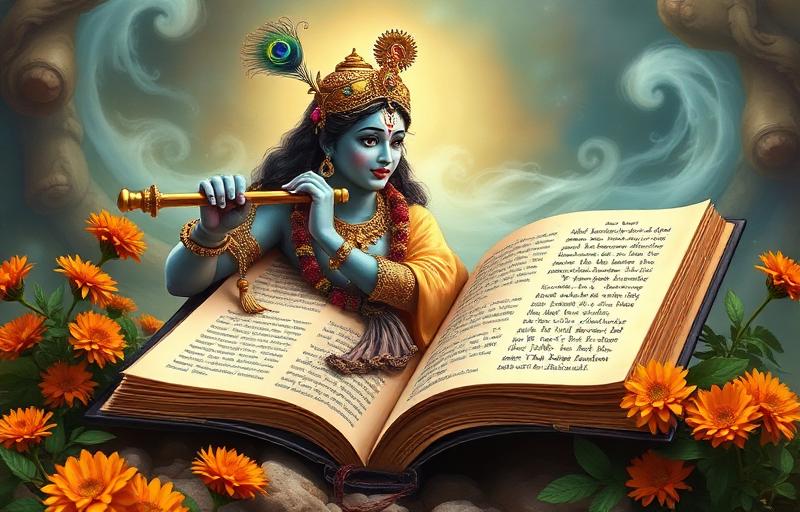
More Than One Account, Never a Casual One
Radha's origin is not told with a single fixed narrative the way most figures in this series receive, and the texts that do address it, chiefly the Brahma Vaivarta Purana, the Padma Purana and later regional devotional literature, differ enough that even devotees comfortable with variant tellings elsewhere in the tradition treat Radha's case as unusually layered.
The most widely told version among these has the gopa chieftain Vrishabhanu and his wife Kirtida performing a ritual on the banks of the Yamuna near what is today Barsana, when Vrishabhanu discovers an infant girl of extraordinary radiance lying in a lotus, not born to Kirtida through ordinary pregnancy at all, and adopts her as his own daughter.
A separate strand within the Brahma Vaivarta Purana's own cosmology goes considerably further, describing Radha as emerging directly from Krishna's own left side during a moment of cosmic creation, positioning her not as a later companion he encounters in Vrindavan but as a being coeval with him, drawn from his own body before either of them took birth in the mortal world at all.
A third strand, more folk and regional in character, simply has her found as an infant in a field, her origin left deliberately mysterious even within the story, discovered rather than born in any way the surrounding gopa community could fully account for.
What the Variation Itself Communicates
Where most figures in Puranic literature get their genealogy pinned down precisely, specifically because lineage matters so much to how a story functions, Radha's deliberately unfixed origin appears to be doing different work: signalling from the outset that she does not belong to ordinary categories of birth and kinship the way even other divine or semi-divine figures in this corpus generally do.
This matters for how later theology, particularly within the Gaudiya Vaishnava tradition associated with Chaitanya Mahaprabhu, comes to treat her: not simply as Krishna's most beloved gopi among many, but as Hladini Shakti, the personification of Krishna's own capacity for bliss and love, inseparable from him in a way ordinary companionship does not capture.
In that framing, the question of a fixed birth narrative becomes almost beside the point: a personification of an aspect of Krishna's own nature does not strictly need the kind of biographical origin a mortal figure requires, which may be exactly why the tradition felt free to tell her arrival multiple, only partially reconcilable ways rather than settling on one.
A Place That Still Carries the Story
Barsana, in the Braj region near Vrindavan and Mathura, remains closely associated with Radha as her traditional childhood home and the seat of Vrishabhanu's household, and pilgrims visiting Braj today move between Krishna's own associated sites and Radha's with the two treated as inseparable halves of one devotional geography.
Whichever origin story a given tradition or text favours, all of them converge on the same underlying claim, which is arguably the actual point of telling her origin at all: that Radha's connection to Krishna does not begin with a chance meeting in Vrindavan's pastures the way the gopis' devotion generally does, but predates it, is built into whatever she fundamentally is, however differently different texts choose to describe that fundamental nature.
A reader who has met Uddhava's changed heart after the Bhramar Geet elsewhere in this series can read Radha's own unresolved origin as the deeper structural fact underneath that entire episode: the gopis' devotion is intense because it mirrors, at one remove, a bond the tradition treats as never having been separate in the first place.
Frequently Asked Questions
How was Radha born, according to Puranic tradition?+
Accounts differ. The most common tells of Vrishabhanu discovering her as an infant of extraordinary radiance during a ritual on the Yamuna's banks near Barsana. Another tradition in the Brahma Vaivarta Purana describes her emerging from Krishna's own left side.
Why does Radha's origin story vary so much across texts?+
Her deliberately unfixed origin appears to signal that she does not belong to ordinary categories of birth, consistent with later theology treating her as Hladini Shakti, the personification of Krishna's own capacity for love and bliss, rather than simply a companion he encountered.
What is Radha's connection to Barsana?+
Barsana, in the Braj region, is traditionally held to be Radha's childhood home and Vrishabhanu's household, and remains a major pilgrimage site closely associated with her alongside Krishna's own sites in Vrindavan and Mathura.
About the author
Anjali Mehta · Editor, M.A. Religious Studies
Anjali is the managing editor for Vandnaa and oversees the festival and vrat coverage. She holds an M.A. in Religious Studies and reviews every published article for accuracy, accessibility, and tradition-fidelity.
Meet the Vandnaa editorial team →