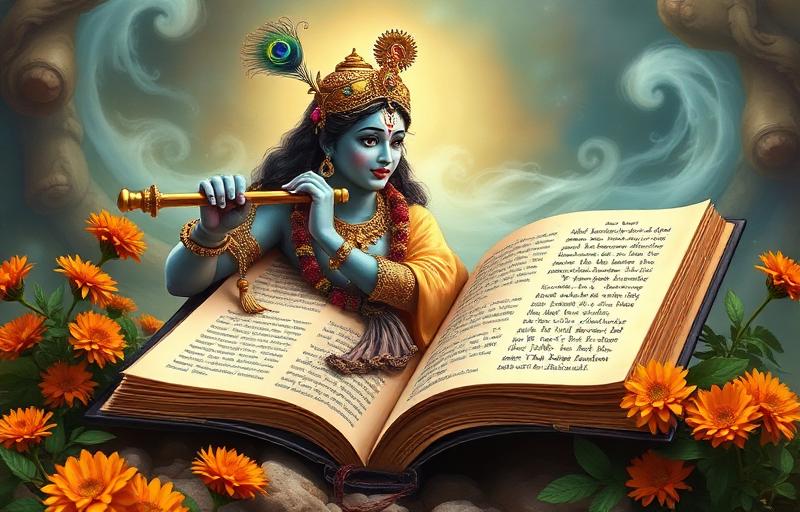
Krishna's Wisest Friend, Sent to Console the Ones He Left
After Krishna left Vrindavan for Mathura to confront Kamsa, told elsewhere in this series, he did not return to the cowherd settlement of his childhood, remaining instead at Mathura and later Dwarka for the rest of his life on earth.
The gopis, the cowherd women whose devotion to him during his Vrindavan years is one of the Bhagavata Purana's central images of bhakti, were left behind with no clear sense of whether he would ever come back, their days consumed by longing described across the tenth canto in some of Sanskrit devotional literature's most intense poetry.
Krishna, aware of their grief, sent Uddhava, his own cousin and closest friend, a man renowned for his learning and specifically for his mastery of Vedanta and Sankhya, to Vrindavan carrying a message of consolation: that Krishna is present everywhere, in every element and every being, and that the gopis' grief at his physical absence rested on a mistaken sense of separation, since the one they loved was never actually apart from them in any ultimate sense.
The Reply Known as the Bhramar Geet
The gopis' response to Uddhava's philosophical consolation is preserved in Sanskrit and, far more extensively, in the vernacular devotional poetry of North India, as the Bhramar Geet, the Song to the Bumblebee, so named because the gopis address much of their reply not to Uddhava directly but to a black bee that happens to hover nearby, using it as a stand-in for Krishna, whose own dark colour and habit of moving from flower to flower without settling gives the gopis their sharpest metaphor.
Their reply is not a rebuttal of Vedanta on its own philosophical terms. It is, rather, an insistence that abstract omnipresence is no substitute for a particular person's particular presence, and that being told their beloved is technically everywhere brings no comfort at all to those who want him specifically, physically, here.
They needle the bee, and through it Uddhava and Krishna both, with pointed sarcasm about Krishna's own inconstancy, comparing him to the bee's habit of sampling one flower and moving to the next, while insisting all the same that their love has not wavered even under that comparison, a combination of grievance and unshaken devotion the poetic tradition treats as the emotional high point of the entire episode.
The Philosopher Who Left Persuaded
The Bhagavata Purana is explicit about the outcome of the exchange: Uddhava, arriving to instruct the gopis in a higher, more detached form of devotion, leaves Vrindavan instead deeply moved by the sheer intensity and single-minded purity of their love, and is said to have declared that their form of bhakti, uncomplicated by any philosophical qualification, surpassed his own accumulated wisdom.
He reportedly asks to be reborn, if reborn he must be, even as a blade of grass in Vrindavan's soil, so that the dust raised by the gopis' feet might touch him - a wish later devotional poets and singers, particularly within the Vallabha and Chaitanya traditions, return to repeatedly as the clearest possible statement of raw bhakti's superiority over dry philosophical knowledge.
The episode's lasting influence runs directly into the wider Bhakti movement's own recurring argument, told across many of the sant biographies elsewhere on this site: that intellectual mastery of scripture is not the same achievement as a devotee's unguarded, undignified, entirely un-philosophical love, and that the second can leave the first looking, by comparison, thin.
Common Questions From Devotees
Who was Uddhava and why did Krishna send him to Vrindavan?+
Uddhava was Krishna's cousin and closest friend, renowned for his mastery of Vedanta. Krishna sent him to console the grieving gopis with the philosophical teaching that Krishna's presence is everywhere, not confined to any one physical place.
What is the Bhramar Geet?+
The gopis' poetic response to Uddhava, addressed largely to a bumblebee as a stand-in for Krishna, expressing that abstract philosophical consolation cannot replace their beloved's particular, physical presence - a major devotional poem in North Indian bhakti literature.
How did the encounter change Uddhava?+
Rather than convincing the gopis of detached philosophical devotion, Uddhava was himself moved by the intensity of their love, reportedly declaring it surpassed his own wisdom and wishing to be reborn even as grass in Vrindavan touched by their footsteps.
About the author
Anjali Mehta · Editor, M.A. Religious Studies
Anjali is the managing editor for Vandnaa and oversees the festival and vrat coverage. She holds an M.A. in Religious Studies and reviews every published article for accuracy, accessibility, and tradition-fidelity.
Meet the Vandnaa editorial team →