The Guardian in Every Complex
Ravalnath is the most widely present guardian deity of Goa and the Konkan coast, and once you know what to look for, you will see his shrine at almost every village temple in the state.
He is a kshetrapal, a guardian of the field or territory, and in the Goan temple system that is a defined office rather than a general description. The gram devata or kul devata holds the centre. Ravalnath holds the boundary.
His form is distinctive:
- A standing male figure, usually armed with a sword and shield
- Dressed and equipped as a warrior or a ruler, unlike the fiercer guardian forms
- Sometimes shown on horseback
- Frequently accompanied by a dog
- Worshipped in his own shrine within the temple complex, generally close to the main sanctum
He is understood as a form of Shiva, in the Bhairav aspect that guards, which is the standard identification for kshetrapal deities across India.
What makes Ravalnath worth understanding is his sheer ubiquity in Goa. He is not a famous deity with a great temple. He is the deity who is present everywhere, in a supporting position, and the Goan temple system does not function without him.
Ravalnath and Betal: Two Guardians, Different Jobs
Goa has two principal guardian deities, and telling them apart is the key to reading a Goan temple complex.
Ravalnath:
- Clothed and armed as a warrior or ruler, with sword and shield
- Present in almost every village temple complex
- Worshipped in the ordinary temple manner, within the daily routine
- Holds the position of the regular guardian, the one on standing duty
Betal:
- Depicted as a tall unclothed figure, fierce, with a dagger and a bowl
- Present at specific shrines rather than universally
- Associated with night, with the boundary and with the spirits
- Worshipped with distinctive customs, including the offering of sandals, since he is understood to walk the boundary at night
The difference is one of register. Ravalnath is the guardian in the form of authority. Betal is the guardian in the form of what authority is for.
Alongside them, a Goan temple complex typically holds:
- The gram devata or kul devata at the centre
- Santeri, worshipped in the anthill, representing the earth itself
- Bhumika or Bhumi Purush, deities of the land
- Subsidiary shrines depending on the village
A visitor who learns to identify these four, the main deity, Santeri, Ravalnath and Betal, can read almost any Goan temple complex without asking, and will start noticing the same structure repeated across the state.
The Kshetrapal Idea
The kshetrapal is one of the most useful concepts in Hindu practice, and it explains a great deal about how temples are actually organised.
The principle is simple. A deity in a sanctum is worshipped. The ground on which the sanctum stands also needs to be held, and that is a different function, given to a different deity.
Where you find kshetrapals:
- Ravalnath and Betal in Goa and the Konkan
- Bhairav at the entrance of Devi temples across north India, and as the kotwal of Kashi
- Bhukund Bhairav at Kedarnath, who holds the shrine through the winter
- Kshetrapal shrines across the Himalaya, alongside village deities
- Ayyanar and Karuppasamy at the boundary of Tamil villages
- Dih Baba and Bhumiya Dev in the north Indian plains, holding the village ground itself
The pattern is universal across India, and the vocabulary changes by region. What does not change is the logic: the deity inside receives the worship, and the deity outside makes it possible.
That is why guardian deities are almost never the famous ones. They are not meant to be. Their shrines are small, their worship is brief, and their position is at the door.
And it is also why devotees do not skip them. In Goa, in Tamil Nadu, in Kashi and at Kedarnath alike, the local instruction is the same. Acknowledge the guardian on the way in or on the way out, because the darshan you came for happens on ground he is holding.
How Ravalnath Is Worshipped
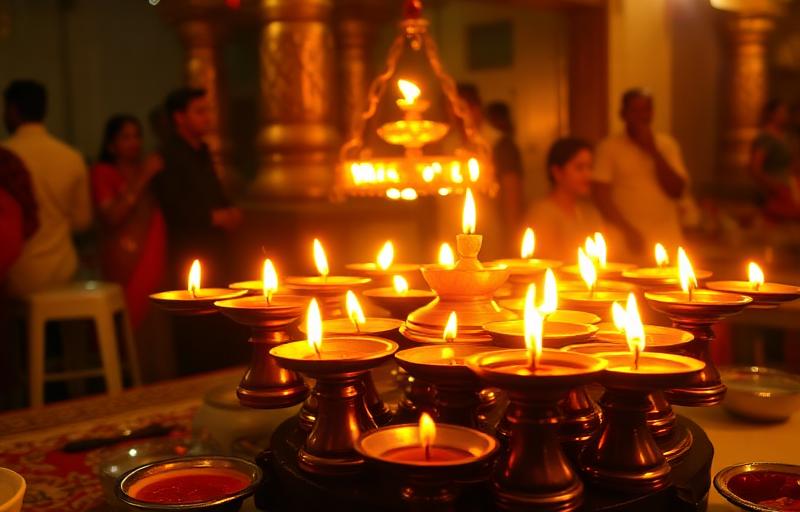
Ravalnath's worship is part of the daily routine of the Goan village temple rather than a separate tradition.
- He receives daily puja along with the other deities of the complex, with flowers, oil lamps, haldi kumkum and naivedya
- Devotees offer at his shrine before or after the main deity, depending on the temple's customary order
- He features in the temple's zatra, the annual festival, when the palkhis go in procession
- Shigmo, Goa's spring festival in Phalgun, brings folk performance and processions to the village temples
- Families who keep the temple as their kul devata shrine include him in their observances at weddings, thread ceremonies and annual visits
What is worth noticing is the customary order. Goan temples have a fixed sequence in which the shrines of a complex are visited, and it is not arbitrary. Asking at the temple which order to follow is the correct approach, and the mahajans or the priest will say.
Ravalnath shrines are also found beyond Goa, along the Konkan coast into Maharashtra and Karnataka, following the same pattern of village temple organisation.
For devotees whose families are from Goa and who now live elsewhere, Ravalnath is part of what they return for. The kul devata visit involves the whole complex, not only the main deity, and the guardian's shrine is part of completing it.
Reading a Goan Temple Complex
Goan temples look different from temples elsewhere in India, and knowing the elements makes a visit far more legible.
What you will find:
- A deepstambha, the lamp tower in the courtyard, lit on festival evenings, which is the single most recognisable feature of Goan temple architecture
- A sabha mandap, a large assembly hall, often with wooden pillars and a distinctive roof
- The main sanctum with the gram devata or kul devata
- Parivar devata shrines around it, including Ravalnath, Betal, Santeri and others
- A temple tank, often stepped
- Agrashalas, accommodation buildings for visiting families of the temple's mahajan community
The architecture itself is a mix. Goan temples of the post sixteenth century period combine Indian temple forms with elements absorbed from the Portuguese era, including domes, church style windows and facade treatments, which is why they look unlike temples anywhere else in India.
The administrative structure is equally distinctive. Goan temples are run by mahajans, the families with hereditary rights and duties in the temple, organised under a system that has continued for centuries.
For a visitor, the practical result is that a Goan temple is not just a shrine but an institution with a membership, a hierarchy of deities and a customary order of worship, all of which is visible if you know to look.
And standing quietly at the edge of it, sword in hand, is Ravalnath.
Seeing Ravalnath in Goa
Ravalnath does not have a single famous temple to travel to. He has hundreds of shrines, and the way to see him is to visit Goan village temples.
Where to go:
- The Ponda temple belt, with Mangeshi, Mahalasa at Mardol, Shantadurga at Kavlem, Nagesh, Ramnathi and Shri Damodar within a short radius, most of which have Ravalnath shrines within the complex
- Village temples across Bicholim, Sanguem, Quepem and Pernem, where the pattern is easier to see without crowds
- Zatra season, when the palkhis go out and the complex is fully active
- Shigmo in Phalgun, when village processions and folk performance fill the temples
Practical notes:
- Dress code is enforced at Goan temples. Shorts and sleeveless tops are usually not permitted, and many temples provide a covering.
- Remove footwear well before the sanctum
- Ask about the order in which the shrines should be visited, since Goan temples have a customary sequence
- Do not photograph inside the sanctum or during rituals without permission
- Weekday mornings are quiet and are the best time to actually look at a complex
A suggestion for anyone who has only seen Goa's beaches. Spend one morning in the Ponda belt, visit three temples, and at each one find the Ravalnath shrine before you leave. By the third you will have understood the structure of Goan village religion better than any amount of reading about it can convey, because the same arrangement will be in front of you each time.
Frequently Asked Questions
Who is Ravalnath?+
Ravalnath is the most widely present guardian deity of Goa and the Konkan, a kshetrapal who holds the boundary while the gram devata or kul devata holds the centre. He is shown as a standing warrior with sword and shield, sometimes on horseback and often with a dog, and is understood as a form of Shiva in the Bhairav aspect.
How is Ravalnath different from Betal?+
Ravalnath is clothed and armed as a warrior or ruler and is present in almost every village temple complex, worshipped within the daily routine. Betal is a tall unclothed fierce figure present at specific shrines, associated with the night and the boundary, and worshipped with distinctive customs such as the offering of sandals.
What is a kshetrapal?+
A kshetrapal is a guardian of the ground on which a shrine stands, a function distinct from that of the deity in the sanctum. The idea appears across India as Bhairav in the north, Ayyanar and Karuppasamy in Tamil Nadu, Dih Baba and Bhumiya Dev in the plains, and Ravalnath and Betal in Goa.
Where can Ravalnath shrines be seen?+
In almost every Goan village temple complex, including those of the Ponda belt such as Mangeshi, Mahalasa, Shantadurga, Nagesh and Ramnathi, and in village temples across Bicholim, Sanguem, Quepem and Pernem, as well as along the Konkan coast in Maharashtra and Karnataka.
What else is found in a Goan temple complex?+
A deepstambha lamp tower, a sabha mandap assembly hall, the main sanctum with the gram devata or kul devata, parivar devata shrines including Ravalnath, Betal and Santeri, a temple tank and agrashalas for visiting mahajan families.
Should devotees visit the guardian shrine as well?+
Yes. Goan temples have a customary order in which the shrines of a complex are visited, and asking at the temple is the correct approach. The local instruction across India is the same, that the guardian should be acknowledged, since the darshan happens on ground he holds.
About the author
Pandit Ravindra Sharma · Vedic Rituals & Bhakti, 22+ years
Pandit Ravindra is the Vandnaa editorial team's resident specialist on aarti, chalisa, and daily devotion. He has performed home and temple pujas across Varanasi and Delhi for over two decades and contributes the bhakti-focused articles on this site.
Meet the Vandnaa editorial team →Explore on Vandnaa
Related Articles

Betal Dev: The Night Guardian of Goa's Villages and the Silver Sandals He Is Offered
8 min read
Santeri: The Anthill Goddess Who Is Goa's Oldest Layer of Worship
8 min read

Shantadurga Temple, Kavalem: Goa's Peace-Bringing Form of Durga
7 min read
Shri Mangeshi Temple, Priol: Goa's Most Visited Shiva Shrine
7 min read