The Fourth Kedar
Rudranath stands at about 3,600 metres in Chamoli district, Uttarakhand, in high meadow below the Nanda Devi and Trishul massif.
What is there:
- A shrine set against a rock face, partly a natural formation
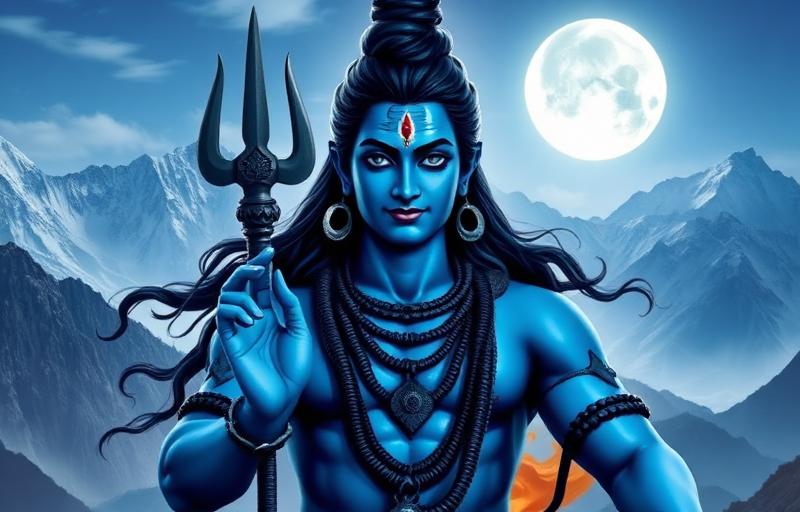
- The deity is the mukha, the face of Shiva, worshipped as a naturally formed image in the rock
- The Vaitarani kund, a pool, close by
- Alpine meadow, rhododendron and bugyal country all around
- Very little else. There is no settlement, no road and minimal shelter
The Panch Kedar. Rudranath is the fourth, and the group needs setting out properly since it is the subject of this entry.
The katha:
- After the Mahabharata war, the Pandavas sought absolution for the killing of kinsmen and of brahmanas
- They were told to seek Shiva
- Shiva, unwilling to forgive them yet, avoided them and went to the Himalaya
- At Guptakashi, he hid, from which the place takes its name, the hidden Kashi
- He then took the form of a bull and went among a herd at Kedarnath
- Bhima identified him, in the standard telling by straddling the valley so that the animals had to pass under his legs, and the bull that refused to do so was Shiva
- Bhima seized the bull, which began to sink into the ground
- The bull's parts appeared in five places
The five places and the five parts:
- Kedarnath: the hump, at 3,583 metres, the most famous and the largest
- Madhyamaheshwar: the navel or middle, at about 3,500 metres
- Tungnath: the arms, at 3,680 metres, the highest
- Rudranath: the face, at about 3,600 metres, the hardest to reach
- Kalpeshwar: the hair, the jata, at about 2,200 metres, the only one open all year
A sixth site is sometimes added: the Pashupatinath temple at Kathmandu in Nepal, where the head is said to have appeared, which extends the geography across an international border.
Why Rudranath is the least visited. Because getting there is genuinely hard, which is the subject of the sections below.
At Kedarnath there are helicopters, ponies, dandis and a town. At Tungnath there is a paved path and a road within four kilometres.
At Rudranath there is twenty kilometres of unmade trail across ridges, forest and open meadow, with a substantial net gain and considerable up and down, and no way to shorten it.
The Route
The standard route:
- Start from Sagar village, about 5 km from Gopeshwar, at around 1,900 metres
- Climb through forest to Pung Bugyal
- Continue to Lyuti Bugyal and on
- Cross Panar Bugyal, where there is basic seasonal shelter
- Cross Pitradhar, a ridge at around 3,700 metres, which is the high point of the route
- Descend to Rudranath at about 3,600 metres
- Around 20 km one way from Sagar
What makes it hard:
- The distance, twenty kilometres, on an unmade trail
- Very substantial up and down. You do not climb steadily; you cross ridges, and the descents undo gains you then have to make again
- Sections of rough and rocky trail
- Exposure on parts of the route
- Weather, which changes fast at this altitude
- Very limited shelter and no facilities along the way
- The same distance back
Typical schedule:
- Two days up, with a night at Panar
- A night at Rudranath
- Two days back, or a long single day
- Total three to five days
It is possible to do it in two very long days each way, and people do, but it is not the sensible plan and it removes any margin for weather or for somebody going slowly.
Alternative routes:
- From Mandal, joining the Sagar route
- From Helang via Kalpeshwar and Urgam, which allows a combined Kalpeshwar and Rudranath trip and is used by those doing the Panch Kedar in sequence
- From Dumak and Kalgoth villages, a longer and less used approach
Pitradhar. The ridge crossing is the crux and the name matters.
Pitra means the ancestors. Dhar is a ridge. The pass is the ancestors' ridge, and its association is with the dead, which connects directly to the Vaitarani kund at the shrine.
When to go:
- May and June, after the snow clears and before the monsoon
- September and October, after the monsoon and before the snow, which is the better window for weather and views
- The temple is generally open from around May to around October, with the deity moving to Gopeshwar for winter
- Do not attempt this in the monsoon. The trail becomes dangerous, leeches are severe, visibility is poor and the risk of getting caught out is real
- Do not attempt it in winter or with snow on the route without proper equipment and experience
Guides and porters:
- A local guide is strongly recommended and for most people is effectively necessary
- The route is not signposted, is not obvious in places, and crosses open meadow where the line is unclear in poor visibility
- Porters can be arranged from Sagar or Gopeshwar
- Hiring locally puts money into the villages the route passes through, which is the correct arrangement
Shelter:
- Panar has basic seasonal accommodation, a hut or tents run locally
- Rudranath has very limited shelter near the temple
- Neither should be relied on. Carry a tent or confirm arrangements in advance
- Facilities are seasonal and may not be operating
Food and water:
- Limited food is available at Panar and Rudranath in season
- Do not count on it. Carry food
- Water is available from streams on the route; treat or filter it
- Carry enough for the long dry sections
The Vaitarani Kund
The pool near the shrine is called Vaitarani, and the name places this site in a specific relationship with the dead.
The Vaitarani in the tradition:
- The river that must be crossed after death, between this world and the next
- Described in the Garuda Purana and elsewhere as terrible, filled with blood, pus and creatures
- Crossed with difficulty, or not at all, depending on what the person has done
- A cow is the traditional means of crossing, and the dying or dead are given a cow, or the tail of a cow to hold, in the rites called godan and vaitarani dan
Why a pool here is called that:
- Rudranath is a site for pitru rites, offerings to the ancestors
- The Pitradhar ridge on the route carries the same association
- Devotees perform pind daan and tarpan here for the dead
- The pool is where the rites are performed
Pitru rites in the tradition. Since this is what the site is used for, they should be explained.
Shraddha:
- Rites performed for the deceased, principally by the son but by others where there is no son
- Performed at fixed intervals after death, and annually thereafter on the death anniversary by the lunar calendar
- Involving pinda, balls of rice or barley, offered to the ancestors
- And tarpana, offerings of water with sesame
Pitru Paksha:
- A fortnight, generally in September or October, in the dark half of Bhadrapada or Ashwin
- The period in which shraddha is performed for all the ancestors
- Concluding at Mahalaya Amavasya, or Sarva Pitru Amavasya
- A time when auspicious undertakings are traditionally avoided
Where pitru rites are performed:
- Gaya in Bihar, the principal site, where the rites are held to be definitive
- Prayagraj, at the sangam
- Haridwar, at Narayani Shila and Kankhal
- Badrinath, at Brahma Kapal
- Rameswaram, Pushkar, Nasik at Trimbakeshwar, and many others
- Rudranath, here
- Thirunelli in Kerala, described elsewhere in this series
Why so many sites. Different families and regions have their own, and doing the rites at a recognised tirtha is held to give them greater efficacy.
Gaya specifically. Rites at Gaya are held to be conclusive, so that a person who performs them there is not obliged to repeat them, and the local expression is that the ancestors are released.
The Gaya shraddha involves offerings at a sequence of sites over several days and is one of the most involved rites in ordinary Hindu practice.
What the practice is actually doing. It is worth setting out because it is easy to describe as superstition and it is not.
- It structures grief, giving it a schedule and a set of things to do
- It maintains a relationship with the dead rather than ending it
- It obliges the living to remember, annually, by name
- It gives a family a reason to gather
- It involves feeding, of brahmanas, of the poor, of crows and of the family, so a rite for the dead ends in a meal for the living
The crows. In many regions the pinda is offered to crows, and the crow taking it is understood as the ancestor accepting.
A family will wait, sometimes for a long time, for a crow to come. If none comes, it is taken to mean something is unresolved, and the family will discuss what.
That is a mechanism for a family to sit down and talk about what is unfinished with somebody who has died, which is what grief counselling attempts to produce by other means.
At Rudranath. Performing pitru rites at 3,600 metres, twenty kilometres from a road, at a pool named for the river of the dead, below the face of Shiva in the rock, is a considerable undertaking.
That is the point. The effort is part of the offering, and people carry their dead a long way up.
The Face in the Rock
The deity at Rudranath is a naturally formed image, and this places the shrine in a specific category.
What is there:
- A rock formation identified as the face of Shiva
- Approached within a shrine built against the rock
- Worshipped as swayambhu, self manifested, since nobody carved it
Swayambhu images generally. As set out at Dwaraka Tirumala, an image that was found rather than made bypasses the requirement of consecration and carries a particular authority.
Natural formations worshipped as deities across India:
- The Amarnath ice linga, which forms seasonally
- The Shivalinga formations at Borra and other caves
- The Kailash and Kinnaur Kailash rock formations identified as lingas
- The Devi at various sites, in stones and outcrops
- Anthill images, as at Dwaraka Tirumala
- Saligrama stones from the Gandaki river, which are ammonite fossils and are worshipped as Vishnu
- Bana lingas from the Narmada, naturally shaped stones used as Shiva lingas
Saligramas deserve a paragraph. They are among the most interesting objects in Indian worship.
- Found in the Gandaki river in Nepal, principally near Muktinath
- They are ammonite fossils, the shells of extinct marine cephalopods, mineralised and eroded
- The chambered spiral inside is read as the chakra of Vishnu
- They are worshipped as Vishnu directly, without consecration, since they are self manifested
- Householders keep them, and a household with a saligrama has obligations of daily worship
So a very large number of Indian households are worshipping a hundred million year old sea creature, which they identify by the marks its shell made, as the presence of Vishnu.
That is a genuinely remarkable fact and the tradition arrived at it without any knowledge of palaeontology, on the basis of a shape.
What the tradition is doing with natural forms. The underlying position is worth stating.
- The deity is everywhere, in everything
- A form is needed for worship because human attention requires an object
- A form that occurs naturally has not been chosen by anybody, so it carries no human intention
- Such a form is therefore held to be a place where presence is manifest rather than invoked
And the pattern recognition question. It is worth saying honestly.
Humans see faces and forms in random patterns. This is a well documented perceptual tendency and it is why people see faces in clouds, in rock and in toast.
A rock formation resembling a face is, on that account, a coincidence of geology and human perception.
What that does and does not settle. It explains the mechanism by which the form was noticed. It does not address why noticing it produced a shrine at 3,600 metres that people walk twenty kilometres to reach.
The tradition's position is not that the rock is unusual. It is that the presence is there and the rock is where it became visible.
Whether you accept that or not, what is not in doubt is that people have been walking a very long way to a rock face in a high meadow for a very long time, and that they carry their dead there.
Why Difficult Pilgrimages Exist
Rudranath is hard to reach and that is not incidental. It is worth thinking about what difficulty does in a pilgrimage.
Difficult Indian pilgrimages:
- Rudranath and Madhyamaheshwar, in the Panch Kedar
- Kailash Mansarovar, the most demanding of the well known ones
- Amarnath, in Kashmir
- Shrikhand Mahadev, in Himachal, which is genuinely dangerous
- Manimahesh, described elsewhere in this series
- Nanda Devi Raj Jat, 280 km over three weeks
- Sabarimala, with its forty one day preparation
- Char Dham, historically on foot over months
What difficulty does:
- It makes the journey the offering, so that arriving is the fulfilment rather than the beginning
- It requires preparation, which means the pilgrimage occupies a person's life for a period before it happens
- It filters for intention. Nobody walks twenty kilometres over a ridge at 3,700 metres casually
- It creates a shared experience among those who did it
- It produces a real physical change of state, since a person at the end of a long walk at altitude is not in the same condition they set out in
The theological reading. The tradition says this directly.
- Merit is proportional to effort, and a tirtha reached without effort yields less
- The body's exhaustion is itself a form of tapas, austerity
- The journey is the sadhana and the destination is where it concludes
The honest complication. Making pilgrimage easier is also a good thing, and the two positions are in genuine tension.
- Roads, helicopters and ropeways bring shrines within reach of the elderly, the disabled and those who cannot take three weeks off work
- A tradition available only to the fit and the free is exclusionary in a way it does not usually admit
- The Vaishno Devi ropeway, the Kedarnath helicopters and the road to Badrinath have allowed enormous numbers of people to reach shrines they otherwise could not
And the costs of access:
- Very large numbers on fragile sites
- Waste and infrastructure that the environment cannot support
- Commercialisation of the approach
- The experience changes when a shrine is reached in twenty minutes by air
- Construction and road building destabilise slopes, as set out in the Tungnath entry
Where the balance sits. There is no clean answer and anybody offering one is not being straight with you.
What can be said:
- Access for those who cannot walk is not negotiable and should not be argued against
- Access for those who can walk but would rather not is a different question
- The carrying capacity of a high Himalayan site is a physical fact and is not adjustable by demand
- Managing numbers, which the Char Dham registration system attempts, is the only mechanism that addresses the actual constraint
Rudranath's position in this. It has no road, no helicopter and no easy option, and it consequently receives a fraction of Kedarnath's numbers.
That means the meadow is intact, the trail is not eroded to a channel, and the site is quiet.
It also means that anybody who cannot do twenty kilometres of hard walking will never see it, and that is a real exclusion, whatever the compensations.
A closing observation. The Panch Kedar contains both ends of this. Kalpeshwar is at 2,200 metres, is open all year and is reached by a short walk from Urgam.
Rudranath is at 3,600, is open five months and takes three days.
The same deity, in the same set of five shrines, from the same story, arranged so that one of them is available to anybody and one of them is not.
Whether that was designed or simply happened, it is a reasonable arrangement, and a person who cannot reach Rudranath can reach Kalpeshwar and has not been left out of anything.
Planning the Rudranath Trek
Getting to the start
- Sagar village, about 5 km from Gopeshwar, Chamoli district, Uttarakhand
- Gopeshwar is about 250 km from Rishikesh, on the road toward Joshimath and Badrinath
- Rishikesh or Haridwar are the nearest railheads
- Dehradun is the nearest airport
- Buses run to Gopeshwar; a taxi or shared vehicle to Sagar
Before you go
- Be honest about your fitness. This is a 40 km round trip on rough trail with substantial altitude gain and loss
- Read the altitude guidance in the Manimahesh and Tungnath entries and apply it
- Arrange a guide from Sagar or Gopeshwar
- Confirm the temple is open for the season
- Check the weather and be prepared to abandon
Suggested schedule
- Day one: reach Gopeshwar. Sleep at about 1,300 metres
- Day two: Sagar to Panar, roughly 12 km, climbing through forest and bugyal. Sleep at Panar
- Day three: Panar over Pitradhar to Rudranath, roughly 8 km. Perform darshan and rites. Sleep at Rudranath
- Day four: return to Panar or, for the strong, all the way to Sagar
- Day five: return to Sagar and Gopeshwar
What to carry
- A tent and sleeping bag if you are not certain of shelter
- Warm layers, including a proper insulating layer, and a windproof outer
- Waterproofs, and expect to use them
- Proper trekking footwear, broken in
- Water for at least two litres, plus means to treat stream water
- Food for the whole trip, not counting on what is available
- A torch, a first aid kit and any personal medication
- Sun protection and sunglasses
- A bag for your waste
Leeches. In the monsoon and immediately after, the forest sections have leeches in numbers. Salt, tobacco or a repellent, and long socks, are the usual measures. They are unpleasant rather than dangerous.
Doing more of the Panch Kedar
- Kalpeshwar at Urgam, reached from Helang, is close to the Rudranath area and is a short walk, so combining them is efficient
- Madhyamaheshwar, from Ransi village near Ukhimath, is around 16 km and is the second hardest
- Tungnath, from Chopta
- Kedarnath, from Gaurikund
A Panch Kedar circuit in the traditional order takes roughly two to three weeks and is one of the great Himalayan pilgrimages. Doing Rudranath and Kalpeshwar together, as a five day trip, is a manageable portion of it.
Combining otherwise
- Gopeshwar, the winter seat of Rudranath, with its own old Gopinath temple which is worth seeing and holds an ancient trident
- Chamoli and Joshimath
- Badrinath and Mana village
- Auli, for the meadow and the views
- Valley of Flowers and Hemkund Sahib, from Govindghat, in season
- Chopta and Tungnath
The Gopinath temple at Gopeshwar is worth a specific mention. It is a substantial early stone temple in the town, holds a large iron trident with an inscription, and is essentially unvisited by people passing through on the way to Badrinath.
A closing thought. The face is the fourth part of the bull, at the far end of the hardest walk in the group, in a meadow with a pool named for the river the dead have to cross.
People carry their fathers' names up there and say them at that pool, twenty kilometres from anywhere, and then walk back.
That is what the difficulty is for, and it is why nobody has built a road.
Reader Questions Answered
Where is Rudranath and how hard is the trek?+
At about 3,600 metres in Chamoli district, Uttarakhand, reached by around 20 km one way from Sagar village near Gopeshwar. The trail is unmade with very substantial up and down across ridges, crossing Pitradhar at around 3,700 metres, and the standard schedule is two days up with a night at Panar, a night at Rudranath and two days back.
What are the Panch Kedar?+
Five Shiva shrines where the parts of the bull appeared when Bhima seized it and it sank into the ground: Kedarnath the hump, Madhyamaheshwar the navel, Tungnath the arms, Rudranath the face and Kalpeshwar the hair. Shiva had taken the bull's form to avoid the Pandavas, who were seeking absolution after the Mahabharata war. Pashupatinath in Kathmandu is sometimes added as the head.
What is the Vaitarani kund?+
A pool near the shrine named for the Vaitarani, the river that must be crossed after death between this world and the next, described in the Garuda Purana as filled with blood and pus and crossed with the help of a cow. Rudranath is a site for pitru rites and devotees perform pind daan and tarpan for the dead at the pool. The Pitradhar ridge on the route carries the same association.
When can I do the Rudranath trek?+
May and June after the snow clears and before the monsoon, or September and October after the monsoon, which is the better window for weather and views. The temple is generally open from around May to around October, with the deity moving to Gopeshwar for winter. Do not attempt it in the monsoon or with snow on the route without proper equipment and experience.
Do I need a guide?+
Strongly recommended, and for most people effectively necessary. The route is not signposted, is not obvious in places, and crosses open meadow where the line is unclear in poor visibility. Guides and porters can be arranged from Sagar or Gopeshwar, and hiring locally puts money into the villages the route passes through.
What is the deity at Rudranath?+
A naturally formed rock formation identified as the face of Shiva, worshipped as swayambhu since nobody carved it. Natural formations worshipped as deities occur across India, including the Amarnath ice linga, bana lingas from the Narmada and saligramas from the Gandaki, which are ammonite fossils worshipped directly as Vishnu without consecration.
About the author
Pandit Ravindra Sharma · Vedic Rituals & Bhakti, 22+ years
Pandit Ravindra is the Vandnaa editorial team's resident specialist on aarti, chalisa, and daily devotion. He has performed home and temple pujas across Varanasi and Delhi for over two decades and contributes the bhakti-focused articles on this site.
Meet the Vandnaa editorial team →