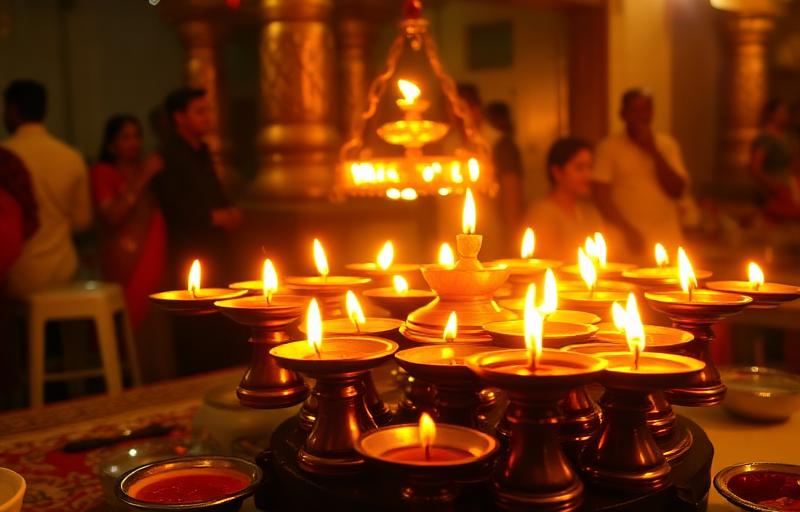
How the Katha Begins: A Merchant's Devotion in Amravati
The traditional Sawan Somwar Vrat Katha, passed down through generations and read aloud in Hindi households every Monday of the sacred month, opens in the prosperous city of Amravati Nagari. Here lived a wealthy merchant (seth), a man of considerable means who lacked nothing material, yet carried one persistent sorrow - he and his wife had no children, and in a household otherwise full of comfort, this absence weighed on them daily.
Despite his grief, the merchant did not neglect his devotion. Every single Monday, without fail, he walked to the Shiva temple, performed a complete abhishek with water and offered bilva leaves with genuine humility, never once asking Shiva directly for a son, only offering his worship as an act of love rather than a transaction. Elders who narrate this katha often pause here to underline the detail deliberately - his vrat began as pure devotion, not as a bargain struck for a specific outcome, and this distinction becomes important to how the rest of the story unfolds.
Parvati, watching this unwavering weekly devotion from Kailash, was moved. She observed the merchant's consistency - never missing a Monday, never faltering in the sincerity of his abhishek even during difficult seasons - and she began to feel that such devotion deserved to be answered. This is the katha's first teaching, often repeated by grandmothers finishing the reading: that Shiva notices consistency, not grand gestures, and that Parvati herself is described throughout Shaiva literature as the compassionate voice who intercedes on behalf of sincere devotees.
One evening, as the merchant completed yet another quiet, unremarkable Monday puja, Parvati turned to Shiva and made a request on his behalf, setting the entire story in motion.
Parvati's Compassion and Shiva's Difficult Promise
Parvati asked Shiva to bless the merchant with a son, moved by years of witnessing his unbroken devotion. Shiva, however, did not answer with simple joy - he explained that according to the merchant's own accumulated karma, he was not destined to have a son at all in this life. This is where the katha introduces its central tension: divine compassion pressing against the working of fate and karma, a theme that runs through many Puranic stories.
Parvati persisted. She could not bear the thought of the merchant's devotion going without any answer, and she pressed Shiva to find some way to grant the boon. Finally, Shiva relented, but with a condition that made the gift bittersweet rather than simply happy: a son would indeed be born to the merchant, but the boy's own fate had a fixed limit - he would live only until his twelfth year.
Parvati, hearing this, was troubled rather than satisfied. She had asked out of compassion and had, in a sense, brought a new sorrow into being alongside the joy - a son who would be loved and then lost. In some tellings of the katha, she asks Shiva whether nothing more can be done, and Shiva's response becomes the story's quiet turning point: fate as written cannot simply be erased, he explains, but it can be softened by circumstance, by merit, and by the accumulated power of devotion itself, including the very Monday vrat the merchant had kept without fail.
This exchange carries the katha's second major teaching: that a vow kept faithfully over years does not just earn a single blessing, it creates a reservoir of merit that can act protectively later, even in ways the devotee never anticipated when he first began his weekly temple visits. The son was conceived and born not long after, and the merchant's household, unaware of the hidden condition attached to their joy, celebrated without reservation.
The Boy Grows Up Under the Shadow of a Fated Day
The merchant's son grew up cherished, intelligent, and - fittingly for this katha - raised with the same devotion to Shiva that had brought him into existence. His father made sure the boy accompanied him to the temple, learned the vrat's rituals, and understood reverence for Mahadev from an early age, though the family remained unaware of the twelve-year condition attached to his birth.
As the boy approached the edge of his twelfth year, the merchant, still ignorant of the exact fate awaiting his son, decided it was time to send him away for education and worldly experience, a common practice in the katha's setting. He arranged for the boy to travel to the city of Kashi (Varanasi) accompanied by his maternal uncle, entrusting the uncle with his son's care and safety for the journey.
Before they departed, tradition holds that a sage or a wise elder - in some versions Narada Muni himself - quietly warned the uncle of the danger ahead, revealing that the boy's fated day was approaching and that particular caution was needed, especially regarding one specific town along their route where an inauspicious event was destined to occur. The uncle was instructed never to allow any act resembling a charitable religious ceremony, particularly anything to do with a wedding, to take place while passing through that town.
The uncle, carrying this quiet warning like a stone in his chest, set out with the boy, watching the roads ahead with an anxiety the boy himself never sensed. This is the part of the katha where listeners typically feel the tension rise - the audience knows what is coming, even as the characters within the story do not.
The Journey to Kashi and the Unexpected Wedding

As fate would arrange it, the uncle and the boy reached the very town they had been warned about at the exact moment a royal wedding was underway. The king of that town was marrying off his daughter, and the entire town was swept up in the celebrations, making it nearly impossible to pass through without pausing.
The wedding itself carried a hidden complication. The groom chosen for the princess was blind in one eye, a fact the bride's family had gone to considerable lengths to conceal, fearing the alliance would collapse if this became known before the ceremony was complete. As the appointed hour for the wedding rituals approached, the groom's family grew anxious about the moment he would have to sit visibly at the mandap for all to see clearly.
Spotting the merchant's son among the travellers passing through, resting near the wedding venue, and struck by his fine appearance, the groom's family conceived a plan - they would have this unfamiliar, handsome young stranger sit in the groom's place for the crucial rituals, concealing the real groom's condition from the gathered guests, then substitute the actual groom quietly afterward for whatever remained. The uncle, seeing this as a harmless favour rather than an act of religious charity or a wedding of consequence to their own family, permitted the boy to participate, unaware that he had just walked directly into the very event he had been warned against.
The rituals were completed. Sacred fire was circled, vows were exchanged in form, and - unknown to almost everyone present except the scheming families - the merchant's son had, for all ceremonial purposes, just been married. It was, the katha specifies, exactly the day marked by his original twelve-year fate.
The Night Yama's Messengers Could Not Take Him
That very night, as tradition tells it, the messengers of Yama, the god of death, arrived to claim the merchant's son at the hour fate had long ago fixed. But they found themselves unable to proceed - the boy, now formally married, however unusual the circumstances, was radiant with the specific auspiciousness Hindu tradition attributes to a newly wedded person, a protective glow the messengers were unwilling or unable to cross.
Yama's messengers returned to their lord without completing their task, reporting what they had witnessed. Yama himself, examining the situation, recognised that something beyond ordinary circumstance was at work, and it was here, the katha explains, that Shiva and Parvati's earlier conversation came to bear its fruit. Parvati reminded Shiva of his own words - that devotion and accumulated merit could soften even a fixed fate - and the years of the merchant's unbroken Monday vrat, now compounded by the accidental auspiciousness of his son's wedding-day protection, tipped the balance decisively.
Shiva extended the boy's life. In most tellings, the extension is generous rather than token - the boy is granted a long, full life, often specified as reaching a hundred years, effectively rewriting what had seemed an unchangeable fate. The wedding, initially a case of mistaken identity and a favour granted to strangers, turned out to be the very mechanism through which the merchant's years of devotion finally paid their protective due.
The boy, entirely unaware of how close he had come to death or how his own accidental wedding had saved him, continued his journey and eventually returned home. When the truth later unfolded - through the uncle's account and, in some versions, through the family's own recognition of the wedding's strange timing - the merchant understood fully, for the first time, what his Monday vrat had truly purchased for his family.
What This Katha Teaches Every Somwar Vrati
This katha is recited every Sawan Monday not merely as entertainment but as a teaching text, and its lessons are usually summarised by elders in a few clear points at the end of the reading.
The core teachings devotees draw from this story:
- Consistency matters more than intensity. The merchant never performed an extravagant ritual; he simply never missed a single Monday, year after year. It was this unbroken regularity, not any one spectacular act of devotion, that ultimately created the protective merit his son needed
- Devotion offered without demanding a specific outcome carries its own power. The merchant worshipped for years without explicitly asking for a son, and this selflessness is presented as part of why his eventual boon carried such deep protective force
- Fate and divine grace are not simply opposites. The katha does not suggest that Shiva can casually erase what karma has written, but it shows that sincere devotion can soften, delay, or transform how fate unfolds, working through circumstance rather than override
- Auspiciousness compounds. The boy's accidental wedding and his father's decades of vrat did not operate as separate events - the katha presents them as two threads of merit that met at exactly the right moment
How this katha is traditionally used in practice: Many households read or listen to this story specifically on the first Sawan Somwar of the year as a way of beginning the month's vrat with the right understanding, and some repeat it every Monday throughout Sawan, treating the retelling itself as a devotional act comparable to japa or abhishek. It is commonly available in small printed vrat katha booklets sold near temples, and is increasingly heard as Hindi audio recordings by families who want to include children and elderly members who may not read easily.
📿 The Vandnaa App carries this Sawan Somwar Vrat Katha in Hindi audio, so your family can listen together after evening puja on all four Sawan Mondays of 2026.
Quick Answers
Is the Sawan Somwar Vrat Katha from a specific scripture?+
The story belongs to the broad tradition of Hindi vrat katha literature, passed down through oral retelling and popular devotional booklets rather than a single, universally cited scriptural verse. Its themes and characters closely follow the style of Puranic storytelling common to many Shiva-related vrat kathas.
When should this katha be read during Sawan Somwar puja?+
It is traditionally read or listened to after the evening abhishek and aarti, before the vrat is broken with the day's falahar meal, making the storytelling itself part of the puja's closing sequence.
Do I need to read this katha every single Sawan Monday, or is once enough?+
Both approaches are followed by different households. Reading it once, on the first Sawan Somwar, is considered sufficient by many families, while others repeat it every Monday as a devotional practice in itself - neither is more correct than the other.
What is the central moral of the Sawan Somwar Vrat Katha?+
That consistent, sincere devotion over time - not grand or occasional gestures - creates a form of spiritual merit powerful enough to soften even a fixed fate, and that this merit often manifests protectively at moments the devotee could never have planned for.
Can this katha be listened to as audio instead of reading it from a book?+
Yes, listening with full attention and devotion carries the same value as reading. Many families, especially those with elderly members or young children, now prefer a Hindi audio narration during evening puja over a printed booklet.
Is this the same story as the hunter's tale told for Mahashivratri?+
No, they are distinct stories. The Mahashivratri katha typically centres on a hunter who unknowingly worships Shiva overnight while stranded in a bilva tree, while the Sawan Somwar Vrat Katha follows the merchant of Amravati and his son - though both share the common theme of Shiva rewarding sincere, even unintentional or quiet, devotion.
About the author
Pandit Mahesh Trivedi · Festival Traditions & Panchang
Pandit Mahesh leads the festival-date and Panchang content on Vandnaa. He cross-references multiple regional panchangs (Drik, Vaishnava, Bengali, Marathi) for every festival date published on the site.
Meet the Vandnaa editorial team →Explore on Vandnaa
Related Articles

7 Common Mistakes Devotees Make During Sawan Somwar Vrat
7 min read

Why Is the Entire Month of Sawan Dedicated to Lord Shiva?
7 min read
Sawan Somwar 2026: Dates, Vrat Vidhi, Shiv Mantras & Why Mondays in Sawan Are So Powerful
10 min read
Shiv Parivar: The Family of Shiva, Parvati, Ganesha & Kartikeya - Its Meaning
8 min read