
The Place on the Ganga
Shringverpur stands on the bank of the Ganga, about forty kilometres from Prayagraj, and it is identified in tradition as the capital of Nishadraj Guha, the chief who ferried Rama, Sita and Lakshmana across the river at the start of the exile.
What is there:
- The Ganga ghat associated with the crossing, which is the focus of the site
- A Ram Chaura, marking where tradition holds the party rested
- Temples and shrines connected with the episode, developed over time
- Archaeological remains excavated at the site, including a substantial ancient water tank, which have established Shringverpur as a settlement of considerable antiquity
The episode it commemorates is short in the text and enormous in devotional memory. Rama, in exile, comes to the Ganga. He needs a boat. Guha, chief of the Nishadas, is the one with boats, and he is a man from a community that the social order of the time placed low.
What happens between them is what makes the site matter, and it is worth reading closely rather than summarising into a moral.
The Katha of Guha
The episode, as the Ramayana and the Ramcharitmanas carry it:
- Rama, Sita and Lakshmana, having left Ayodhya, reach the Ganga at Shringverpur
- Guha, the Nishada chief, comes to meet them, bringing food and offering everything he has
- Rama receives him not as a subject but as a friend, and in Tulsidas's telling addresses him in terms of brotherhood
- Guha refuses at first to ferry Rama, in the version where he asks to wash Rama's feet before allowing him onto the boat, fearing what happened to Ahalya's stone might happen to his wooden boat
- Rama permits it, his feet are washed, and the crossing is made
- Guha waits on the bank, and when Bharata later comes searching for Rama, Guha is initially suspicious of his intent and only then satisfied of his sincerity
What the episode does:
- It puts a forest chief in a relationship of equality with a prince of Ayodhya
- It has the prince accept food and hospitality from him without hesitation
- It gives the boatman a moment of negotiation with the divine, and the divine agrees
- It shows Guha's grief and loyalty afterwards, on the bank, waiting
The feet washing scene in particular is among the most beloved passages in the Manas, recited and sung across north India, and the boatman's line about not letting the boat turn into a woman is remembered with affection everywhere it is told.
Why the Episode Matters
The Guha episode is short, and it carries a weight out of all proportion to its length.
What devotional tradition has consistently drawn from it:
- That Rama's friendships are not bounded by birth. Guha the Nishada, Shabari the forest woman, Sugriva and Hanuman, Vibhishana the rakshasa. The list is deliberate and the text returns to it.
- That service, offered honestly, is sufficient. Guha has nothing but boats and food, and offers both, and it is received as fully as any tribute at court.
- That the divine permits itself to be asked for something. The boatman sets a condition, and Rama accepts it. He does not override the request or explain it away.
- That waiting is a form of devotion. Guha remains on the bank, and his grief is recorded as carefully as anyone else's.
How it is used. Across north India, Guha is invoked in kathas and in Ramlila as the example of the devotee whose station is irrelevant to the relationship. The Nishada communities of the Ganga basin hold him as an ancestor figure and a source of dignity, and Shringverpur is a site of importance to them specifically.
What is worth avoiding is flattening this into a slogan. The text does not argue a position. It simply narrates a prince embracing a boatman and calling him brother, and lets that stand.
The Site Today
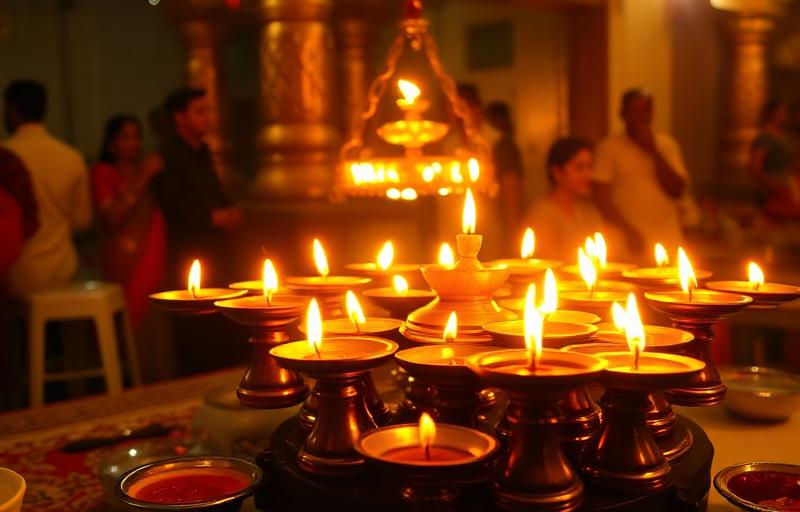
Shringverpur today is a village on the Ganga with a set of associated sites, and it has been receiving increasing attention as part of the Ram Van Gaman path development in Uttar Pradesh.
What is there:
- The ghat on the Ganga, associated with the crossing
- Ram Chaura, the raised platform marking where the party is held to have rested
- The Nishadraj Guha memorial and associated development, which has expanded in recent years
- Shringi Rishi association, from which the place takes its name, connecting it to the sage of the Ramayana's opening
- Archaeological remains, including the excavated ancient tank, which are of considerable interest
The site is part of a wider effort to identify and develop the places associated with Rama's forest journey, which runs from Ayodhya through Prayagraj, Chitrakoot and onward south.
For a visitor, what is compelling is not scale. There is no great temple here. What there is, is a riverbank where a specific and much loved episode is held to have occurred, and where the memory is maintained by the communities that live along the river.
Go for the ghat, sit on the bank, and the episode reads differently afterwards.
The Van Gaman Path
Shringverpur is one stop on a route that devotional geography has mapped in considerable detail.
The sequence, as tradition holds it:
- Ayodhya, the departure
- Tamsa river, the first night
- Shringverpur, the crossing of the Ganga with Guha
- Prayag, and the ashram of Bharadwaja
- Chitrakoot, where the party stays and where Bharata comes to plead for their return
- Satna, Panna and onward through the forests
- Dandakaranya, the great forest of central India
- Panchavati near Nashik
- Kishkindha at Hampi, and the meeting with Sugriva and Hanuman
- Rameswaram and the crossing to Lanka
Each of these has shrines, and many have katha traditions maintained locally over centuries.
What is worth understanding about this geography is how it functions. It converts a narrative into a landscape. A family that travels from Ayodhya to Chitrakoot is not merely visiting temples. It is following a route, in order, that a story established, and the sequence itself is the devotional act.
Shringverpur's place in that sequence is early and specific. It is where the exile stops being a departure from a city and becomes a crossing into forest, and the man who makes that crossing possible is a boatman who asked to wash the traveller's feet first.
Visiting Shringverpur
Practical notes.
Getting there
- Shringverpur is about 40 km from Prayagraj, on the Ganga, reached by road in around an hour
- It can be combined easily with a Prayagraj visit, since the city is the natural base
- Taxis and local transport run from Prayagraj, and the road is in reasonable condition
When to go
- Kartik Purnima and Ganga Dussehra, when snan draws crowds to the ghat
- Ram Navami, when the association with the Ram katha is marked
- Magh, when the whole Prayagraj region is busy with the mela
- Ordinary days are quiet, which for this site is the better experience
What to see
- The Ganga ghat and the crossing site
- Ram Chaura
- The Nishadraj memorial
- The archaeological remains, including the ancient tank
Practical points
- Facilities are limited, so carry water and plan to eat in Prayagraj
- The riverbank has the usual hazards of a large river, with deep water and currents close to the bank
- Combine the trip with Prayagraj, taking the Sangam, Bade Hanuman ji and Nag Vasuki on the same circuit
A closing suggestion. Read the Kevat prasang of the Ramcharitmanas before you go, in Hindi if you can manage it or in translation if not. It is a few dozen lines. Then sit on the ghat at Shringverpur and read it again. That is the entire visit, and it is enough.
Reader Questions Answered
Who was Nishadraj Guha?+
Guha was the chief of the Nishadas at Shringverpur who met Rama, Sita and Lakshmana at the Ganga at the start of the exile, brought them food, and ferried them across the river. Rama received him as a friend and, in Tulsidas's telling, in terms of brotherhood.
What is the Kevat prasang?+
It is the passage in which the boatman asks to wash Rama's feet before letting him board, fearing his wooden boat might turn into a woman as Ahalya's stone became one. Rama permits it, his feet are washed, and the crossing is made. It is among the most beloved passages of the Ramcharitmanas.
Where is Shringverpur?+
On the bank of the Ganga about 40 km from Prayagraj, reached by road in around an hour. It is easily combined with a Prayagraj visit, and the city is the natural base for the trip.
What can be seen at the site?+
The Ganga ghat associated with the crossing, Ram Chaura marking where the party is held to have rested, the Nishadraj Guha memorial, and archaeological remains including a substantial excavated ancient water tank.
Why does the Guha episode matter?+
It places a forest chief in a relationship of equality with a prince of Ayodhya, has Rama accept his food and hospitality without hesitation, gives the boatman a condition the divine agrees to, and records his waiting on the bank as devotion. Nishada communities of the Ganga basin hold him as an ancestor figure.
How does Shringverpur fit the Ram Van Gaman path?+
It comes early in the route, after Ayodhya and the Tamsa river and before Prayag and Chitrakoot. It marks the point where the exile stops being a departure from a city and becomes a crossing into the forest.
About the author
Anjali Mehta · Editor, M.A. Religious Studies
Anjali is the managing editor for Vandnaa and oversees the festival and vrat coverage. She holds an M.A. in Religious Studies and reviews every published article for accuracy, accessibility, and tradition-fidelity.
Meet the Vandnaa editorial team →Explore on Vandnaa
Related Articles
Bade Hanuman ji of Prayagraj: The Hanuman Who Lies Down and Is Bathed by the Ganga
8 min read

Nag Vasuki of Prayagraj: The Serpent Who Was the Rope of the Churning
8 min read
Kaushalya Mata of Chandkhuri: India's Only Temple to Ram's Mother
8 min read

Ram Tirath: The Punjab Site Where Luv and Kush Are Said to Have Been Born
8 min read