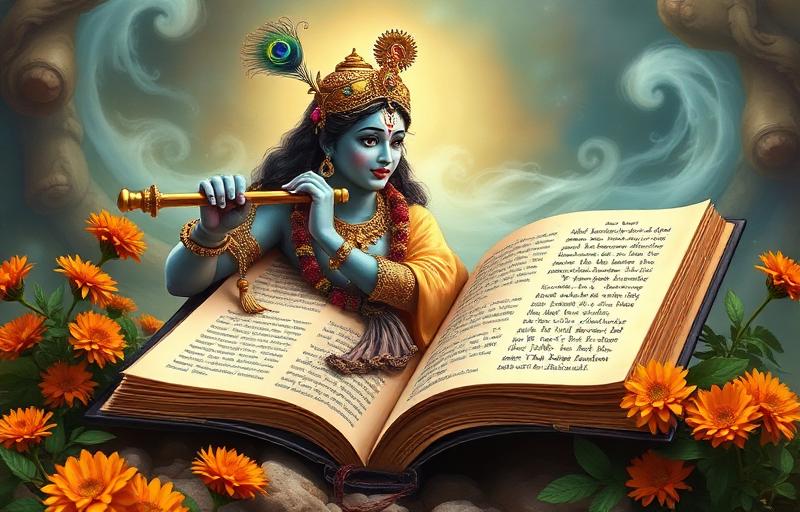
A Brother's Promise Krishna Did Not Agree With
Subhadra was Krishna and Balarama's younger sister, and by the time Arjuna arrived in Dwarka during his exile-period travels, Balarama had already, without fully consulting Krishna, begun favouring a match between Subhadra and Duryodhana, valuing the political alliance such a marriage would create with Hastinapura's ruling line.
Krishna, aware that Arjuna and Subhadra had taken an immediate liking to each other when Arjuna visited Dwarka disguised as a wandering ascetic during a festival period, and holding his own preference for a Pandava marriage over a Kaurava one, engineered a solution that avoided directly contradicting his elder brother: rather than negotiate or object openly, he advised Arjuna to simply abduct Subhadra with her own consent, a recognised form of marriage, Rakshasa vivaha, in which the groom carries off a willing bride, sometimes with a show of resistance from her family that both sides understand as ceremonial.
The Chariot and the Chase
Arjuna, with Subhadra's own willing participation, drove her away from Dwarka by chariot during a public festival when she had gone out with reduced guard. Balarama, on learning what had happened, was initially furious, wanting to pursue and punish what he saw as a direct insult to the family's honour and his own broken commitment to Duryodhana.
Krishna calmed his brother by pointing out the practical and dharmic realities: Subhadra had gone willingly, Arjuna was a suitable match by lineage and character regardless of the political convenience Duryodhana represented, and pursuing the matter by force would only create open conflict between Dwarka and the Pandavas at a moment when such an alliance was strategically valuable rather than something to discard over a broken informal understanding that had never been formally finalised.
Balarama, persuaded, allowed the marriage to be formally recognised rather than treated as a scandal, and Krishna personally ensured Subhadra was sent to Indraprastha with a dowry and escort appropriate to a properly sanctioned union rather than left to seem like a runaway bride.
The Marriage That Produced Abhimanyu
Subhadra and Arjuna's marriage produced Abhimanyu, whose death at Kurukshetra inside the Chakravyuha, an episode already well established elsewhere in Mahabharata retelling, and whose son Parikshit, born to Uttara after Abhimanyu's death, would become the sole surviving heir of the entire Kuru line, carrying the dynasty forward after the Mausala Parva's destruction of the Yadavas and the Pandavas' own eventual departure.
Subhadra herself remained closely tied to both her birth family in Dwarka and her married family among the Pandavas throughout the epic, appearing at key moments including Abhimanyu's death and the family's final years, and her marriage stands as the clearest example in the text of Krishna using indirect strategy rather than open confrontation to secure an outcome he believed was right, a pattern that recurs throughout his role in the wider epic.
Frequently Asked Questions
Was Rakshasa vivaha considered an acceptable form of marriage?+
It is listed among the eight traditional forms of Hindu marriage in Dharmashastra texts, primarily associated with the Kshatriya warrior class, and considered valid provided the bride's own consent was genuinely present, as it was in Subhadra's case.
Did Duryodhana react to losing this marriage prospect?+
The text does not give this a major dramatic treatment; it is treated as one of several long-running grievances Duryodhana held against the Pandavas rather than a singular flashpoint.
Where did Arjuna and Subhadra settle after the marriage?+
They settled at Indraprastha, the Pandavas' capital, where Subhadra lived as part of the royal household alongside Draupadi and the extended Pandava family.
About the author
Anjali Mehta · Editor, M.A. Religious Studies
Anjali is the managing editor for Vandnaa and oversees the festival and vrat coverage. She holds an M.A. in Religious Studies and reviews every published article for accuracy, accessibility, and tradition-fidelity.
Meet the Vandnaa editorial team →