The Swan Beside Goddess Saraswati
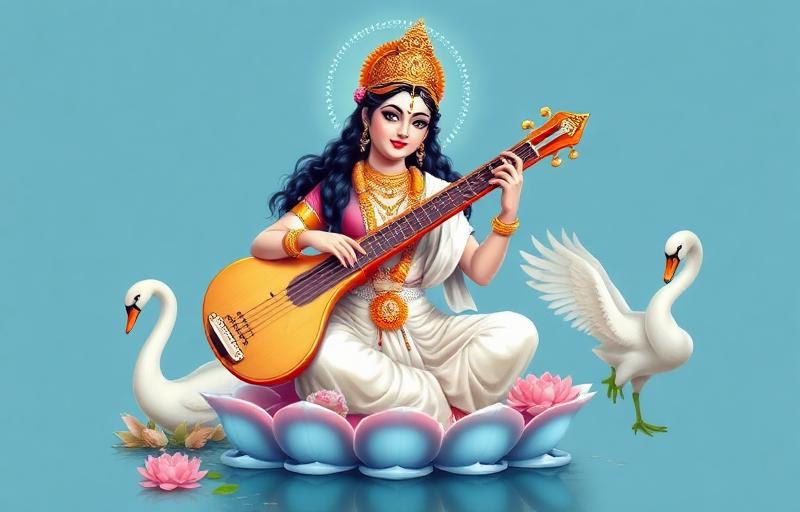
Goddess Saraswati, the deity of knowledge, music and the arts, is almost always depicted seated upon or beside a graceful white swan, known in Sanskrit as hamsa. Dressed in white, holding a veena, a book and a mala, she is shown either gently resting a hand upon the swan or gliding upon its back across still, clear waters, an image cherished in classrooms, homes and temples devoted to learning.
In some traditions, the hamsa is understood not as an ordinary swan but as a mythical bird possessing a unique gift of discernment, which lies at the very heart of why it accompanies the goddess of wisdom.
The Traditional Story of the Hamsa's Gift
Tradition holds that the hamsa possesses a rare and remarkable ability, when offered a mixture of milk and water, it can separate the two, drinking only the pure milk while leaving the water behind. This quality, called Neera Ksheera Viveka, milk-water discernment, is often narrated in devotional teaching to describe the swan's symbolic wisdom rather than as a claim about the bird's biology.
Because Saraswati embodies the highest wisdom, tradition places this most discerning of birds at her side, forming a pair in which the goddess of knowledge and her chosen companion together represent perfect clarity of judgment.
What the Hamsa Represents
The hamsa's discernment between milk and water is read by devotees as a profound metaphor for the discernment every seeker must cultivate between truth and falsehood, the eternal and the temporary, and wisdom and mere information. This quality, known as viveka, is considered essential on any spiritual path, and the swan beside Saraswati is a constant reminder of its importance.
The hamsa's pure white feathers further symbolize the purity of true knowledge, untouched and unclouded by ego, while its serene gliding across water, without sinking or being troubled by the surface, reflects the calm clarity of a truly wise mind.
The Hamsa in Saraswati Worship

During Basant Panchami and Navratri, when Saraswati is worshipped with particular devotion, her image alongside the hamsa is installed in schools, colleges, music academies and homes, with students placing books and instruments before her, seeking clarity of mind and success in learning. Prayers often invoke both the goddess and her wise companion together.
The term Paramahamsa, meaning supreme swan, is also used in Hindu spiritual tradition as a title of honour for the most realised of sages, directly borrowing the swan's symbolism of discernment to describe a being who has fully separated eternal truth from illusion.
Significance and the Takeaway
As per tradition, devotees believe that worshipping Saraswati alongside her hamsa cultivates clarity of thought, discernment in decisions, and success in education, music and the arts. The swan's gentle glide, undisturbed by turbulent waters, also teaches devotees to remain calm and focused amid the distractions of daily life.
Worship of Saraswati and her hamsa vahana, like all Hindu devotion, is an act of faith and love, not a transaction, encouraging every devotee to seek not just knowledge but the wisdom to discern what truly matters.
Common Questions From Devotees
Why does Saraswati have a swan as her vahana?+
The swan, or hamsa, is traditionally believed to possess the gift of separating milk from water, symbolizing the discernment between truth and illusion that Saraswati, the goddess of wisdom, embodies.
What is Neera Ksheera Viveka?+
Neera Ksheera Viveka is the traditional quality attributed to the hamsa of separating milk from water, used as a metaphor for the discernment between truth and falsehood.
What does the title Paramahamsa mean?+
Paramahamsa, meaning supreme swan, is an honorific title given to highly realised sages in Hindu tradition, drawing on the swan's symbolism of discernment between the eternal and the illusory.
About the author
Anjali Mehta · Editor, M.A. Religious Studies
Anjali is the managing editor for Vandnaa and oversees the festival and vrat coverage. She holds an M.A. in Religious Studies and reviews every published article for accuracy, accessibility, and tradition-fidelity.
Meet the Vandnaa editorial team →