Who Tejaji Is
Tejaji, addressed as Veer Tejaji and Tejaji Maharaj, is one of the most widely worshipped folk deities of Rajasthan, with a following that extends into Madhya Pradesh, Gujarat and Haryana.
He is remembered as a warrior of the Jat community, born at Kharnal in Nagaur district, and his shrines are found across the farming villages of the region. Like Gogaji, he is invoked above all for protection from snakebite, but the reason is entirely different, and the difference is the whole story.
How he is depicted:
- Riding his mare Leelan, sword in hand
- With a snake at his mouth or tongue, which is the detail that identifies him instantly
- Wounded, in some images, since the katha places his death immediately after his greatest act
His devotees:
- Farming and pastoral families across Rajasthan, for whom cattle protection is not symbolic
- Households who keep him as kul devta
- Anyone in the region dealing with snakebite, for whom the tanti thread from his shrines is the customary recourse alongside treatment
The two great snakebite deities of Rajasthan, Gogaji and Tejaji, are worshipped side by side across the same villages, and families frequently keep both.
The Katha: A Promise Made in Passing
The Tejaji katha is one of the tightest folk narratives in India, and every element in it pays off.
The theft. The cattle of a woman named Lachha Gujari were taken by raiders. She came to Tejaji for help, and he set out immediately to recover them.
The snake. On the way he came upon a snake caught in a fire. He rescued it. The snake, however, told him that he had interfered with its death and demanded to bite him.
The promise. Tejaji explained that he was on his way to recover a woman's cattle, and asked the snake to wait. He gave his word that he would return and present himself once the cows were safe.
The snake let him go.
The fight. Tejaji found the raiders, fought them and recovered the herd. He was wounded across his entire body in the fighting.
The return. He rode back to the snake, as he had promised, bleeding from every part.
The bite. The snake looked at him and refused. There was no unwounded place left on his body to bite.
Tejaji put out his tongue, the one part of him that had not been cut, and the snake bit him there.
He died. The snake, in the telling, granted that anyone bitten by a snake who remembers Tejaji would be protected, and that is the origin of his worship.
Why This Katha Holds
Folk deity kathas are usually about power. This one is about keeping your word when nobody would blame you for not.
What the story is careful about:
- Tejaji could have simply not gone back. He had a legitimate reason, mortal wounds and a completed act of protection behind him. He went back anyway.
- The snake did not chase him. It let him go on his word alone, which makes the return a matter of honour rather than compulsion.
- The snake tried to release him at the end. It refused to bite a body already destroyed, and it was Tejaji who insisted.
- The tongue is the detail that makes the story unforgettable. The instrument with which the promise was given is the one part offered when nothing else remains.
That last point is why Rajasthani devotees describe Tejaji as the deity of vachan, the given word. The snakebite protection follows from it, but the devotion is about the promise.
It is also why he is worshipped by farming communities in particular. In a village economy built on unwritten agreements about cattle, water, boundaries and labour, a deity who died to keep a verbal promise to a snake is not a curiosity. He is the enforcement mechanism of an entire social order, and his shrines sit exactly where that order is negotiated.
The Tanti: A Thread Against Poison

The most widespread practice associated with Tejaji is the tanti, a thread taken from his shrines.
How it works in the tradition:
- The thread is obtained at a Tejaji temple, where it is offered and tied
- It is worn on the arm or wrist, and villages in Rajasthan take it as protection through the season when snakes are active
- In cases of snakebite, the tradition prescribes taking the person to a Tejaji shrine, where the tanti is used and the deity's name invoked
- Devotees who recover complete a vow, returning to the shrine with an offering
This needs to be stated plainly for readers today, and devotees in Rajasthan increasingly say it themselves.
Snakebite is a medical emergency. Antivenom works, delay kills, and the correct response is to get the person to a hospital immediately, keep them still and calm, immobilise the bitten limb and not attempt cutting, sucking or tourniquets.
The traditional practice and the medical one are not in competition unless someone makes them so. Families across the region now do both, taking the person to hospital first and completing the vow at the shrine afterwards, and that is the pattern being encouraged by community leaders and by shrine authorities themselves.
The tanti's meaning, kept alongside treatment, is what it has always been. It is a reminder that Tejaji went back when he did not have to.
Tejadashami and the Fairs
Tejadashami, on the dashami of Bhadrapada Shukla Paksha, is Tejaji's day, and it is marked across Rajasthan.
The principal sites:
- Kharnal, Nagaur district, his birthplace, with a large temple and fair
- Sursura, in Ajmer district, associated with the place of his death, which draws very large numbers on Tejadashami
- Parbatsar, Nagaur, where the fair is also a major cattle fair, one of the largest in the state, which fits a deity who died protecting cattle
- Village thans across Rajasthan, Madhya Pradesh and Haryana, where local observances are held on the same day
What happens:
- Devotees walk or ride to the shrines, and processions with flags arrive from surrounding villages
- Tanti threads are taken and tied in large numbers
- Offerings of churma, gud, coconut and cloth are made, and bhandaras are run
- Tejaji ki katha is sung, and the folk singing tradition around him is performed through the night
- Cattle are brought, traded and blessed at the fairs
The cattle fair element is worth noting. Parbatsar's fair is a working agricultural market as well as a religious gathering, exactly as Sonepur is in Bihar and Pushkar is elsewhere in Rajasthan. In an economy where livestock is the main asset, the deity's day is also the day the market meets.
Tejaji and Gogaji: Two Deities, One Danger
Rajasthan has two great snakebite deities, and villages worship both. The difference between them is instructive.
Gogaji:
- A Chauhan warrior of the Dadrewa region, blessed by Guru Gorakhnath
- Associated with the Nath tradition
- The earth opened and took him in at Gogamedi, and in some tellings he took a serpent form at that moment
- Worshipped with a chhari, a peacock feather staff, and his Goga Navami falls in Bhadrapada Krishna Paksha
- His protection comes from his identity with the serpent
Tejaji:
- A Jat warrior of Kharnal, with no ascetic lineage attached
- Died keeping a promise to a snake after recovering stolen cattle
- Worshipped with the tanti thread, and his Tejadashami falls in Bhadrapada Shukla Paksha
- His protection comes from the snake's own boon, given because he kept his word
Both days fall in the same month, both are worshipped by farming communities in the same villages, and families frequently keep both without any sense that they are choosing between them.
What this shows about folk religion is worth stating. A real and recurring danger produces more than one deity, and the tradition does not rationalise them into a single figure. Each carries a different lesson. Gogaji is about the serpent's own power. Tejaji is about a man's word.
Quick Answers
Who is Tejaji?+
Tejaji is a folk deity of Rajasthan, remembered as a warrior of the Jat community born at Kharnal in Nagaur district. He is worshipped for protection from snakebite, and is shown riding his mare Leelan with a snake at his mouth.
Why is Tejaji shown with a snake at his mouth?+
He had promised a snake he would return to be bitten after recovering stolen cattle. When he came back, wounded across his whole body, the snake refused because there was no unwounded place left. Tejaji offered his tongue, the only part uncut, and the snake bit him there.
What is the tanti thread?+
The tanti is a thread taken from a Tejaji shrine and tied on the arm or wrist as protection during the season when snakes are active. Devotees who recover from a snakebite complete a vow by returning to the shrine with an offering.
Does the tanti replace snakebite treatment?+
No. Snakebite is a medical emergency, antivenom works and delay is dangerous. The person must be taken to a hospital immediately, kept still, with the bitten limb immobilised. Families in Rajasthan now commonly do both, treating first and completing the vow afterwards.
When is Tejadashami?+
On the dashami of Bhadrapada Shukla Paksha. The main fairs are at Kharnal, his birthplace, Sursura in Ajmer district associated with his death, and Parbatsar, where the fair is also one of Rajasthan's largest cattle markets.
How is Tejaji different from Gogaji?+
Gogaji was a Chauhan warrior blessed by Guru Gorakhnath, taken into the earth at Gogamedi, worshipped with the chhari, and his protection comes from his identity with the serpent. Tejaji was a Jat warrior whose protection comes from the snake's own boon, given because he kept his promise.
About the author
Anjali Mehta · Editor, M.A. Religious Studies
Anjali is the managing editor for Vandnaa and oversees the festival and vrat coverage. She holds an M.A. in Religious Studies and reviews every published article for accuracy, accessibility, and tradition-fidelity.
Meet the Vandnaa editorial team →Explore on Vandnaa
Related Articles
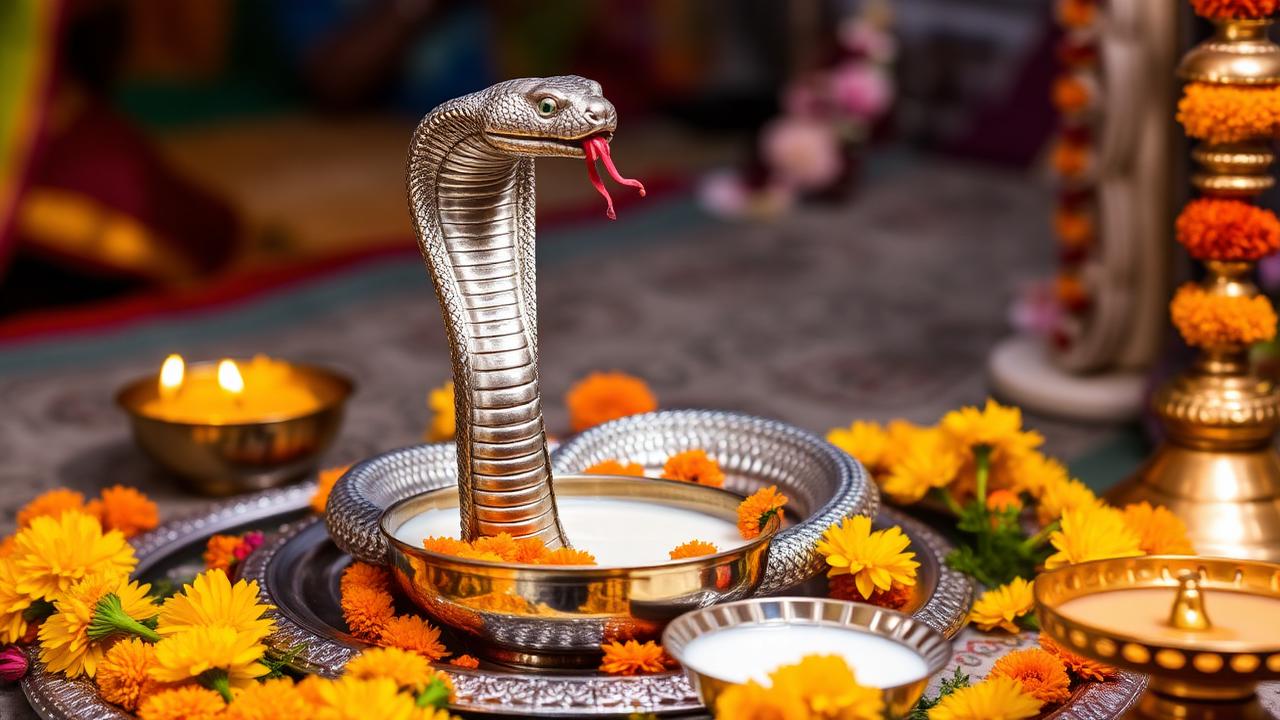
Gogaji Jaharveer: The Serpent Deity of Rajasthan Worshipped From Churu to Punjab
9 min read
Pabuji: The Rajasthan Deity Whose Temple Is a Painted Scroll
9 min read
Baba Ramdev of Ramdevra: The Rajasthan Deity Whose Shrine Refused Caste
9 min read

Naga Worship: The Significance of the Sacred Snake in Hinduism
7 min read