The Chieftain
Thirumangai Alvar is the twelfth and last of the Alvars in the traditional order, and the most prolific after Nammalvar.
Who he was:
- Born Neelan, at Thirukuraiyalur in what is now Thiruvarur district, Tamil Nadu
- Of the Kallar community
- A military man, who rose in the service of the Chola king
- Given the territory of Ali Nadu or Thirumangai to govern, from which his name comes
- Titles: Kaliyan, Parakalan, Nalkaviperumal, Arulmaari
The marriage. The thing that changed his direction.
- He fell in love with Kumudavalli, a woman he saw at Thiruvellakulam
- She was the adopted daughter of a physician and was a devotee
- She set conditions for marriage: that he should be initiated into Vaishnavism, take the marks, and
- That he should feed a thousand and eight Sri Vaishnavas every day, for a year
He agreed to all of it.
And then the money ran out.
- Feeding a thousand and eight people daily is expensive
- He spent his own resources
- He then withheld the revenue he was collecting for the Chola king
- He was found out, arrested, and imprisoned
- By tradition he escaped or was released, and could not go back
So he took to the road.
He became a highway robber, with a band of men, waylaying travellers, taking what they had, and using it to continue feeding devotees.
How the tradition holds this. Without pretending it was acceptable, and without disowning him.
He is a robber in the biography. The tradition says so plainly, calls him Kaliyan and keeps the whole account, and then places him in the canon as the author of a sixth of it.
On the ethics. A guide should be clear rather than admiring.
Robbing travellers to fund charity is theft. The people he robbed did not consent, and the tradition does not present them as having deserved it.
What the tradition does with the story is different: it uses it to say that a person in this condition was not written off, and that what happened next was that the Lord came and stopped him.
The Robbery That Ended It
The story, which is among the most enjoyed in the tradition.
- The Lord decided to stop him, and to do it in a way he would not forget
- He came, with Lakshmi, in the form of a wedding party: a bridegroom and bride, richly dressed, in gold and jewels, travelling through the forest at Thirumanankollai
- Thirumangai and his men stopped them
- He took everything: the ornaments, the clothes, the gold
- He tried to lift the bundle and could not. It would not move
- He recited the mantras he knew to remove obstacles, and nothing happened
- Then he noticed a toe ring on the bridegroom's foot that he had missed
- He bent to take it, and could not get it off with his hands, so he put his mouth to it
- And the Lord placed his foot on his head
What happened then:
- Thirumangai asked who this was
- The Lord gave him the Ashtakshara, the eight syllable mantra, Om Namo Narayanaya, whispering it in his ear
- And from that moment the verses started, and did not stop
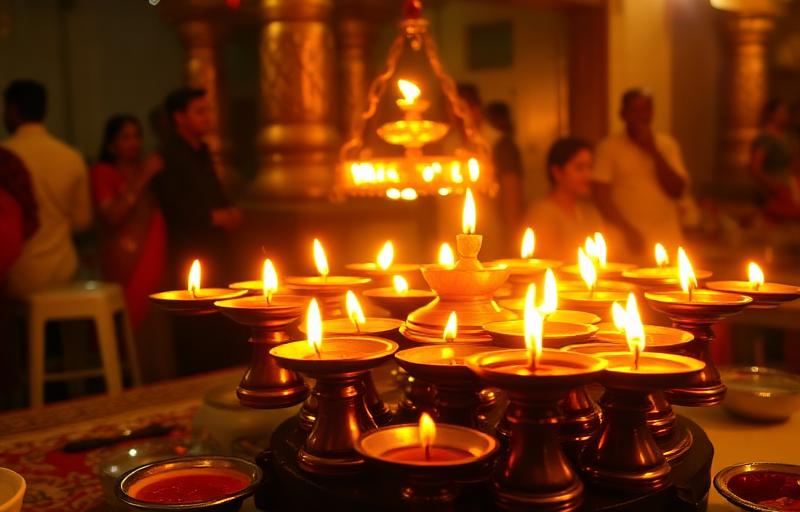
Thirumanankollai is the place, near Thiruvali Thirunagari, and the event is enacted there annually as the Vedupari utsavam, in which the deity comes in procession as the bridegroom and is waylaid.
The Vedupari. It is worth going to.
At Thiruvali Thirunagari and at several other temples, the festival re enacts the robbery: Thirumangai Alvar's image, with his spear, holds up the deity's procession, the exchange is performed, and the mantra is given.
It is one of the few Indian temple festivals that stages a mugging.
On the wedding party detail. The tradition finds it very funny and so should a reader.
The Lord did not appear in a vision, did not send a messenger and did not arrange a coincidence. He dressed up in gold, walked into the forest where he knew a robber was working, and got robbed on purpose.
And he brought his wife.
What the story is for. Two things.
One, it is the tradition's most concrete statement that the initiative is the Lord's. Thirumangai was not looking. He was working. The approach came from the other direction entirely.
Two, it is about the mantra being given rather than earned. He received the Ashtakshara at the moment of committing a robbery, from the person he was robbing.
The spear. Thirumangai Alvar is the only Alvar depicted holding a weapon.
His images carry a spear, and this is deliberate: the tradition does not tidy him into a gentle poet. He was a soldier, then a robber, and afterward a man who argued and fought for the tradition, and the iconography keeps it.
The Six Works
What he wrote. Six works, 1361 verses in all, roughly a third of the Prabandham and second only to Nammalvar.
- Periya Thirumozhi, 1084 verses, the largest single work in the Prabandham after Thiruvaymozhi
- Thirukurunthandagam, 20 verses
- Thirunedunthandagam, 30 verses
- Thiruvezhukootrirukkai, 1 verse
- Siriya Thirumadal
- Periya Thirumadal
The Periya Thirumozhi. His major work and a kind of gazetteer.
He sang more Divya Desams than any other Alvar. Of the 108, he is the sole singer of a large number of them, and without his verses they would not be on the list at all.
What that means practically: the canonical list of 108 temples exists substantially because one man travelled to them and composed on each.
The range of his travels. He went far beyond the Tamil country.
- Badrinath in the Himalaya, which he sang, and which is a Divya Desam because of him
- Ayodhya, Mathura, Dwaraka, Naimisharanya, Salagrama, Prayaga
- The Kerala temples
- The Andhra temples including Tirupati
- And the great majority of the Tamil ones
That is a very substantial amount of travelling for the period, undertaken on foot and by whatever transport existed, by a man composing at each stop.
The Thiruvezhukootrirukkai. Worth describing because it is unlike anything else in the canon.
It is a single poem, in the shape of a chariot.
The verse is constructed so that the number pattern of its lines, when laid out, forms the figure of a chariot with wheels. It is a chitra kavya, a pattern poem, and it is among the earliest and most accomplished examples in Tamil.
It is addressed to the deity at Thirukkudanthai, Kumbakonam, whose sanctum is itself built in the shape of a chariot.
The two Thirumadal works. These are unusual and worth explaining.
Madal is a Tamil convention. In the classical poetic tradition, a man whose love was not returned could ride a madal, a horse made of palmyra stems, through the streets, carrying a portrait of the woman, publicly declaring his condition and shaming her family into consenting.
It was a man's recourse. Women did not do it.
Thirumangai Alvar writes as a woman threatening to ride the madal.
In both Thirumadal works, the speaker is a woman in love with the Lord who declares that if he does not come, she will break the convention, ride the madal herself, and make her situation public regardless of what anybody thinks.
Why that is remarkable. It is a deliberate breach of a gender convention, made by a male poet writing in a female voice, for theological purposes.
The argument is that the soul's want for God is not bound by what is socially permitted, and that a soul in that condition will do the thing that is not done.
The Thandagam works. Two works in the thandagam metre, which is a longer line, and both are highly regarded, particularly the Thirunedunthandagam.
His style. Different from the other Alvars.
- More narrative. He tells stories at length
- More geographic. He names places, describes them, and situates the deity in landscape
- More combative. He argues against rival positions directly
- And formally inventive, with the chariot poem and the madal works being unlike anything else in the canon
What He Built
The other thing Thirumangai Alvar is remembered for is not a poem. It is a wall.
What he did at Srirangam:
- He undertook substantial construction and repair at the temple
- Tradition credits him with building enclosure walls, the prakaras, and other structures
- He is credited with the Thiruvellarai and other temple works
- And with arranging the temple's affairs and services
Where the money came from. This is the part the tradition tells without flinching.
By the traditional account, he took gold from a Buddhist vihara, in some tellings at Nagapattinam, and used it for the temple.
How to handle that honestly. A guide should not pass over it.
What the story says: he took wealth belonging to another religious community and used it to build his own tradition's temple.
What the tradition does with it: it records it, and does not present it as shameful.
What a modern reader should think: that this is theft from another community, that the traditions of the period were in genuine and sometimes hostile competition, and that this is a real part of the historical record rather than something to be explained away.
The wider context. The period saw active competition between Jain, Buddhist, Shaiva and Vaishnava traditions in the Tamil country.
- Public debates were held, with real consequences for the losers
- Royal patronage shifted between traditions
- There are accounts of persecution, including the tradition around Sambandar and the Jains at Madurai, which involves impalements and is deeply contested
- Jain and Buddhist institutions in the Tamil country declined substantially over this period
How to hold this now. Plainly.
The bhakti traditions were not uniformly gentle. They competed, sometimes with royal power behind them, and the decline of Jainism and Buddhism in the Tamil country is part of that history.
A person who loves this poetry can hold that alongside knowing that the tradition's own accounts include a saint funding a temple with somebody else's money.
Pretending otherwise is not devotion. It is just inaccuracy, and the tradition itself is more honest than its modern defenders sometimes are.
What he built that survives. Srirangam's enclosures were added to over many centuries by many patrons, and disentangling what belongs to him specifically is not straightforward.
What is not in doubt is that the tradition credits him with a substantial building programme and treats him as the temple's organiser as much as its poet.
His image at Srirangam. He is present in the temple, with his spear, and his festival is observed.
The Thirumangai Alvar shrine and the Vedupari enactment at Thiruvali Thirunagari keep the whole biography in circulation: the soldier, the robber, the poet and the builder.
The Divya Desam list, once more. Since it is his real monument.
The 108 are the temples the Alvars sang. Thirumangai sang more of them than anybody, travelled to them, and in many cases is the only Alvar who did.
The pilgrimage circuit that Sri Vaishnavas have followed for a thousand years is, in effect, his itinerary.
For People With a Past
This Alvar is in the canon for a particular kind of reader, and it is worth naming who.
What the biography contains:
- Embezzlement of public revenue
- Imprisonment
- Armed robbery, repeatedly, as a way of life
- Theft from another religious community
And what the tradition did with him:
- Made him the author of a third of its scripture
- Recites his verses daily
- Carries his image in procession, with the weapon
- Credits him with building its principal temple's enclosures
- Enacts the robbery annually as a festival
The point being made. That the tradition's entry requirement is not a clean record.
How this compares across the tradition. He is not alone.
- Thondaradippodi Alvar fell completely and was retrieved
- Valmiki, in the tradition, was a highway robber before he wrote the Ramayana
- Ratnakara becoming Valmiki is the same shape of story
- Angulimala in the Buddhist tradition
- Ajamila in the Bhagavata, who is saved by calling his son's name, which happened to be Narayana
- Bilvamangala or Surdas in some accounts
Why the tradition keeps generating these stories. Because the alternative doctrine, that only the already good are admitted, makes the whole thing pointless.
If devotion is available only to people who do not need it, it is a reward system rather than a refuge.
What the stories do not say. Three cautions.
One. They are not permission.
The tradition does not present Thirumangai's robberies as acceptable because his motives were devotional. The story ends with him being stopped, not endorsed. The Lord came to end the robbery, not to bless it.
Two. Harm to others is not cancelled by good intentions.
He was feeding devotees with money taken from travellers who did not consent. The tradition's own resolution is that this had to stop.
Three. Restitution is not addressed.
The story does not tell us what happened to the people he robbed, and honesty requires noting that. Hagiography attends to the saint.
What can genuinely be taken:
- That a person's history does not close the door
- That the approach can come from the other side, when you are not looking for it
- That being stopped is sometimes the intervention
- That what follows a bad period can be more substantial than what preceded it
If somebody reading this has a record, criminal, financial or otherwise: the tradition's position is unambiguous, and it is stated across the whole bhakti corpus. There is no conduct that disqualifies a person from the name.
That is not a legal or a social statement. Debts remain owed, harms remain done, and consequences remain. It is a statement about access to practice, and on that the tradition is completely clear.
And a practical note. If you are currently in a situation involving debt, coercion or criminal activity, the useful steps are practical: legal advice, which is available free through legal aid services in India, and talking to somebody.
A saint's biography is a reason to think you are not beyond help. It is not a plan.
Following His Route
Thiruvali Thirunagari
- In Nagapattinam district, Tamil Nadu, near Sirkazhi
- Two temples counted as one Divya Desam
- The Vedupari utsavam, in which the robbery is enacted, is held here and is the reason to time a visit
- The Thirumanankollai site, where the Lord was waylaid, is nearby
- Around 20 kilometres from Sirkazhi
Thirukuraiyalur
- His birthplace, in Thiruvarur district
Srirangam
- Where he built and organised
- His shrine, with the spear
- The Adhyayana Utsavam in Margazhi, when his 1361 verses are recited along with the rest
The Divya Desams he alone sang. This is the real itinerary.
A large number of the 108 are on the list because Thirumangai went there. Following his route means, in practice, following most of the Divya Desam circuit.
Some he is particularly associated with:
- Thiruvellarai, near Srirangam, a rock cut and structural temple of great age
- Thirunaraiyur, Nachiyar Koil, where the Kal Garuda image is famous for becoming heavier as it is carried
- Thirukkannamangai, Thirukkannapuram, Thirukkoodalur and the temples of the Kaveri delta
- Badrinath, in Uttarakhand, which is a Divya Desam because he sang it
A Kaveri delta circuit. If you want to follow him, this is the concentration.
The delta between Kumbakonam, Thanjavur, Mayiladuthurai and Nagapattinam holds a very large number of Divya Desams within a small area, most of them sung by Thirumangai.
A week in that area, with a car, covers more of his work than any other route.
Practical:
- Tiruchirappalli and Thanjavur are the bases
- October to March for weather
- Many of these temples are small, quiet and have short opening hours with a long midday closure. Check before going
- Some have very few visitors, which is part of the appeal
On the small Divya Desams. Worth saying.
The famous ones, Srirangam, Tirupati, Badrinath, get the crowds. A great many of the 108 are village temples with a priest, a few families and almost no visitors.
Those are frequently the better experience, and they are the ones where the Alvar verses were actually composed, in front of the same image, by a man walking between them.
A closing thought. He was a soldier who became a governor, who embezzled to feed people, who went to prison, who became a robber, who was robbed by God in a wedding party, who was given a mantra with a foot on his head, and who then walked most of the subcontinent composing.
The list of 108 temples that Sri Vaishnavas have travelled for a thousand years is essentially his route.
And he carried a spear the whole time.
What People Ask Most
Who was Thirumangai Alvar?+
The twelfth and last of the Alvars, born Neelan at Thirukuraiyalur in Thiruvarur district, of the Kallar community. He was a military man who rose in Chola service and was given territory to govern. To meet the marriage condition set by Kumudavalli, that he feed a thousand and eight Sri Vaishnavas daily, he spent his own money, then withheld the king's revenue, was imprisoned, and afterward became a highway robber.
What is the story of the robbery?+
The Lord came with Lakshmi in the form of a wedding party, richly dressed in gold, travelling through the forest at Thirumanankollai. Thirumangai and his men stopped them and he took everything, but could not lift the bundle. He then noticed a toe ring he had missed, could not remove it by hand, and put his mouth to it, at which the Lord placed his foot on his head and gave him the Ashtakshara mantra in his ear. The Vedupari festival at Thiruvali Thirunagari re enacts it annually.
What did Thirumangai Alvar write?+
Six works totalling 1361 verses, roughly a third of the Prabandham and second only to Nammalvar. The Periya Thirumozhi of 1084 verses, the Thirukurunthandagam and Thirunedunthandagam, the Thiruvezhukootrirukkai which is a single poem laid out in the shape of a chariot, and the two Thirumadal works in which a woman threatens to ride the madal, breaking a convention reserved for men.
Why does he matter for the Divya Desam list?+
He sang more of the 108 Divya Desams than any other Alvar and is the sole singer of a large number of them, meaning that without his verses they would not be on the list at all. He travelled far beyond the Tamil country, to Badrinath, Ayodhya, Mathura, Dwaraka, Naimisharanya and Prayaga, composing at each stop. The pilgrimage circuit Sri Vaishnavas have followed for a thousand years is essentially his itinerary.
Did he really take gold from a Buddhist vihara?+
The traditional account says he did, in some tellings at Nagapattinam, and used it for building work at Srirangam. The tradition records it without presenting it as shameful. A modern reader should note that this is theft from another community, that Jain, Buddhist, Shaiva and Vaishnava traditions were in genuine and sometimes hostile competition in the Tamil country of that period, and that this is a real part of the historical record rather than something to explain away.
What does his story mean for somebody with a past?+
That the tradition's entry requirement is not a clean record. It made a man who embezzled public revenue, went to prison and lived by armed robbery the author of a third of its scripture. But the story ends with him being stopped, not endorsed: the Lord came to end the robbery, not to bless it. Harm to others is not cancelled by good intentions, debts remain owed and consequences remain. It is a statement about access to practice, not a legal or social one.
About the author
Anjali Mehta · Editor, M.A. Religious Studies
Anjali is the managing editor for Vandnaa and oversees the festival and vrat coverage. She holds an M.A. in Religious Studies and reviews every published article for accuracy, accessibility, and tradition-fidelity.
Meet the Vandnaa editorial team →