Who Ugratara Is
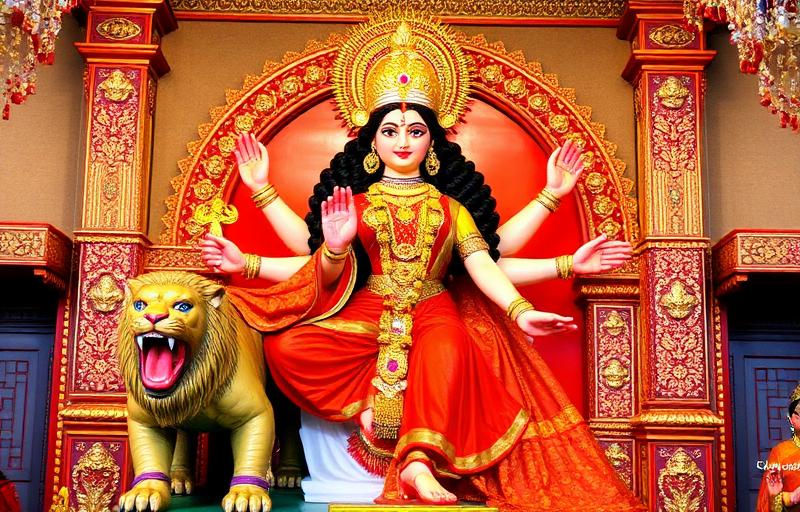
Ugratara is the Devi worshipped at a temple in Uzan Bazar, in the older part of Guwahati, close to the Brahmaputra. She is a form of Tara, who is counted among the Dasa Mahavidyas, the ten great forms of the Devi in the Shakta tantric tradition.
Tara in this tradition is the Devi who carries a devotee across, the same root that gives the word tarini. Ugra means fierce, and Ugratara is her intense aspect, invoked in situations that call for decisive intervention rather than gradual help.
Her worship in Assam sits within a wider regional context:
- Guwahati and the Nilachal hill are among the most important tantric centres in India, with Kamakhya at the centre and the Mahavidya shrines around it
- Tara worship in this region has developed alongside neighbouring traditions in Bengal and the Himalayan belt, where Tara is a major deity in more than one religious tradition
- Assamese Shakta worship, Ahom royal patronage and older local traditions have all shaped how she is worshipped today
For Guwahati's residents, Ugratara is a regularly visited city shrine rather than a distant pilgrimage, and the temple is busiest on ordinary evenings and during Navratri.
A Shrine With No Image
The most striking feature of the Ugratara temple is that the sanctum holds no conventional murti.
Worship is offered at a pit within the sanctum that holds water. Devotees make their offerings there, and the presence of the Devi is understood to rest in that spot rather than in any sculpted form.
This places the temple in the same devotional family as Kamakhya, where the Devi is likewise worshipped at a natural rock cleft kept moist by a spring rather than through an image. Assamese tradition connects both to the katha of Sati, whose body parts are said to have fallen at different places, creating the network of Shakti Peethas. In this tradition, the site of Ugratara is associated with the falling of Sati's navel.
What the absence of an image does to the experience of worship is consistent across such shrines:
- The devotee's attention goes to the offering and the act rather than to a face
- The shrine cannot be recreated elsewhere, since the presence is tied to the place itself
- Photography and reproduction of the deity, common at image temples, is largely absent here
For visitors used to sculpted deities, this is the aspect of Assamese Shakta worship that takes the longest to absorb and stays with them the longest afterwards.
The Ahom Era Temple
The present temple was built under Ahom patronage in the eighteenth century, during the reign of Swargadeo Shiva Singha, who along with his queen was a major patron of Shakta worship in Assam.
The Ahom kings, originally from a distinct tradition of their own, gradually adopted and supported Hindu worship in the Brahmaputra valley, and their patronage shaped much of the temple landscape around Guwahati and Sivasagar. Under Shiva Singha in particular:
- Several Shakta temples were built, rebuilt or endowed
- Land grants and hereditary service arrangements were made to support daily worship
- Kamakhya and the associated shrines received substantial support
The temple stands beside a tank, and the surrounding Uzan Bazar area is among the oldest parts of Guwahati, close to the Brahmaputra and to the ghats.
This history matters for understanding Assam's devotional map. The valley's Shakta shrines are not isolated village temples but institutions that were supported by the state for centuries, which is why their rituals, service families and calendars are as detailed as they are.
How Ugratara Is Worshipped

Worship follows Shakta practice, with daily rites and larger observances through the year.
- Daily puja is performed morning and evening by the temple's traditional service families
- Red flowers, sindoor, cloth, sweets and lamps are the usual offerings brought by visiting devotees
- Navratri, both in Chaitra and Ashwin, is the busiest period, and Durga Puja fills the temple along with the rest of Guwahati
- Deepavali and Kali Puja are marked, as at Shakta shrines across the east
- Ambubachi, the great observance at nearby Kamakhya in Ashadha, brings a very large number of visitors to Guwahati as a whole, and many include Ugratara in the same trip
As at several old Shakta shrines in Assam and eastern India, animal offerings have been part of the historical tradition at some temples in this region. Practice has changed considerably, and the offerings brought by the great majority of ordinary devotees today are flowers, cloth, sweets and lamps.
For devotees interested in the Mahavidya tradition, Ugratara belongs with the shrines around Kamakhya, where several of the ten Mahavidyas have their own temples on and around the Nilachal hill. Visiting a few of them together is the usual way devotees approach the tradition.
Guwahati's Shakta Landscape
Guwahati has one of the densest concentrations of Shakta shrines in India, and Ugratara sits within it.
- Kamakhya, Nilachal hill - the central shrine, where the Devi is worshipped at a rock cleft, and the site of the Ambubachi mela
- The Mahavidya temples around the Kamakhya complex, dedicated to forms including Kali, Tara, Bhuvaneshwari, Bagala, Chhinnamasta, Bhairavi, Dhumavati, Matangi and Kamala
- Ugratara, Uzan Bazar - the Tara shrine in the city itself
- Umananda - the Shiva temple on Peacock Island in the Brahmaputra, reached by boat
- Basistha ashram and Navagraha temple on Chitrachal hill, completing the city's older devotional circuit
- Hajo's Hayagriva Madhava temple, a short drive away, a major Vaishnava site
A practical route for a devotional visit to Guwahati runs Kamakhya first in the morning, Ugratara and the city shrines afterwards, Umananda by boat in the afternoon, and Hajo or Basistha the next day.
The combination is worth noting for what it shows about Assam. Within a few kilometres, the same city holds a tantric Devi shrine of national importance, a Vaishnava centre of the Ekasarana tradition and older nature linked worship, all of it continuously active.
Visiting the Temple
Ugratara is in the city, which makes it one of the easier shrines to include in a Guwahati visit.
- Location - Uzan Bazar, in old Guwahati, close to the Brahmaputra and a short drive from the railway station and city centre
- Best time - mornings and evenings during daily worship. Navratri and Durga Puja are the busiest, and the Ambubachi period brings crowds across the whole city.
- What to carry - red flowers, sindoor, a cloth offering, sweets and a lamp, available from stalls near the temple
- Etiquette - remove footwear, do not photograph inside the sanctum, and follow the instructions of the temple's service families, particularly during festival days
- Nearby - Kamakhya on Nilachal hill, Umananda by boat, the Brahmaputra ghats and Basistha ashram
One note for planning: if you intend to visit Kamakhya during Ambubachi in Ashadha, book accommodation well in advance and expect the entire city to be full, since it is among the largest religious gatherings in the northeast. Outside that period, Guwahati's shrines including Ugratara can be covered comfortably over two unhurried days.
Common Questions From Devotees
Who is Ugratara?+
Ugratara is a fierce form of Tara, one of the ten Mahavidyas of the Shakta tantric tradition, worshipped at a temple in Uzan Bazar in Guwahati, Assam. Tara is the Devi who carries a devotee across difficulty.
Why is there no murti at the Ugratara temple?+
Worship is offered at a water filled pit in the sanctum, where the Devi's presence is understood to rest. This follows the same pattern as Kamakhya, where the Devi is worshipped at a rock cleft rather than through an image.
Who built the Ugratara temple?+
The present temple was built in the eighteenth century under Ahom patronage, during the reign of Swargadeo Shiva Singha, who was a major supporter of Shakta worship in the Brahmaputra valley.
What are the Dasa Mahavidyas?+
They are the ten great forms of the Devi in the Shakta tantric tradition, including Kali, Tara, Tripura Sundari, Bhuvaneshwari, Bhairavi, Chhinnamasta, Dhumavati, Bagalamukhi, Matangi and Kamala. Several have their own temples around the Kamakhya complex.
When is the temple busiest?+
During Chaitra and Ashwin Navratri and Durga Puja. The Ambubachi period at nearby Kamakhya in Ashadha brings very large numbers to Guwahati as a whole, and many visitors include Ugratara in the same trip.
Which other shrines can be visited in Guwahati?+
Kamakhya on Nilachal hill with its Mahavidya temples, Umananda on Peacock Island reached by boat, the Navagraha temple, Basistha ashram, and the Hayagriva Madhava temple at Hajo a short drive away.
About the author
Pandit Ravindra Sharma · Vedic Rituals & Bhakti, 22+ years
Pandit Ravindra is the Vandnaa editorial team's resident specialist on aarti, chalisa, and daily devotion. He has performed home and temple pujas across Varanasi and Delhi for over two decades and contributes the bhakti-focused articles on this site.
Meet the Vandnaa editorial team →